Why digital workflows matter in construction projects
Digital workflows are more than just software; they are structured processes that govern how project information is managed to reduce errors and boost site efficiency.
By James Shorter ·
Why digital workflows matter in construction projects
 A purpose-built construction snagging software keeps these items tracked through to sign-off.
TL;DR:
- Digital workflows in construction are structured processes for managing information flow across the project lifecycle, not just software tools. They improve efficiency, reduce errors, and enhance collaboration by governing how data is created, shared, and reviewed. Most benefits are realised during operations, but many firms neglect lifecycle integration, limiting their digital transformation potential.
Most construction professionals assume digital workflows means buying new software or adopting 3D modelling tools. That assumption costs firms time, money, and morale. Understanding why digital workflows matter requires a shift in thinking. The real value is not in the tools themselves but in how information moves, who has access to it, and how decisions get made as a result. For UK project managers and site teams dealing with fragmented communications, missed updates, and costly rework, this distinction changes everything.
Table of Contents
- Key takeaways
- What digital workflows actually are
- Why digital workflows matter for efficiency and quality
- Overcoming the real barriers to adoption
- How digital workflows improve collaboration
- Designing workflows for the whole asset lifecycle
- My take: the workflow gap most firms ignore
- Get your workflows working with Brcks
- FAQ
Key takeaways
| Point | Details |
|---|---|
| Workflows, not just tools | Digital workflows are managed information processes, not software purchases; the process design determines the outcome. |
| Efficiency gains are measurable | BIM-supported digital workflows reduce project schedules by around 12%, with direct cost and rework benefits. |
| Collaboration is the core benefit | Centralised data environments reduce information silos and cut miscommunication across all project stakeholders. |
| Lifecycle value is underused | 73% of BIM benefits are realised during operations, yet most workflows are designed only for the delivery phase. |
| Adoption needs change management | Skills gaps and resistance are the leading causes of failed digital workflow implementation, not the technology itself. |
What digital workflows actually are
The term “digital workflow” gets used loosely in construction, and that vagueness creates confusion. A digital workflow is not a piece of software. It is a structured, managed process for how information is created, shared, reviewed, and acted upon across a project’s lifecycle. The software is just the channel.
In UK construction, this understanding has matured considerably. 70% of construction professionals now regard BIM as a collaborative project information management process rather than simply a 3D modelling exercise. That shift reflects a broader recognition that structured information flows, governed by standards like ISO 19650, deliver more durable value than any single tool.
Here is what a well-structured digital workflow covers in practice:
- Information creation: Drawings, specifications, and instructions produced in consistent, agreed formats
- Version control: A single source of truth preventing teams from working from outdated documents
- Distribution protocols: Clear rules for who receives information, when, and through which channel
- Review and approval gates: Defined checkpoints before information is acted upon or issued to site
- Audit trails: A traceable record of decisions, changes, and communications throughout the project
Traditional paper-based or disconnected methods fail at nearly every one of these points. Documents travel by email, get saved locally, and get updated without notification. The result is predictable: errors, delays, and disputes. Digital workflows replace that chaos with a governed, repeatable process from design to handover.
Pro Tip: Before choosing any platform, map your current information flow on paper. Identify where delays, duplications, and miscommunications actually occur. This is your baseline, and it tells you where digital workflows will have the most immediate impact.
Why digital workflows matter for efficiency and quality
The efficiency argument for digital workflows in UK construction is no longer theoretical. BIM reduces project schedules by around 12% through better upfront planning and a significant reduction in rework caused by documentation errors. On a large residential or commercial scheme, that figure translates directly into programme savings and overhead cost reductions.
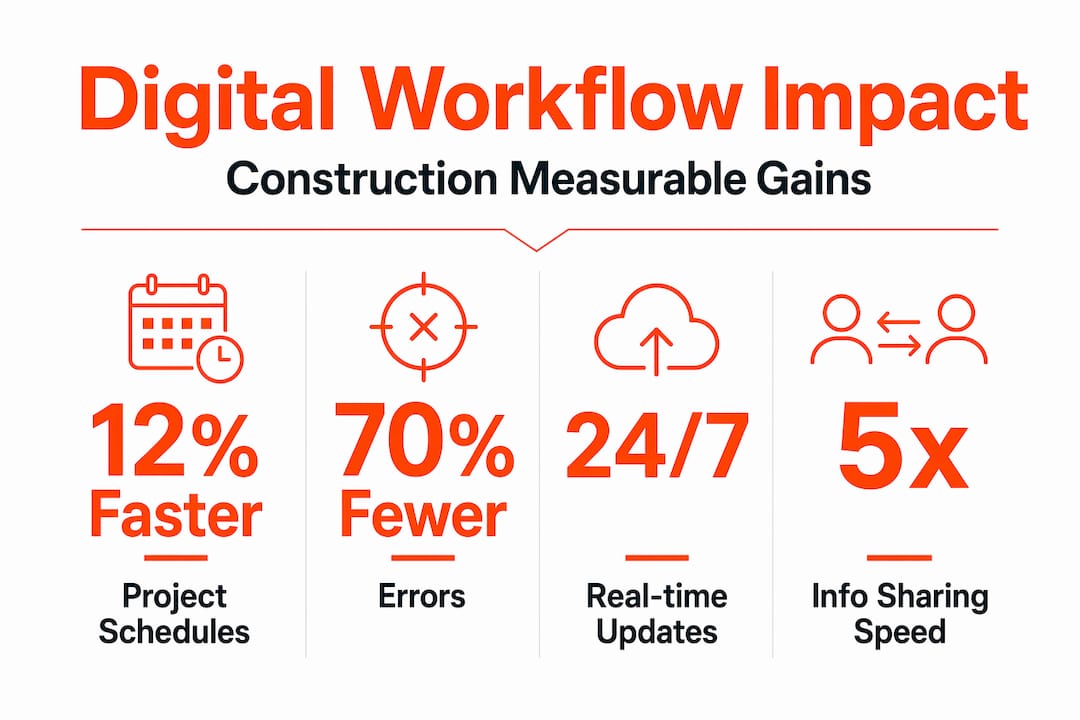
Beyond schedule improvements, digitalisation reduces design errors, duplication, and enables proactive problem detection, improving quality and reducing waste across the project. This matters particularly for UK contractors under pressure from the Building Safety Act and tighter quality assurance requirements.
The specific efficiency gains construction professionals report most frequently include:
- Reduced rework: Accurate, version-controlled documentation means trades are not building from superseded drawings
- Better resource management: Real-time data on task progress allows project managers to allocate labour and materials before delays compound
- Faster RFI resolution: Digital workflows connect queries to the right people and track response times, cutting the back-and-forth that stalls site progress
- Improved snagging: Digital snag list software captures defects on-site with photos, locations, and assigned responsibility, making close-out far quicker than paper-based methods
Digital workflows improve coordination, reduce errors, and support real-time project monitoring, leading to measurably better resource management and cost control. For UK SME builders managing multiple sites with lean teams, this level of visibility is not a luxury. It is what prevents small problems from becoming programme-breaking issues.
Pro Tip: Do not wait until project handover to test your digital workflow. Run a two-week pilot on a single site process, such as variation approvals or daily progress updates, and measure the time saved. Concrete results are the fastest way to build team buy-in.

Overcoming the real barriers to adoption
The technology barriers to adopting digital workflows are largely solved. The human and organisational barriers are not. Digital workflow adoption is most frequently hindered by skills gaps, resistance to change, poor interoperability, and uneven distribution of benefits across the supply chain. Understanding this upfront prevents firms from spending on platforms only to watch adoption stall.
The most common pitfalls in UK construction digital adoption include:
- Leadership treating digitalisation as an IT project rather than a business process change requiring senior commitment
- Selecting tools before defining processes, which results in expensive software that nobody uses consistently
- Neglecting subcontractors and smaller supply chain partners who lack the digital literacy or devices to participate, creating two-tier workflows
- Assuming compliance equals adoption, meaning teams tick the digital box without genuinely changing how they work
The interoperability problem deserves specific attention. When design teams use one platform, contractors use another, and clients expect reports in a third format, the information chain fractures. Selecting tools aligned to common data environments and ISO 19650 principles addresses this, but it requires coordination across the project team from the outset. You can read more about why digital construction collaboration fails and what drives it in practice.
Phased adoption works significantly better than whole-firm rollouts. Start with one process, demonstrate the benefit, then extend. Cultural acceptance follows demonstrated value far more reliably than it follows top-down mandates.
How digital workflows improve collaboration
The single most significant communication problem in UK construction is not that people refuse to talk. It is that information reaches the wrong people, in the wrong format, at the wrong time. Digital workflows solve this structurally rather than culturally.
A centralised data environment enables transparency across all project stakeholders, reducing the information silos that generate miscommunications and costly rework. Here is how that plays out across a typical UK commercial project:
- The architect issues a revised drawing into the central environment. Every party with access sees the update immediately. No email chains. No version confusion.
- The main contractor’s site manager reviews the change, raises a query through the platform, and the response is logged against that specific drawing revision.
- The subcontractor receives the current document, not a forwarded copy of a forwarded copy from two weeks ago.
- The client accesses a live project portal showing programme status, recent communications, and milestone progress without needing to chase the project manager.
- The project manager can see which information requests are outstanding and who is holding up a decision, allowing early intervention before delays compound.
Tools like Brcks are built specifically around how construction teams already communicate. By integrating with WhatsApp, Brcks meets site teams where they are rather than requiring them to learn an entirely new system. Effective digital communication strategies are not about removing familiar tools. They are about giving those tools structure and accountability.
The commercial impact is significant. Information sharing cuts construction errors by up to 70% in UK projects, and most of those errors originate in communication failures rather than technical mistakes. Digital workflows address the root cause.
Designing workflows for the whole asset lifecycle
Here is something most UK construction firms have not fully absorbed yet. The majority of the value created by digital workflows is realised not during construction but after it. 73% of BIM-related benefits are realised during the operational phase of an asset’s lifecycle. Yet most workflow design in the UK still focuses exclusively on the delivery phase and treats handover as an afterthought.
The table below shows the practical difference between a delivery-focused and a lifecycle-focused digital workflow approach:
| Workflow design focus | What gets captured | What gets lost | Operational impact |
|---|---|---|---|
| Delivery only | Drawings, specs, RFIs during construction | Asset data, maintenance schedules, installed product records | FM teams work from incomplete or outdated records |
| Lifecycle aware | All of the above plus structured asset data, O&M information, and digital product records | Very little, if properly structured at outset | FM teams have accurate data for planned maintenance and compliance |
Information handover gaps between construction and facilities management are the primary reason lifecycle BIM benefits go unrealised. This is not a technical failure. It is a planning failure. When digital workflows are designed from the start to capture operational data, including installed asset records, commissioning certificates, and maintenance requirements, the handover package becomes genuinely useful rather than a filing exercise.
Emerging technologies including AI-assisted data validation and IoT sensor integration are beginning to extend digital workflows into live operational monitoring. The firms that will benefit most from these developments are those that have already built structured, data-rich workflows during the delivery phase.
My take: the workflow gap most firms ignore
I’ve spent years watching UK construction firms invest in platforms and see minimal return. The pattern is remarkably consistent. The software gets purchased, a brief training session happens, and then teams revert to WhatsApp group chats and email attachments within a month.
In my experience, the firms that genuinely benefit from digital workflows are not the ones with the most sophisticated tools. They are the ones that invested time in defining their information management processes before selecting any technology. That distinction sounds simple, but it runs completely counter to how most construction software is sold and purchased.
What I’ve found particularly undervalued is the friction reduction that comes from well-designed workflows. When a site manager knows exactly where to find a current drawing, who to contact about a variation, and how to log a defect without filling in a form, the cumulative time saving across a project is substantial. It is not glamorous, but it is where the real productivity gains live.
My honest view is that most UK SME builders could implement 80% of the workflow benefits described in this article using tools they already have, provided they govern the process properly. Brcks fits naturally into this picture because it builds structure around WhatsApp rather than replacing it, which means adoption is far less resistant than a full platform migration. The impact of digital workflows on day-to-day project management is most visible when the tools match how teams actually work.
— James
Get your workflows working with Brcks
If the benefits described in this article feel difficult to achieve with your current setup, the problem is almost certainly fragmentation. Most UK site teams are managing projects across WhatsApp, email, shared drives, and spreadsheets simultaneously. Each of those tools works individually, but the gaps between them are where errors, delays, and miscommunications grow.

Brcks is built specifically for construction teams that want to bring order to that fragmentation without abandoning the tools that already work. It integrates with WhatsApp, supports task management, file sharing, snagging, and client communication in a single place, and saves teams over two hours daily in administrative effort. You can explore Brcks as construction software for builders or see how it handles construction communication across your project team. A 14-day free trial gives you enough time to see the difference on a live project.
FAQ
What are digital workflows in construction?
Digital workflows are structured, managed processes for how project information is created, shared, reviewed, and acted upon, governed by agreed standards rather than individual habits. They are not defined by the software used but by the quality of the process behind it.
Why do digital workflows matter more than digital tools?
Tools only deliver value when the underlying process is well-defined. A poorly designed workflow implemented in expensive software produces the same errors as a paper-based system, just faster. The process design determines the outcome.
How do digital workflows improve efficiency on site?
BIM and digital processes reduce project schedules by around 12% and cut rework by improving documentation accuracy and real-time coordination. Site teams spend less time chasing information and more time building.
What is the biggest barrier to digital workflow adoption in UK construction?
Skills gaps and resistance to change are the most frequently cited barriers, ahead of cost or technology availability. Phased adoption with demonstrated early wins addresses both more effectively than top-down mandates.
Do digital workflows benefit operations as well as construction?
Yes, significantly. 73% of BIM-related benefits accrue during the operational phase of an asset’s lifecycle, meaning workflows designed to capture structured handover data unlock the majority of the total value available.
Recommended
- Digital Tools in Residential Construction: 5-8% Savings | BRCKS
- BRCKS | Construction Project Communication Software
- BRCKS | Construction Project Communication Software
- Digital Communication Strategies for Construction Teams
How BRCKS Can Help
Transitioning to digital workflows is no longer a luxury but a necessity for staying competitive in today’s fast-paced construction industry. By centralising project data and automating routine tasks, BRCKS empowers your team to reduce costly errors and focus on delivering high-quality results. Our platform is designed to simplify these complex processes, ensuring that every stakeholder remains aligned from initial ground-breaking to final handover. We invite you to explore how BRCKS can modernise your site management and help your next project run more efficiently. Learn more at BRCKS and explore our full feature set.