Why construction projects fail: key causes & solutions 2026
Nearly half of UK residential projects face delays and overruns. Explore the internal root causes of construction project failures and how to implement effective solutions.
By James Shorter ·
Why construction projects fail: key causes & solutions 2026
 A purpose-built construction snagging software keeps these items tracked through to sign-off.
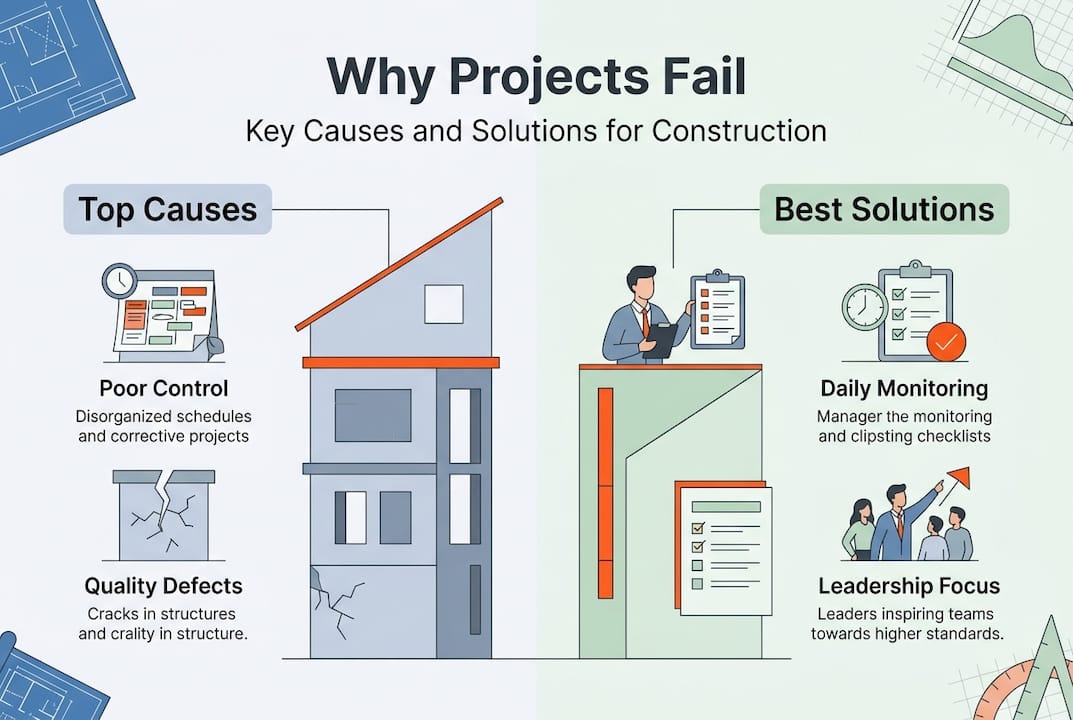
Nearly half of UK residential construction projects experience significant delays and cost overruns, yet most firms attribute these failures solely to market conditions or external factors. Poor project control practices lead to widespread time and cost overruns in UK construction projects. The reality is more complex: failures stem from internal issues including weak monitoring systems, quality rework, leadership gaps, and inadequate risk management. Understanding these root causes and implementing proven strategies can dramatically improve your project outcomes and profitability.
Table of Contents
- Common Causes Of Construction Project Failures In The UK
- The Role Of Leadership, Risk Management And Culture In Project Failure
- How Regulatory And Quality Issues Delay And Undermine Construction Projects
- Learning From Failures: Case Studies And Practical Strategies For UK Smes
- Improve Your Construction Projects With Specialised Software
Key takeaways
| Point | Details |
|---|---|
| Project control failures | Poor monitoring and reporting systems fail to catch deviations early, causing routine delays exceeding six months and budget overruns. |
| Quality rework costs | Endemic quality failures generate substantial rework that adds significant delays and costs across projects. |
| Leadership impact | Weak accountability and culture drift in SMEs directly cause increased rework and project delays. |
| Regulatory pressures | Building Safety Act processes and planning issues delay nearly half of UK residential projects. |
| Financial stress | Late payments and 38% material cost rises between 2019 and 2024 tighten margins and escalate project failures. |
Common causes of construction project failures in the UK
UK construction projects routinely fail due to fundamental weaknesses in how teams monitor and control work. Poor project control practices cause frequent time and cost overruns, with UK projects routinely delayed over six months and a majority experiencing budget excesses. The problem isn’t a lack of plans but a failure to track actual progress against those plans in real time. When you can’t see deviations early, small issues compound into major overruns.
Many firms rely on outdated reporting methods that provide information too late to act. Weekly site meetings with handwritten notes don’t capture the granular detail needed to spot problems. By the time monthly financials reveal a budget issue, you’ve already burned through contingency. Modern construction site monitoring requires daily visibility into labour, materials, and progress so you can adjust quickly.
Quality failures represent another massive drain on project performance. Quality failures generate endemic rework that adds significant delays and costs on projects. Rework doesn’t just waste time on the immediate fix; it disrupts schedules, demoralises teams, and often introduces new defects. Poor workmanship, inadequate supervision, and unclear specifications all contribute to quality problems that force you to redo work you’ve already paid for.
Financial pressures compound these operational issues. Late payments, rising material costs by 38% between 2019 and 2024, and tight margins contribute heavily to project stress and failures. When suppliers delay deliveries due to payment disputes, your critical path extends. When material prices spike mid-project, your contingency evaporates. These financial stresses create a cascade effect that amplifies every other project control weakness.
Key control failures include:
- Inadequate baseline planning that makes deviation tracking impossible
- Infrequent progress monitoring that misses early warning signs
- Poor communication between site and office teams
- Weak cost tracking that reveals problems too late
- Insufficient contingency planning for common risks
Pro Tip: Implement daily progress photos linked to your schedule. This simple practice creates a visual record that catches quality issues and delays immediately, not weeks later when fixing them costs far more.
Effective managing of subcontractors becomes nearly impossible without proper monitoring systems. When you can’t track subcontractor progress accurately, you can’t coordinate trades effectively or hold them accountable for delays and defects.
The role of leadership, risk management and culture in project failure
Leadership quality directly determines project outcomes in ways that spreadsheets and schedules cannot. Poor leadership and weak accountability cause culture drift leading to rework and project delays, but fixing leadership can reduce rework by 15% and cut overruns weeks after changes. When project managers fail to set clear expectations, communicate decisions promptly, or hold teams accountable, the entire project culture deteriorates. Workers stop caring about quality because no one notices. Subcontractors miss deadlines because there are no consequences.
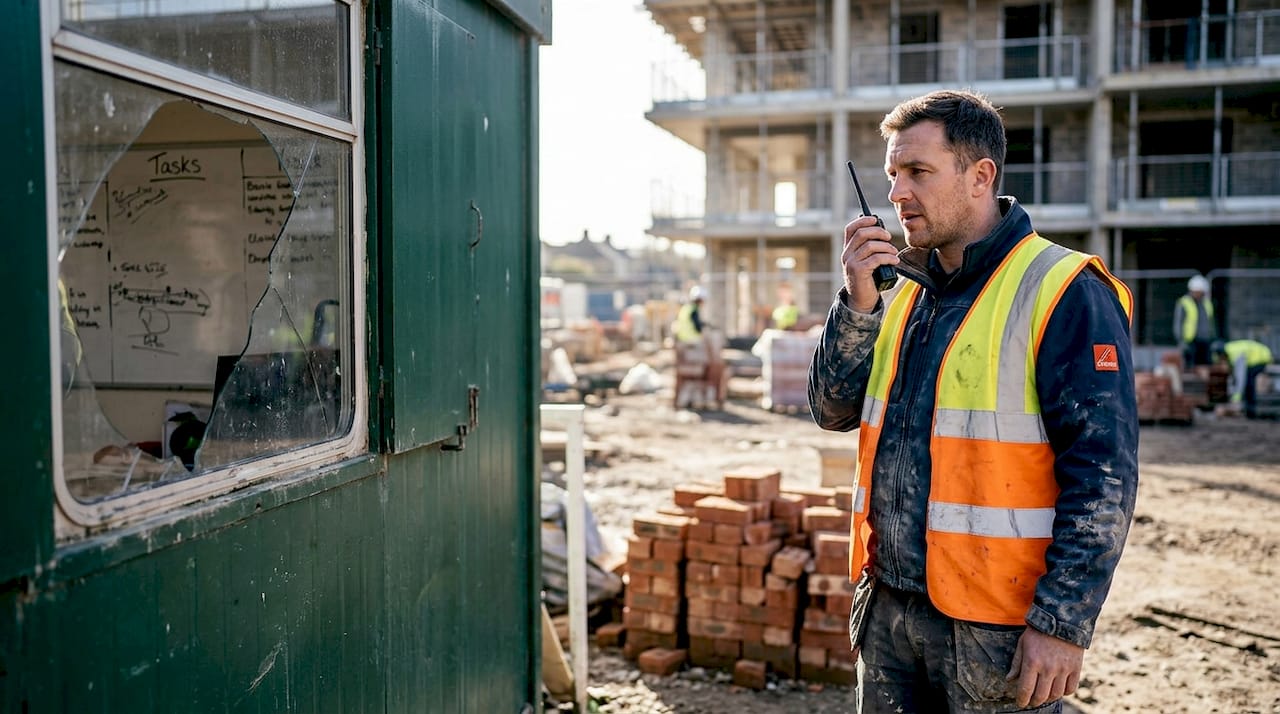
Culture drift in SMEs manifests as sloppy handovers between trades, incomplete documentation, and casual attitudes towards specifications. You see it when electricians don’t bother photographing their work before the plasterer covers it. You see it when the plumber leaves without updating the as-built drawings. These small cultural failures accumulate into major rework when problems surface later. The construction manager who tolerates these behaviours creates an environment where failure becomes normalised.
Risk management remains poorly implemented across UK construction SMEs despite its proven value. Ineffective risk management implementation stems from difficulties scaling processes, cost concerns, tool adoption challenges, and culture misalignment. Smaller firms often view formal risk management as bureaucratic overhead rather than practical protection. They rely on experience and intuition instead of systematic identification and mitigation of threats.
This informal approach works until it doesn’t. The experienced site manager who “knows” the risks misses the one that brings down the project. Without documented risk registers and mitigation plans, you can’t learn from near misses or share knowledge across projects. Your entire risk management capability lives in people’s heads, and when they leave, it walks out the door.
“Leadership behaviours shape project culture more powerfully than any system or process. When leaders demonstrate accountability, communicate clearly, and insist on quality standards, teams follow. When leaders are absent, vague, or inconsistent, culture drift sets in and projects suffer.”
Key leadership and risk failures include:
- Project managers who avoid difficult conversations with underperforming subcontractors
- Lack of clear decision-making authority causing delays
- Failure to document and communicate changes promptly
- Informal risk assessment that misses critical threats
- No systematic lessons-learned process between projects
Pro Tip: Hold a 15-minute daily standup with key trades on site. This simple leadership practice catches coordination issues, clarifies priorities, and reinforces accountability far more effectively than weekly meetings.
Improving construction communication requires leadership commitment to new practices and tools. The best communication system fails if project managers don’t model its use consistently. Similarly, addressing construction communication problems starts with leadership acknowledging that fragmented WhatsApp groups and email chains create more problems than they solve.
How regulatory and quality issues delay and undermine construction projects
Regulatory compliance now represents a major source of project delays in UK residential construction. The Building Safety Act causes delays through Gateway 2 approvals, viability assessments, and planning issues in nearly half of UK residential projects. The Act’s enhanced scrutiny of fire safety and structural integrity adds months to approval timelines. Projects that once moved quickly through planning now face extended reviews as building control bodies implement stricter validation processes.
Viability challenges compound these regulatory delays. Local authorities increasingly require detailed viability assessments that prove projects meet affordable housing requirements and planning obligations. These assessments involve complex financial modelling and often trigger negotiations that extend timelines by three to six months. For SMEs operating on tight cash flow, these delays create significant financial pressure even before construction begins.
Quality defects that emerge post-construction generate some of the costliest project failures. Latent defects in systems such as water penetration and MEP failures arise from lack of design validation and poor execution, resulting in costly litigation and replacement years after completion. Water penetration through building envelopes, improperly installed mechanical systems, and electrical faults often remain hidden until occupants move in and use the building under real conditions.
The consequences of these latent defects extend far beyond repair costs. One Hyde Park case highlights systemic MEP workmanship failures requiring multi-million-pound replacements years later. The luxury development’s heating, cooling, and ventilation systems failed systematically due to poor installation quality. The resulting litigation, replacement costs, and reputational damage far exceeded the original installation value.
| Regulatory and quality issue | Typical delay impact | Cost impact |
|---|---|---|
| Building Safety Act Gateway 2 approval | 3-6 months | £15,000-£40,000 in holding costs |
| Planning viability assessment | 2-5 months | £20,000-£50,000 in consultant fees |
| Latent MEP defects discovered post-occupancy | 1-3 months for remediation | £50,000-£500,000+ replacement costs |
| Water penetration requiring envelope repairs | 2-4 months including investigation | £30,000-£200,000 depending on extent |
Common quality control gaps include:
- Insufficient design validation before construction starts
- Poor coordination between MEP trades during installation
- Inadequate commissioning and testing of systems
- Lack of independent quality inspections at critical stages
- Incomplete handover documentation and O&M manuals
Implementing rigorous og/construction-snagging-software">construction snagging software helps catch quality issues before practical completion. Digital snagging tools with photo documentation create clear audit trails and ensure defects get tracked to resolution rather than forgotten.
Learning from failures: case studies and practical strategies for UK SMEs
Real-world failures illustrate the devastating consequences of the issues we’ve discussed. Ardmore Construction collapsed due to unforeseen fire safety remediation costs exceeding £100 million, causing administration entry in 2025. The firm had completed numerous residential projects that later required expensive cladding replacement and fire safety upgrades under the Building Safety Act. These latent liabilities, combined with tight margins on current projects, created an impossible financial situation that forced the company into administration despite decades of operation.
The Ardmore case demonstrates how regulatory changes can transform completed projects into financial liabilities. Projects finished years earlier to the standards of that time suddenly required costly remediation. Firms that hadn’t reserved adequate funds for potential future compliance costs found themselves trapped. The lesson for SMEs: building contingency reserves and maintaining strong financial buffers protects against regulatory risk that emerges years after completion.
The One Hyde Park MEP failures show how quality control weaknesses create long-term exposure. Systematic workmanship problems across heating, ventilation, and cooling systems went undetected during construction. Only after occupants moved in and used the systems under real conditions did the failures become apparent. The resulting litigation and replacement costs dwarfed the savings from rushing installation or accepting substandard work.
Practical strategies to avoid similar failures:
- Implement frequent baseline reviews and earned value management to catch deviations early, as improvements like these reduce overruns significantly
- Establish clear quality gates at critical project stages where work cannot proceed until inspections pass
- Document all design decisions and changes with clear rationale to support future compliance reviews
- Build financial reserves specifically for potential regulatory changes affecting completed projects
- Invest in leadership training focused on accountability and communication skills
- Implement systematic risk reviews at project milestones with documented mitigation plans
- Use digital tools to centralise project information and improve team coordination
| Strategy | Implementation effort | Impact on failure risk | Typical ROI timeline |
|---|---|---|---|
| Daily progress monitoring with photos | Low, 15 minutes daily | Reduces rework by 10-15% | Immediate |
| Weekly risk review meetings | Medium, 1 hour weekly | Catches 60-70% of issues early | 1-2 months |
| Digital project management platform | Medium, 2-3 days setup | Improves coordination 30-40% | 2-3 months |
| Independent quality inspections | Medium, cost per inspection | Reduces defects by 20-25% | 3-6 months |
| Leadership accountability training | High, ongoing commitment | Reduces culture drift significantly | 6-12 months |
Pro Tip: Start with the lowest effort, highest impact improvements first. Daily progress photos and weekly risk reviews cost almost nothing but catch most problems before they become expensive failures.
A construction communication workflow that cuts rework provides a proven framework for implementing these strategies. The key is consistency: these practices only work when you apply them systematically on every project, not just when problems emerge.
Improve your construction projects with specialised software
The strategies we’ve discussed require tools that support better monitoring, communication, and quality control. Specialised software designed for construction teams helps you implement these best practices without adding administrative burden. Construction software for builders centralises project information so everyone works from the same current plans, specifications, and schedules. Construction software for plumbers and other trades ensures coordination and quality tracking across all project participants.

BRCKS construction project communication software replaces fragmented WhatsApp groups and email chains with a single organised platform. You get unlimited video meetings with AI-generated action items, a unified project feed showing all updates, and mobile apps that work on site. The platform sets up in five minutes and saves teams over two hours daily by eliminating the chaos of searching multiple places for project information. With a 14-day free trial, you can test whether centralised communication reduces your rework and improves coordination before committing.
Pro Tip: Integrate your project management software at project kickoff, not midstream when problems emerge. Early adoption aligns your entire team on communication standards and creates the documentation trail you need to catch issues fast.
Frequently asked questions
Why do so many UK construction projects fail?
UK construction projects fail primarily due to poor project control practices, quality rework, weak leadership, and inadequate risk management rather than external market factors alone. Communication crises compound these issues by fragmenting information across multiple platforms. Financial pressures from late payments and rising material costs further stress already weak project systems.
What is the biggest cause of construction project delays?
Poor monitoring and reporting systems represent the biggest delay cause because they fail to catch deviations early when corrections are still simple and inexpensive. By the time problems become visible through traditional reporting, projects have already fallen significantly behind schedule. Quality rework from defects and regulatory approval processes also contribute major delays.
How can SMEs improve their project success rates?
SMEs should prioritise daily progress monitoring, weekly risk reviews, and leadership accountability practices that cost little but catch most problems early. Implementing digital project management platforms centralises information and improves coordination. Independent quality inspections at critical stages prevent costly latent defects that emerge post-completion.
What role does leadership play in construction project failure?
Leadership quality directly determines project culture and accountability standards. Poor leadership creates culture drift where teams tolerate sloppy work, incomplete documentation, and missed deadlines. Strong leadership that communicates clearly, makes decisions promptly, and holds teams accountable can reduce rework by 15% and cut project overruns by weeks.
How do regulatory changes impact construction project timelines?
The Building Safety Act now delays nearly half of UK residential projects through extended Gateway 2 approvals, viability assessments, and enhanced planning scrutiny. These regulatory processes add three to six months to project timelines and increase holding costs significantly. Projects must also account for potential future compliance costs on completed work.
What are the most common quality defects in UK construction?
Water penetration through building envelopes and MEP system failures represent the most common and costly quality defects. These latent defects often remain hidden until after occupancy when they require expensive remediation and can trigger litigation. Poor workmanship, inadequate supervision, and insufficient commissioning testing all contribute to these failures.
Recommended
- BRCKS | Construction Project Communication Software
- BRCKS | Construction Project Communication Software
- BRCKS | Construction Project Communication Software
- BRCKS | Construction Project Communication Software
- Understanding Construction: Key Concepts Explained – WorkWearComfort
- Industrial Lead Gen: 5 Infrastructure Mistakes
How BRCKS Can Help
While construction failures often stem from fragmented communication and poor data visibility, these risks are entirely manageable with the right digital infrastructure. BRCKS provides a unified platform that bridges the gap between site and office, ensuring that every stakeholder remains aligned on timelines and budgets. By centralising your project management, you can proactively address bottlenecks before they jeopardise your delivery. We invite you to explore how BRCKS can safeguard your next project and help you build with greater confidence. Learn more at BRCKS.