Why adopt cloud-based project management in construction
UK construction projects often exceed budgets due to fragmented data. Learn how cloud-based project management centralises information to ensure timely completion.
By James Shorter ·
Why adopt cloud-based project management in construction
 A purpose-built construction snagging software keeps these items tracked through to sign-off.
TL;DR:
- Most UK construction projects fail to finish on time or within budget due to fragmented information, not effort. Cloud-based project management centralises data, provides real-time visibility, and enhances compliance, reducing costly errors and delays. Successful adoption depends on clear planning, team onboarding, and selecting platforms tailored to construction workflows.
Most construction projects in the UK do not finish on time or on budget. That is not an opinion. Only 34% of companies report completing projects mostly on time and on budget, and in construction, that figure feels generous. If your team is still coordinating across WhatsApp threads, emailed spreadsheets, and site-based paper records, the root cause is rarely effort. It is the absence of a shared system. Understanding why adopt cloud-based project management matters for construction professionals is really understanding why fragmented information kills projects before they begin.
Table of Contents
- Key takeaways
- What cloud-based project management actually means
- Key benefits of cloud project management for construction
- Cloud vs traditional project management methods
- How to apply cloud project management on site
- My take on cloud adoption in UK construction
- How Brcks supports UK construction teams
- FAQ
Key takeaways
| Point | Details |
|---|---|
| Cloud centralises project data | A single source of truth replaces scattered files, reducing errors and version confusion across teams. |
| Real-time visibility improves control | Live dashboards and updates let project managers act before problems escalate, not after. |
| Cost model shifts predictably | Subscription pricing replaces unpredictable hardware and maintenance bills with fixed operational costs. |
| Adoption requires a clear plan | Onboarding subcontractors and trades properly is as important as choosing the right platform. |
| UK compliance is easier to maintain | Cloud platforms support audit trails and documentation requirements under the Building Safety Act and NHBC standards. |
What cloud-based project management actually means
Before weighing the benefits, it helps to be precise about what the term means in practice, especially in a construction context where “digital” can still mean a shared drive nobody updates.
Cloud-based project management refers to software hosted on remote servers and accessed via a browser or mobile app, rather than installed on a specific machine or local server. There is no hardware to maintain on site. There is no single computer that holds the master copy of anything. Every team member with access sees the same version of every document, schedule, and task list, regardless of whether they are in the site office, working from home, or standing in a basement flat.
For UK construction teams specifically, this matters in ways that desktop software does not address. Consider a mid-sized residential developer running three schemes simultaneously. The commercial manager is in the head office. The site manager is on the ground. The structural engineer works remotely. The subcontractors operate across all three sites. With a traditional on-premises system, coordinating between these parties involves:
- Emailing updated drawings and hoping everyone downloads the latest version
- Chasing approvals by phone when people miss emails
- Manually reconciling budget updates between the QS and the site team
- Storing site photos in personal phone galleries or inconsistent folder structures
- Recreating progress reports from disparate sources every week
Cloud platforms eliminate all of that by design. Single source of truth resolves version control issues and communication gaps for distributed teams. Everyone works from the same live data. Updates appear instantly. File access is permission-based, so subcontractors only see what is relevant to them. The cloud communication benefits for dispersed site teams are not marginal. They are structural.
Key benefits of cloud project management for construction
The benefits of cloud project management in construction are concrete and measurable. They are not about convenience. They are about reducing the specific types of failure that cost UK builders money, time, and professional reputation.
Collaboration across dispersed teams
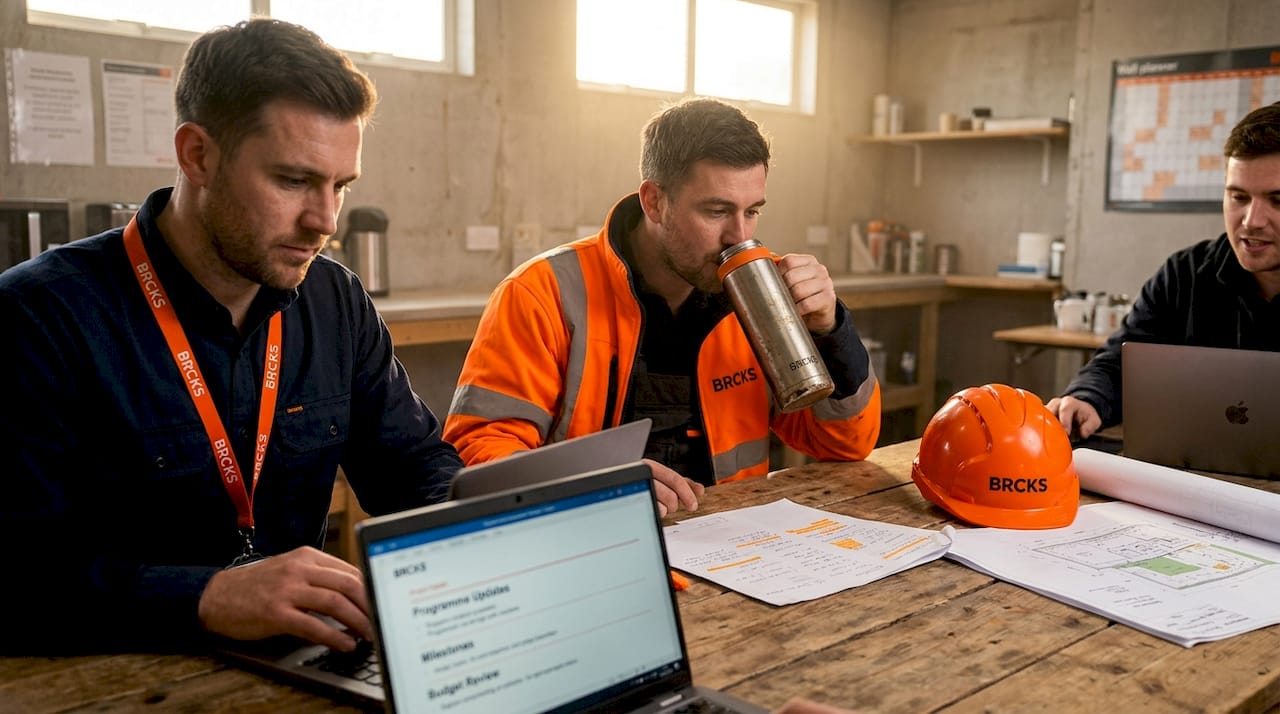
Construction is inherently distributed. Trades, subcontractors, suppliers, consultants, and clients rarely occupy the same physical space. Cloud platforms make real-time coordination possible without relying on any single person to relay information. When a site manager uploads a revised floor plan, every relevant party sees it immediately. There is no delay, no miscommunication, and no version mismatch between what the bricklayer has printed and what the architect approved yesterday.
A single source of truth
Manual data reconciliation between project management and financial systems creates significant friction and often leads to costly errors. Cloud platforms connect project delivery and financial data in one pipeline. Your QS and site manager are looking at the same budget figures. Your project director sees real progress against programme without waiting for a weekly report to be compiled manually. Real-time dashboards provide insight without manual data collation, enabling proactive decisions before a delay becomes a dispute.
Budget and deadline control
Integrating project delivery and financials in a single platform prevents the kind of manual reconciliation errors that quietly accumulate until the end-of-month review reveals a problem that started three weeks earlier. When budget-to-actual tracking happens in real time, project managers can act on variance immediately rather than retrospectively.
Cost model advantages
Subscription pricing replaces hardware and maintenance costs with predictable operational expenses. For SMEs in particular, this matters. There is no capital expenditure on servers, no IT contractor required to maintain them, and no risk of losing project data when a site laptop is stolen or dropped in a skip. The hidden costs of traditional software are often underestimated until they land at the worst possible moment.
Regulatory compliance
Under the Building Safety Act and NHBC standards, documentation and audit trails are not optional. Cloud platforms maintain timestamped records of every update, approval, and communication automatically. That is a meaningful compliance advantage that paper-based or locally stored systems cannot easily replicate.
Pro Tip: Set up your cloud platform’s permission structure before inviting subcontractors. Granular access control prevents information overload and keeps sensitive commercial data away from parties who do not need it.
Cloud vs traditional project management methods
The practical differences between cloud and traditional project management become clearest when things go wrong on site. That is when the limitations of legacy approaches surface.
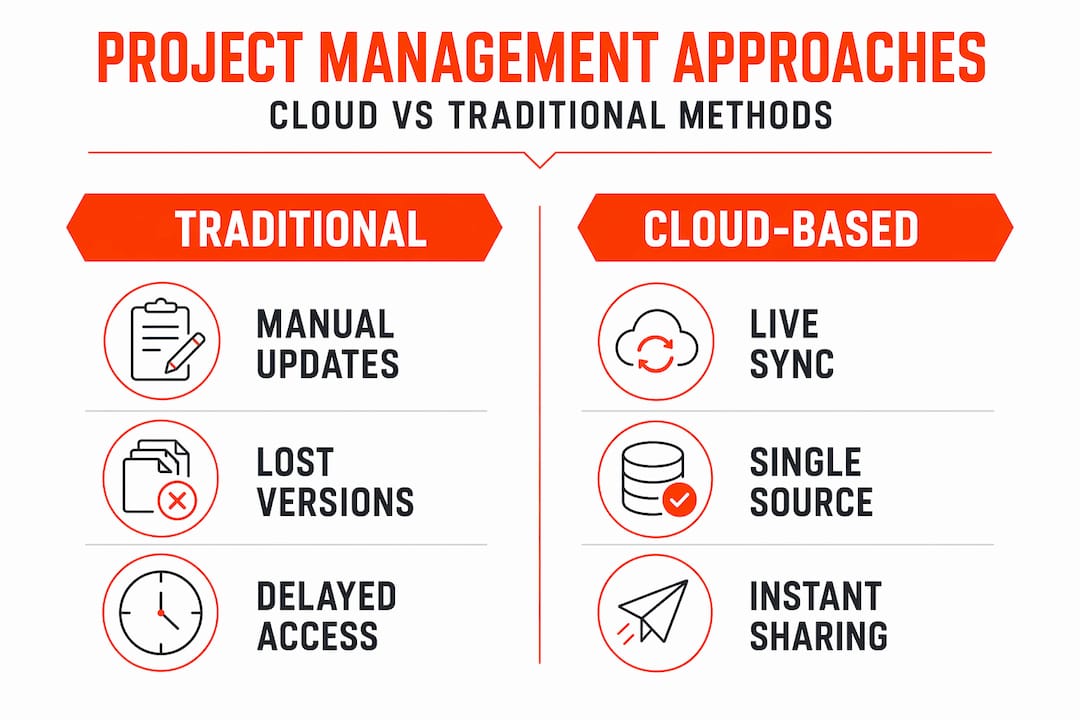
| Feature | Traditional methods | Cloud-based approach |
|---|---|---|
| File versions | Multiple copies, manual tracking | Single live version, always current |
| Access location | Office or specific device only | Any device, any location |
| Budget visibility | Weekly or monthly reports | Real-time dashboards |
| Subcontractor comms | Phone, email, WhatsApp groups | Centralised platform with audit trail |
| Compliance documentation | Manual filing | Automatic timestamped records |
| IT costs | Hardware, maintenance, licensing | Predictable monthly subscription |
| Scaling up | New licences, hardware | Adjust user count as needed |
Traditional methods are not simply less convenient. They are actively risky. When a structural drawing gets emailed to six people and one of them prints an older version, the risk of rework is real. When your budget data lives in a spreadsheet that three people update independently, therisk of a costly reconciliation error is real. Eliminating version control confusion alone justifies the move to cloud for most mid-sized construction businesses.
The question of migration often raises concerns about disruption. In practice, the bigger risk is staying put. Cloud platforms today are designed for rapid onboarding. Most reputable cloud project management solutions offer mobile-first interfaces that work on standard smartphones, meaning trades and subcontractors do not need specialist training or new hardware to participate.
Pro Tip: Run a single project on your chosen cloud platform before committing the whole business. It gives your team time to build confidence and surfaces any workflow gaps before they affect a live scheme.
How to apply cloud project management on site
Choosing the right platform and deploying it effectively are two separate challenges. Many construction teams select good software and then undermine it with poor rollout.
Selecting the right platform
When evaluating cloud project management solutions for construction, the criteria that matter most are:
- Mobile access that works reliably on site, including areas with poor signal
- Integration with your financial and accounting systems to avoid manual data entry
- Clear permission structures for subcontractors and client-facing portals
- Document management with version control and search functionality
- Compliance-ready audit trails for snagging, sign-off, and handover documentation
- Transparent pricing with no hidden per-feature costs as the team grows
A money-saving approach to platform selection focuses on total cost of ownership, not just the monthly subscription. Factor in training time, integration effort, and whether subcontractors need to pay to access the system.
Onboarding your team and supply chain
The most common failure in cloud adoption is treating it as an IT project rather than a people project. Here is what works in practice:
- Identify one champion per site or project who owns the platform’s day-to-day use
- Run a brief walkthrough with subcontractors before the project starts, not during it
- Set clear expectations about which communications must go through the platform versus other channels
- Use the platform for something immediately useful, such as snagging or daily progress updates, so the team sees the value from day one
Platforms that integrate with tools people already use lower the friction significantly. Brcks, for example, is built around WhatsApp-native communication, which means trades can receive and respond to updates without learning a new interface from scratch. That is a material advantage when managing subcontractors who may be working across multiple employers simultaneously.
Measuring success
Once adopted, track the metrics that matter: reduction in rework caused by version errors, time saved in weekly reporting, reduction in RFI response time, and budget variance compared to previous projects. Resource management functionality in cloud platforms also helps prevent delivery failures by tracking team capacity and workload across multiple schemes.
My take on cloud adoption in UK construction
I have worked with enough construction businesses to know that the resistance to cloud adoption is rarely about technology. It is about culture and habit. Site managers who have run projects with spreadsheets and phone calls for twenty years do not distrust cloud software because they think it is inferior. They distrust it because it represents a change to a system that they feel they already have under control.
The uncomfortable truth is that the control they feel is often illusory. I have seen project managers walk into final account meetings with completely different budget figures from the commercial manager, both convinced their version was correct. That kind of discrepancy does not happen because people are careless. It happens because the information architecture of traditional construction management makes it almost inevitable.
What I have found in practice is that the teams who benefit most from cloud adoption are not the most technically sophisticated. They are the ones who commit to using a single system consistently. Half adoption, where some people use the platform and others still send updates by text, produces the worst outcome. You get the cost of the new system without the benefit of centralised data.
The other pitfall worth naming is choosing the wrong platform for the wrong reason. Price is not the best selection criterion when your livelihood depends on the system working reliably. Fit matters more. A platform built specifically for construction, with digital construction workflows in mind, will serve you better than a generic project management tool with a construction template bolted on.
The direction of travel in UK construction is clear. Cloud platforms have evolved from convenience tools into strategic necessities. The Building Safety Act has raised the stakes on documentation and accountability. Clients expect visibility. Funders expect transparency. The question is no longer whether to adopt cloud-based project management. It is how quickly you can do it without disrupting the projects you already have running.
— James
How Brcks supports UK construction teams
If the case for cloud-based project management resonates, the next question is which platform fits how your team actually works. Brcks is built specifically for UK construction professionals, from small builders to enterprise project managers, and it is designed around the communication patterns that construction teams already use.
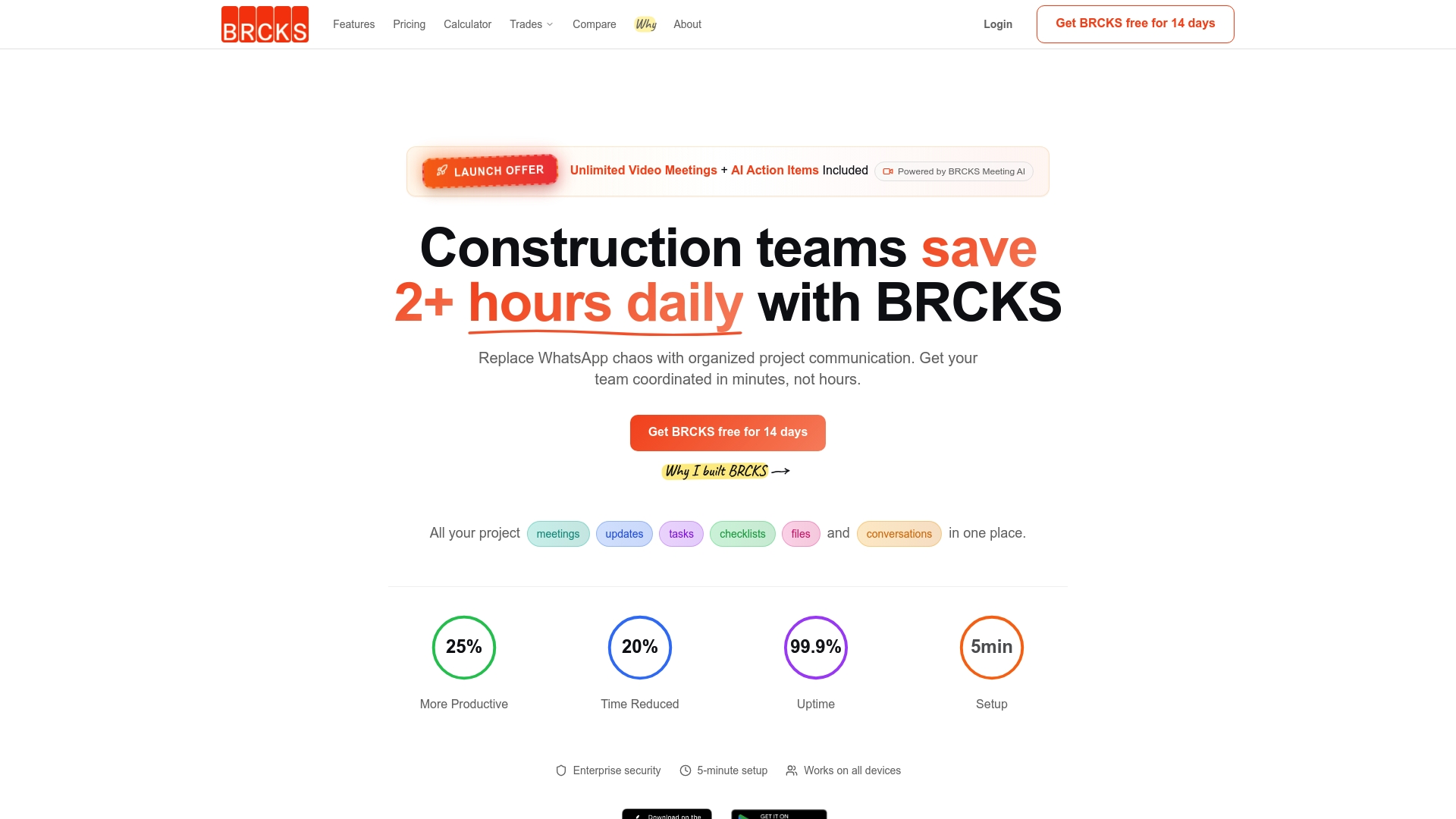
With Brcks, project updates, checklists, file sharing, meeting recordings, and client portals sit in one place. The WhatsApp-native interface means subcontractors can participate without learning new software. Automation saves teams over two hours daily by removing manual follow-up and reporting tasks. The builders software from Brcks includes free subcontractor access and transparent pricing with no surprise costs as your team scales. If you are currently managing projects through WhatsApp groups alone, it is worth looking at how the two approaches compare on the Brcks comparison page. You can try Brcks free for 14 days without committing.
FAQ
What is cloud-based project management?
Cloud-based project management is software hosted remotely and accessed via browser or app, giving all team members live access to the same data regardless of location. Unlike desktop software, it requires no on-site hardware and updates automatically.
Why should construction teams adopt cloud-based project management?
Construction teams benefit from cloud project management because it centralises communication, eliminates version control errors, provides real-time budget visibility, and creates audit trails required under UK regulations such as the Building Safety Act.
How does cloud project management improve collaboration on site?
Cloud platforms act as a single source of truth, meaning subcontractors, site managers, and consultants all work from the same live documents and schedules. This removes the delays and mismatches that occur when updates are shared by email or phone.
Is cloud project management cost-effective for small builders?
Yes. Subscription pricing converts unpredictable hardware and IT maintenance costs into fixed monthly expenses. Hidden on-premises costs such as server upkeep and manual reconciliation are eliminated, and most platforms allow you to scale user numbers up or down as project workload changes.
What should I look for in a cloud project management platform for construction?
Prioritise mobile access that works reliably on site, integration with your financial systems, clear subcontractor permission controls, and compliance-ready documentation features. A platform built for construction will serve you better than a generic tool adapted for the sector.
Recommended
- Cloud Communication for UK Construction Teams | BRCKS
- Construction Software for Builders | BRCKS
- BRCKS | Construction Project Communication Software
- Remote Construction Management: Best Practices for Success
How BRCKS Can Help
Transitioning to cloud-based project management is no longer just an option but a necessity for firms looking to remain competitive and efficient in a fast-paced industry. BRCKS simplifies this digital transformation by providing a centralised platform that ensures your site teams and office staff stay perfectly aligned through real-time data. By integrating these modern tools into your daily workflow, you can reduce costly errors and focus on delivering high-quality projects on schedule. We invite you to explore how BRCKS can streamline your operations and help your business reach its full potential. Learn more at BRCKS and explore our full feature set.