The importance of centralised project information
UK construction teams lose 13% of working hours searching for data. Learn how centralising project information through a CDE reduces rework and ensures regulatory compliance.
By James Shorter ·
The importance of centralised project information
 A purpose-built construction snagging software keeps these items tracked through to sign-off.
TL;DR:
- Construction teams in the UK lose approximately 13% of their working hours searching for project data, leading to costly rework and inefficiencies. Centralised project information through a structured Common Data Environment enforces workflows, reduces errors, and ensures regulatory compliance, especially under the Building Safety Act. Implementing governance, proper tools, and change management is essential for successful data centralisation across projects of all sizes.
Construction teams across the UK lose roughly 13% of their working hours searching for project data. That is not a minor inconvenience. On a 12-month project with a team of 20, it adds up to thousands of hours wasted before a single brick is laid incorrectly or a drawing is superseded. The importance of centralised project information becomes obvious when you look at what fragmented data actually costs: rework, disputes, regulatory risk, and the grinding inefficiency of teams working from different versions of the same document. This article explains what centralisation really means, why UK regulations now make it urgent, and how to put it into practice.
Table of Contents
- Key takeaways
- What is centralised project information?
- Benefits of centralising project information
- Challenges in implementing centralised systems
- UK regulations driving the need for centralisation
- Practical steps to centralise project information
- My perspective on centralised information in UK construction
- How Brcks supports centralised project information
- FAQ
Key takeaways
| Point | Details |
|---|---|
| CDE is not just file storage | A true Common Data Environment enforces approval gates, audit trails, and role-based access per ISO 19650. |
| Regulatory pressure is real | The Building Safety Act and UK BIM Framework make centralised, auditable project data a compliance obligation. |
| Rework is quantifiable | Rework costs up to 10% of project cost; governed data workflows reduce this directly. |
| Governance matters as much as technology | Cloud storage without structured workflows creates new silos, not fewer. |
| SMEs can adopt accessible tools | Simplified platforms lower the barrier without sacrificing the governance benefits. |
What is centralised project information?
The term gets used loosely, so it is worth being precise. Centralised project information means all project data — drawings, specifications, contracts, schedules, BIM models, site photographs, snagging records — is held in a single, governed environment where every team member accesses the same current version. The formal term for this environment is a Common Data Environment, or CDE.
A CDE is not a shared drive or a folder in the cloud. ISO 19650 and the CDE concept defines a structured workflow that moves information through four states: Work in Progress, Shared, Published, and Archived. Each state has formal approval gates. Nothing moves from “Shared” to “Published” without a qualified review. This prevents a superseded drawing from reaching the site team, which is exactly the scenario that causes the most costly errors in construction.
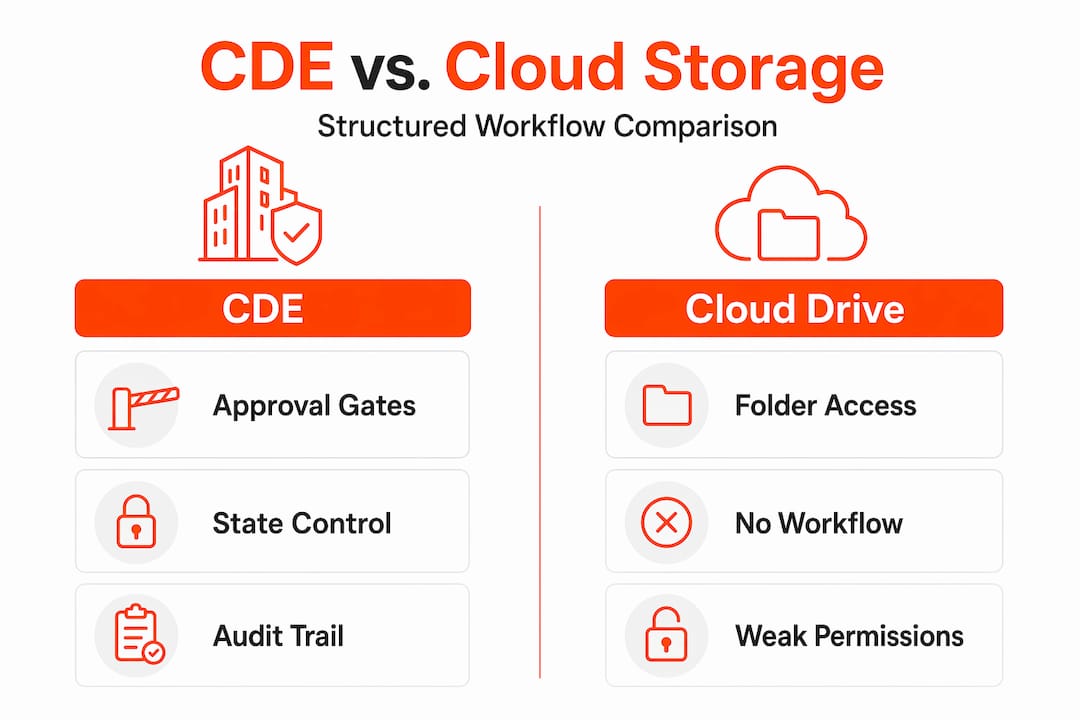
How a CDE differs from cloud storage
Many project managers assume that moving files to a cloud platform solves the problem. It does not. Governance and approval gates are what separate a genuine CDE from a digital filing cabinet. Without them, you have the same fragmented information problem, just hosted online instead of on a local server.
The data types managed inside a CDE span the full project lifecycle:
- BIM models and clash detection outputs
- Contracts and employer’s information requirements
- Construction schedules and programme updates
- Inspection records, snagging lists, and health and safety files
- Meeting minutes, correspondence, and RFI logs
Pro Tip: When evaluating any CDE or project management tool, ask specifically whether it enforces state-based workflows and maintains an immutable audit trail. If the vendor cannot clearly answer both questions, it is not a true CDE.
Benefits of centralising project information
The case for project information management is not theoretical. The measurable advantages show up in project budgets, timescales, and compliance records.
-
Productivity gains. Teams that stop hunting for data have more time for actual work. Reducing the 13% search time across a project team translates directly into earlier completions and lower labour costs.
-
Lower rework rates. Rework accounts for 5-10% of total project cost. When every operative works from the same approved drawing set, the risk of building from a superseded document drops sharply.
-
Improved project success rates. Projects that manage complexity with centralised information systems are five times more likely to succeed, achieving an 88% success rate compared to fragmented approaches. That figure alone justifies the investment.
-
Regulatory compliance. The Building Safety Act and its Golden Thread obligation require continuous, auditable records for higher-risk buildings. Centralised data acts as a compliance mechanism, not just an operational convenience.
-
Stronger dispute resolution. An immutable audit trail showing who approved what, and when, is invaluable when contractual disputes arise. The document control benefits of a proper CDE extend well beyond day-to-day project management.
-
Enhanced collaboration across disciplines. Structural engineers, architects, M&E contractors, and main contractors working from a single source of truth reduces coordination errors. Information sharing across disciplines can cut construction errors by up to 70%.
“The role of centralised project data is shifting. It is no longer just an efficiency tool. For building owners and contractors managing higher-risk structures, it is the primary mechanism for demonstrating safety compliance across the asset lifecycle.”
Challenges in implementing centralised systems
Understanding the importance of centralised project information is the straightforward part. Getting there involves real obstacles that are often underestimated.

The most common misconception is that uploading existing files to a new platform counts as centralisation. It does not. Effective centralisation requires structured, machine-readable data inside the containers, not just correctly named folders. ISO 19650 governs the process and containers but does not specify internal data schemas. Without consistent internal data formats (such as COBie for asset data), you end up with new silos within the system.
Other significant challenges include:
- Integration with legacy systems. Connecting existing estimating software, accounting platforms, and procurement tools is not trivial. Integration and validation work can account for 30-40% of total implementation effort.
- Technical debt. Older project data often exists in formats that cannot be automatically migrated. Budget for data extraction, normalisation, and validation before you go live.
- Change management. Site managers and subcontractors who have worked with email and WhatsApp for years do not automatically adopt new systems. Training and genuine buy-in are non-negotiable.
- SME barriers. Complex enterprise platforms are inaccessible to most small builders and specialist contractors. Social proof and simplified tools are key to adoption at this level of the market.
Pro Tip: Do not attempt to migrate all historical data at once. Start with live projects, establish governance habits, then backfill historical records systematically. Trying to do everything simultaneously is the most common reason implementations stall.
UK regulations driving the need for centralisation
The regulatory context is where why centralise project data moves from best practice to obligation. Several interconnected frameworks now push UK construction professionals towards formal information management.
| Regulation or standard | What it requires | Implication for data centralisation |
|---|---|---|
| Building Safety Act 2022 | Golden Thread of information for higher-risk buildings throughout design, construction, and occupation | Continuous, auditable, accessible records mandatory |
| UK BIM Framework (ISO 19650) | Standardised information management and CDE adoption for public projects | Formal governance and state-based workflows required |
| Construction Playbook | Government guidance mandating digital, standardised information management for public contracts | ISO 19650 compliance expected on public sector work |
| Part L and EPC requirements | Energy performance data must be documented and accessible | Centralised asset data supports EPC compliance throughout the project |
The UK BIM Framework and Construction Playbook together create a clear expectation: public sector projects must use standardised information management practices that reduce information loss by 30-40%. For private sector work, the Building Safety Act provides the harder legal obligation.
The longer-term picture is equally significant. Centralised data enables digital twins and whole-life asset management. The data captured during construction becomes the operational foundation for facilities management, refurbishment planning, and AI-driven performance optimisation. Think of centralised project information as the digital handshake between construction and asset management. Getting it right at project stage removes enormous cost and risk further down the line.
Compliance with TM59 and similar performance standards also depends on documented, retrievable data from the construction phase. Without centralised records, demonstrating compliance after practical completion becomes a reconstruction exercise rather than a simple retrieval.
Practical steps to centralise project information
Knowing why project information centralisation matters is one thing. Doing it is another. Here is a realistic sequence for construction professionals starting from scratch or upgrading from basic cloud storage.
-
Audit your current fragmentation. Map where project information currently lives: email threads, WhatsApp groups, shared drives, individual laptops, site noticeboards. Identify the highest-risk gaps, typically drawings and snagging records.
-
Choose tools that enforce governance, not just storage. Look for platforms that implement state-based workflows, role-based access, and audit trails. ISO 19650 alignment is the baseline for any public sector work.
-
Define your information requirements upfront. Before a project starts, agree on what information will be produced, by whom, in what format, and at what stage. This is the Employer’s Information Requirements (EIR) in BIM terminology.
-
Plan for integration. If you use project management, accounting, or estimating software, check what API connections exist. Budget time and cost for data normalisation. Do not assume platforms will talk to each other without configuration work.
-
Invest in training and change management. A system only works if people use it. Run short, practical training sessions for site teams. Make the tools accessible on mobile. Platforms that integrate with familiar tools like WhatsApp significantly lower the adoption barrier for trades and subcontractors.
-
Use real-time updates as a gateway to centralisation. Live project feeds and notification systems give teams an immediate reason to stay in the platform, building habitual use before more complex governance features are introduced.
My perspective on centralised information in UK construction
I have watched UK construction firms spend significant budget on CDE platforms only to end up with a well-organised filing cabinet and none of the governance benefits. The technology is the easy part. The hard part is persuading a site manager with 20 years of experience that the approved drawing is in the system, not in the email he received last Tuesday.
What I have learned is that the firms getting this right are not the ones with the most sophisticated platforms. They are the ones that took governance seriously from day one. They defined approval workflows before the project started. They assigned information managers with real authority. They treated a document state as meaningful, not bureaucratic.
The regulatory pressure from the Building Safety Act is genuinely useful here. It gives project managers a non-negotiable reason to enforce proper information management that was previously difficult to argue for internally. The Golden Thread obligation is not just compliance theatre. It is the industry finally being required to do what good practice demanded for decades.
My concern about the future is that SMEs, who represent the vast majority of the UK construction sector, will be left behind if the tools remain too complex. The advantages of centralised projects are not exclusive to tier-one contractors. A small builder managing three live sites simultaneously needs the same version control and audit trail capabilities, just in a format that does not require a BIM manager to operate. That gap is closing, but not quickly enough.
— James
How Brcks supports centralised project information
Brcks is built specifically for construction teams who need the benefits of centralised data without the complexity of enterprise CDE platforms. It brings project updates, file sharing, task management, snagging records, and team communication into a single environment, accessible directly through WhatsApp. That last point matters more than it sounds. Trades and subcontractors who already live in WhatsApp do not need to learn a new interface. The information still flows into a governed, searchable, auditable central record.
For project managers running UK SME construction businesses, Brcks reduces the two most expensive information problems: data scatter and version confusion. Every file, message, and update has a time-stamped record. Every team member sees the same current status. Explore construction software for builders and try Brcks free for 14 days to see how centralised project communication works in practice. It is a practical starting point for teams that need to improve their construction communication without rebuilding their entire workflow from scratch.
FAQ
What is centralised project information in construction?
Centralised project information means all project data is held in a single governed environment where every team member accesses the same current, approved version. In formal terms, this is typically delivered through a Common Data Environment (CDE) aligned with ISO 19650.
How does a CDE differ from a shared drive?
A genuine CDE enforces state-based workflows, formal approval gates, role-based access, and immutable audit trails. A shared drive simply stores files without any governance over who can publish what, or which version is current.
Why is centralised project data important for Building Safety Act compliance?
The Building Safety Act requires a Golden Thread of information for higher-risk buildings, meaning continuous, auditable records across design, construction, and occupation. Centralised data is the only practical way to maintain and demonstrate that thread.
Can small construction firms benefit from centralised project information?
Yes, and the benefits are proportionally significant. Rework, version confusion, and time lost searching for information affect small sites just as much as large projects. Accessible platforms designed for SMEs, like Brcks, provide governance benefits without the complexity of enterprise systems.
How much can centralising project information reduce rework?
Rework attributable to incorrect or superseded information can reach 10% of project cost. Centralised, governed data workflows reduce this by ensuring site teams only work from approved, coordinated documents.
Recommended
- BRCKS | Construction Project Communication Software
- Document Control in Construction: Streamline UK Projects | BRCKS
- Site Communication Workflow: UK Project Manager’s Guide | BRCKS
- UK Construction Project Management Terminology Guide | BRCKS
How BRCKS Can Help
Centralising your project data is no longer just a convenience; it is a fundamental requirement for maintaining clarity and accountability on site. By integrating every document and communication into a single source of truth, BRCKS eliminates the costly delays associated with fragmented information and manual tracking. Our platform is designed to streamline these complex workflows, ensuring your entire team stays aligned from groundbreak to completion. We invite you to see how BRCKS can transform your project management by booking a demo or exploring our features today. Learn more at BRCKS and explore our full feature set.