Step-by-step construction checklist for UK project management
UK construction projects frequently exceed time and budget. This guide provides a practical, phased framework built around UK regulations to manage every stage with confidence.
By James Shorter ·
Step-by-step construction checklist for UK project management
 A purpose-built construction snagging software keeps these items tracked through to sign-off.
TL;DR:
- UK construction projects frequently exceed time and budget expectations, risking reputational damage.
- Pre-construction planning, site safety checklists, and ongoing reviews are essential for compliance and risk management.
- Digital tools enhance real-time communication, document control, and tracking, improving project efficiency.
UK construction projects frequently overrun on both time and budget, with complex projects regularly exceeding six months beyond their planned completion date. For project managers and site supervisors, the cost of missed steps goes far beyond financial penalties. Delayed handovers, compliance failures, and fragmented communication can damage client relationships and your firm’s reputation in equal measure. A well-structured, stepwise checklist addresses these pain points directly. This guide gives you a practical, phased framework built around UK regulations and real site workflows, so you can manage every stage with confidence.
Table of Contents
- Preparing your project for success
- Step-by-step workflow: The daily construction checklist
- Building robust communication and risk control
- Verification, reviews, and continuous improvement
- Why checklists alone are not enough: Real-world lessons from the field
- Simplify construction management with advanced software
- Frequently asked questions
Key Takeaways
| Point | Details |
|---|---|
| Comprehensive preparation | Thorough pre-construction planning and documentation set your project up for success and legal compliance. |
| Structured daily checks | A robust daily checklist ensures safety, workflow efficiency, and helps avoid costly overruns or HSE penalties. |
| Effective communication | Centralised, digital communication keeps teams aligned and project risks managed in real time. |
| Continuous improvement | Regular milestone reviews and snag management drive higher quality and support smoother project handovers. |
| Customisation matters | Tailoring your checklist and engaging your team delivers better outcomes than one-size-fits-all templates. |
Preparing your project for success
Before a single piece of plant arrives on site, your legal and logistical groundwork must be solid. Under CDM 2015 regulations, principal contractors are required to prepare a Construction Phase Plan (CPP) before construction begins. This is not optional paperwork. It is a live document that governs how health and safety is managed throughout the project.
A thorough CPP should cover the project description, management structure, arrangements for site risks, and emergency procedures. Beyond the CPP, most projects also require a Construction Management Plan (CMP) or Construction Environmental Management Plan (CEMP), which addresses logistics, noise, dust, and community impact.
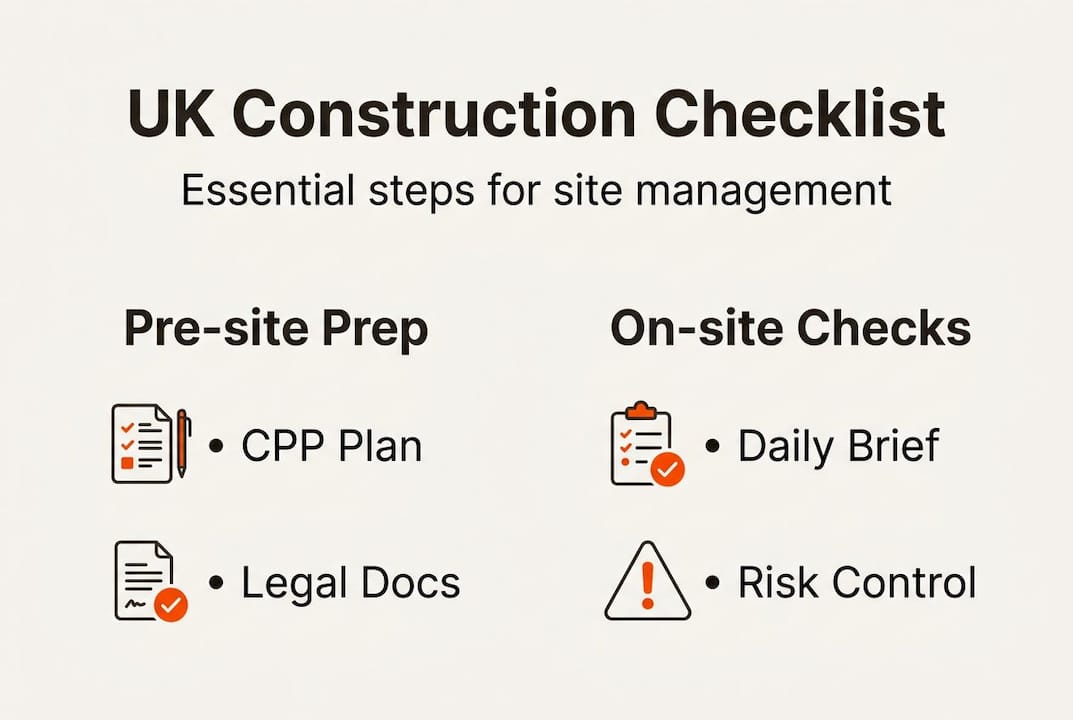
Here is a summary of the key pre-construction documents and who owns them:
| Document | Purpose | Responsible party |
|---|---|---|
| Construction Phase Plan (CPP) | Health and safety governance | Principal contractor |
| Construction Management Plan (CMP) | Logistics, access, and environmental impact | project manager |
| Site Rules | On-site conduct and access control | Site supervisor |
| Emergency Procedures | Incident response protocols | Health and safety lead |
| Risk Arrangements | Identified hazards and mitigations | Principal contractor |
Before work begins, your physical and logistical setup should include:
- Secure hoarding and perimeter fencing with appropriate signage
- Clearly marked access and egress routes for vehicles and pedestrians
- Welfare facilities: toilets, washing stations, rest areas, and first aid
- Designated areas for materials storage and waste management
- Site induction procedures and visitor sign-in protocols
For guidance on construction management plans and what they should contain, industry resources provide solid starting templates. When managing subcontractors, ensure every trade is briefed on site rules before they mobilise.
Pro Tip: Digitise all pre-construction documents from day one. Version control and a clear audit trail are essential when inspectors or clients request evidence of compliance. A digital system removes the risk of outdated paper copies circulating on site.
Step-by-step workflow: The daily construction checklist
With your site set up and documents in place, the daily workflow is where compliance and safety either hold firm or break down. Every site supervisor needs a consistent routine that covers the full scope of site conditions, not just a quick walk-around.
Here is a numbered daily checklist based on best-practice safety standards covering site setup, welfare, plant, working at height, excavations, fire, and health hazards:
- Perimeter check: Confirm hoarding, fencing, and signage are intact and clearly visible
- Welfare inspection: Verify toilets, handwashing facilities, and rest areas are clean and operational
- Plant and equipment: Check all machinery has valid inspection records and operators hold current certifications
- Working at height: Inspect scaffolding, edge protection, and access equipment before use begins
- Excavations: Confirm trench supports are in place and no unauthorised access has occurred overnight
- Fire safety: Check extinguisher locations, hot works permits, and emergency exit routes are unobstructed
- Dust and noise: Assess suppression measures and confirm compliance with permitted working hours
- Hazardous materials: Verify storage, labelling, and disposal arrangements for COSHH substances
- Briefings: Conduct a morning briefing with all trades covering the day’s sequence of operations
- Sign-off: Record completed checks with date, time, and name of the responsible supervisor
Safety note: Slips, trips, and falls consistently rank as the leading cause of non-fatal injuries on UK construction sites according to HSE data. Proactive daily checks are your primary defence against these incidents and the enforcement action that follows.
For workers exposed to outdoor conditions, UV-protective clothing is an often-overlooked health consideration worth including in your welfare checks during warmer months.
Pro Tip: Assign a named individual to sign off each checklist step rather than allowing a generic team sign-off. Digital tracking through your site monitoring guide creates a timestamped record that paper forms simply cannot match. Pair this with solid document control strategies to keep everything auditable.
Building robust communication and risk control
Day-to-day operations only run smoothly when your team is aligned and risks are actively managed. Communication failures are one of the most common causes of site incidents and project delays. Moving beyond paper-based systems makes a measurable difference.

Here is how paper and digital communication methods compare in practice:
| Factor | Paper-based | Digital platform |
|---|---|---|
| Admin time | High, manual filing required | Reduced significantly |
| Error risk | High, version confusion common | Low, single source of truth |
| Auditability | Poor, documents can be lost | Strong, timestamped records |
| Real-time updates | None | Instant notifications |
| Accessibility | On-site only | Any device, any location |
RAMS (Risk Assessment and Method Statement) documents are central to this process. Method statements complement risk assessments and must be site-specific, delivered verbally to the workforce, and evidenced with signatures. A generic RAMS printed from the internet and filed away does not satisfy legal requirements and will not protect you during an HSE inspection.
For workflow management best practices, consider these communication essentials:
- Weekly toolbox talks: Short, focused briefings on a specific hazard or task relevant to that week’s work
- Centralised document sharing: All RAMS, CPP updates, and site instructions held in one accessible location
- Actionable reporting: Incidents, near-misses, and observations logged immediately with corrective actions assigned
- Milestone briefings: Formal team reviews at key project stages to reassess risks and update documents
Your CPP and CMP are living documents that must be reviewed and updated at every significant milestone. Treating them as static files is a common mistake that creates compliance gaps. Investing in digital documentation removes the friction of manual updates and ensures everyone works from the current version.
Verification, reviews, and continuous improvement
Effective communication sets the stage for ongoing verification. Without structured reviews, even the best-run sites accumulate small problems that compound into costly overruns or defects at handover.
Milestone reviews are recognised as a benchmark practice for maintaining audit trails and keeping projects outcome-focused. Schedule them at defined stages rather than waiting for problems to surface.
Here is a practical review schedule with typical findings at each stage:
| Review stage | When to conduct | Typical findings |
|---|---|---|
| Pre-construction audit | Before mobilisation | Missing documents, undefined roles |
| Foundation milestone | Completion of groundworks | Drainage deviations, setting-out errors |
| Structure milestone | Frame or shell completion | Specification variances, material substitutions |
| Pre-handover review | Two weeks before completion | Snag items, outstanding certifications |
| Lessons-learned review | Post-handover | Programme delays, communication gaps |
For independent audits, follow these steps:
- Appoint a reviewer who was not directly involved in the work being audited
- Use a standardised audit checklist aligned to your CPP and contract requirements
- Record findings with photographic evidence where applicable
- Assign corrective actions with named owners and target completion dates
- Close out actions formally before the next milestone
Snag lists are the final quality gate before handover. A thorough snagging and defect tracking process ensures nothing is handed over with outstanding defects, protecting you from post-completion disputes. Combining this with a disciplined approach to saving money on projects through early defect identification reduces the cost of remedial work significantly.
Why checklists alone are not enough: Real-world lessons from the field
Here is the uncomfortable truth most training courses will not tell you. A checklist is only as good as the culture behind it. We have seen sites where every box was ticked and every form was signed, yet serious incidents still occurred. Why? Because the checklist became a ritual rather than a genuine assessment.
Rigid, generic templates create false confidence. When a supervisor runs through the same 20-point list every morning without engaging their team, they stop seeing what is actually in front of them. The form gets signed. The hazard goes unnoticed.
The solution is not a better template. It is better involvement. Brief your team on the specific risks for that day’s work. Review your RAMS with fresh eyes at each new phase, not just at the start of the project. Involve your trades in identifying hazards rather than presenting them with a completed document to sign.
Digital tools help enormously here because they make it easier to update and share information in real time. But technology only amplifies the habits you already have. If your effective real-world communication is weak, a digital checklist will not fix it. Invest in workforce buy-in first. The paperwork will follow.
Pro Tip: Once a month, ask a colleague from a different project to review your RAMS. A fresh perspective catches assumptions and gaps that familiarity blinds you to.
Simplify construction management with advanced software
Managing checklists, documents, and team communication across a live construction site is genuinely complex. The processes covered in this guide are only sustainable when you have the right tools supporting them.
 BRCKS.io">
BRCKS brings together task management, file sharing, team chat, and client updates in a single platform built specifically for construction teams. You can assign checklist items, track sign-offs in real time, and give clients transparent access to project progress without the back-and-forth of emails and spreadsheets. Our construction management software is designed for site conditions, meaning it works on any device and integrates with WhatsApp so your team can update from wherever they are working. Explore our project communication tools and start a free 14-day trial to see how much time you can reclaim each week.
Frequently asked questions
What is legally required in a construction checklist under UK law?
Principal contractors must prepare and maintain a Construction Phase Plan before work begins, covering health and safety arrangements, site rules, and emergency procedures. This is a mandatory requirement under CDM 2015.
How often should site safety checklists be reviewed or updated?
Daily site checks are standard practice for operational safety. Major documents such as the CPP and RAMS must be updated at every project milestone or whenever a significant risk change occurs, as milestone reviews are considered best practice.
Who is responsible for signing off each checklist step?
Site supervisors are typically responsible for daily sign-off on individual checklist steps, with project managers or independent auditors conducting formal reviews at key milestones.
What is RAMS and when is it required?
RAMS stands for Risk Assessment and Method Statement. It is legally required for high-risk or complex works and must be specific to the task, site, and workforce involved.
How can digital tools help with checklist management?
Digital platforms reduce admin time, improve auditability through timestamped records, and deliver real-time updates to all project stakeholders, making compliance far easier to demonstrate and maintain.
Recommended
- UK Construction Project Coordination Best Practices 2026 | BRCKS
- BRCKS | Construction Project Communication Software
- BRCKS | Construction Project Communication Software
- Construction Document Management: Solving the £21bn Problem | BRCKS
How BRCKS Can Help
Navigating a complex UK construction checklist is far simpler when you have a centralised platform to manage every moving part. BRCKS streamlines this process by digitising your workflows, ensuring that compliance, scheduling, and site communications are handled in one secure place. By integrating these essential steps into our intuitive software, you can reduce administrative friction and focus on delivering high-quality projects on time. We invite you to explore how BRCKS can transform your project management approach and help your business scale with confidence. Learn more at BRCKS and explore our full feature set.