Site communication workflow: a UK project manager's guide
Discover how a structured site communication workflow can eliminate costly rework and improve accountability on UK construction sites.
By James Shorter ·
Site communication workflow: a UK project manager’s guide
 A purpose-built construction snagging software keeps these items tracked through to sign-off.
TL;DR:
- Miscommunication on a UK construction site can lead to significant costs, with up to 30% of project expenses lost to rework caused by poor information sharing. Establishing a structured communication workflow that includes clear message categorisation, daily habits, and formal meetings enhances safety, coordination, and accountability. Using tools like RFIs, daily diaries, and accountability loops, combined with fostering a trust-based culture, ensures effective communication across all site stakeholders.
Miscommunication on a UK construction site is not just frustrating — it is expensive. Up to 30% of project costs can vanish through rework driven by poor information sharing. A well-structured site communication workflow addresses this directly, giving project managers and team leaders a repeatable process for keeping everyone — from groundworkers to clients — properly informed. This guide walks you through practical, field-tested steps to build that workflow, covering everything from daily habits and meeting cadence to RFI management, site diaries, and weekly accountability loops.
Table of Contents
- Understanding your site communication workflow needs
- Building your communication plan and meeting cadence
- Effective use of requests for information (RFI) and communication records
- Daily site diaries and handover communication best practices
- Advanced accountability: the Monday commitment and Friday review loop
- Rethinking construction communication: beyond tools to culture
- Streamline your site communication with BRCKS
- Frequently asked questions
Key Takeaways
| Point | Details |
|---|---|
| Miscommunication costs | Up to 30% of UK project costs can be lost to rework without a clear communication workflow. |
| Assess and match channels | Identify message types and site risks to select the right communication channels for safety and clarity. |
| Structured meetings | Daily huddles and weekly meetings create predictable communication rhythms vital for coordination. |
| RFI management | Using a RACI matrix and software to handle RFIs prevents costly delays and confusion. |
| Accountability loop | A Monday commitment and Friday review cadence keeps projects on track with clear responsibility and progress updates. |
Understanding your site communication workflow needs
Before you redesign how your team communicates, you need to understand exactly what your site requires. Not all messages carry equal weight. A delivery confirmation and a gas leak alert are both “communication” — but treating them the same way is where things break down.
Start by categorising message types across three levels:
- Time-critical messages: Immediate safety issues, accidents, urgent stoppages. These need direct radio or verbal communication with no delay.
- Safety-critical messages: Toolbox talks, permit-to-work confirmations, method statement briefings. Written records are essential alongside verbal delivery.
- Informational messages: Programme updates, delivery schedules, site instructions. These suit email, chat platforms, or notice boards.
Communication planning should begin at the risk assessment stage, matching the medium to the urgency and environment of each message type. A noisy steel-frame erection site has different needs to a fit-out floor in an occupied office block. The channel must suit the conditions, not just the convenience.
Matching your channels to message types is only half the job. The other half is building consistent daily habits. A morning briefing of five to ten minutes at the start of each shift does more for site safety and coordination than any app, because it gives workers the chance to ask questions, flag concerns, and receive the day’s priorities face to face. Shift handovers deserve the same attention. A verbal handover without a written summary is a liability — whoever takes over needs to know what was left unfinished, what instructions were issued, and what hazards were identified.
Improving site communication is not a one-off project. It is a daily discipline, and understanding how your site’s specific environment shapes that discipline is where effective workflows begin. Understanding jobsite coordination roles also helps you identify who owns each communication layer and where gaps tend to appear.
Pro Tip: Use a simple communication matrix in your pre-construction planning. List message types in one column, channels in the next, and the responsible person in the third. It takes 30 minutes and eliminates weeks of confusion.
Building your communication plan and meeting cadence
Identifying your communication needs gives you the raw material. Now you need to shape it into a formal plan that everyone on your project can follow.
Map your stakeholders at the outset. Client representatives, your design team, principal subcontractors, specialist trades, site supervisors, and the health and safety officer all have different information needs and different tolerance for communication frequency. Group them by role and decide early what each group needs to receive, how often, and through which channel.
Choosing tools is the next decision. You need one system for each communication category, and they need to connect to each other. Fragmented tools create fragmented records. A good construction workflow management approach consolidates these into a single point of truth wherever possible.
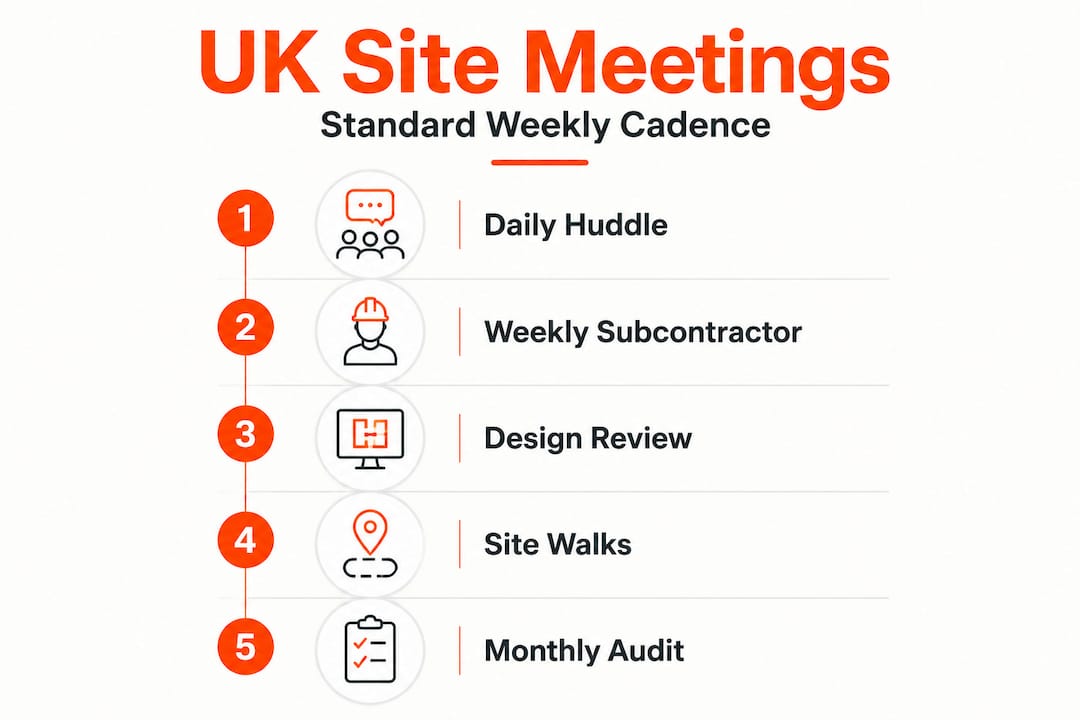
Once tools and stakeholders are mapped, establish your meeting cadence. The standard UK construction rhythm looks like this:
- Daily huddle (5 to 15 minutes): Held at the start of each day on site. Cover safety, the day’s programme, resource conflicts, and any overnight issues. Attendance is mandatory for supervisors and trade foremen.
- Weekly subcontractor meeting (45 to 60 minutes): Review the three-week look-ahead programme, confirm upcoming material deliveries, resolve interdependency clashes, and assign action owners. Subcontractor scheduling coordination is one of the most common sources of delay, and a structured weekly meeting is your primary tool for managing it.
- Weekly or bi-weekly OAC meeting (60 to 90 minutes): The Owner, Architect, and Contractor meeting covers design progress, contract issues, financial matters, and programme milestones. Minutes must be distributed within 24 hours.
Standard UK communication cadence includes exactly this combination of daily huddles, weekly subcontractor meetings, and weekly or bi-weekly OAC meetings, and it exists because each layer solves a different coordination problem.
Meeting minutes are non-negotiable. They do not need to be long. A numbered action list with owner, deadline, and status is more useful than three pages of narrative.
| Meeting type | Frequency | Duration | Key outputs |
|---|---|---|---|
| Daily huddle | Every workday | 5 to 15 mins | Day plan, safety reminders, blockers |
| Subcontractor meeting | Weekly | 45 to 60 mins | Programme look-ahead, action log |
| OAC meeting | Weekly/bi-weekly | 60 to 90 mins | Design, finance, milestones, minutes |
Effective use of requests for information (RFI) and communication records
Meetings set the rhythm. But the detail of site coordination often lives in RFIs — Requests for Information — and the written trail that surrounds them.
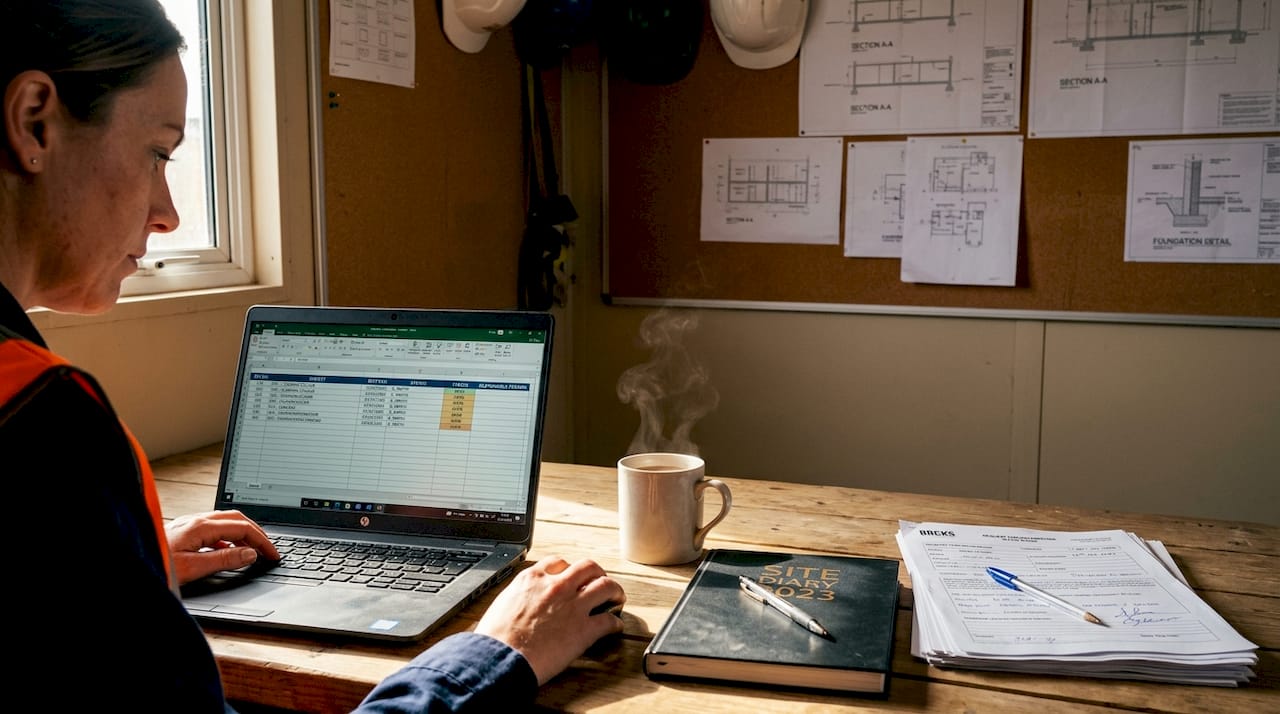
An RFI is formally raised when site teams need a design clarification, a specification decision, or confirmation of intent before work can proceed. Handled well, an RFI is a minor administrative task. Handled poorly, it becomes a three-week delay and a contract dispute. The difference is almost always process.
Before work starts, establish your RFI workflow using a RACI matrix. RACI stands for Responsible, Accountable, Consulted, and Informed. Assign each role to a named individual for each type of RFI so that nobody is waiting to find out who should answer a question. RFIs in UK projects are most effective when centrally logged, with defined responsibilities via a RACI matrix and an expected 14-day response window to avoid knock-on programme delays.
- Log every RFI in a central register, not in someone’s email inbox.
- Assign a unique reference number, submission date, and required response date to each entry.
- Track status weekly in your subcontractor meeting.
- Escalate overdue RFIs immediately — a missed response is a programme risk.
Verbal instructions are equally important to manage. Verbal site instructions are worthless in claims; you must confirm any site conversation by email the same day to build a defensible record. This is not about being bureaucratic. It is about ensuring that when a dispute arises — and at some point, it will — you have clear evidence of what was agreed, when, and by whom.
Pro Tip: Set up a folder structure in your construction reporting tools platform that mirrors your RFI register. When an RFI is resolved, attach the confirmation email and close it out within 24 hours. This single habit saves enormous time during project close-out.
Daily site diaries and handover communication best practices
Formal meetings and RFI logs cover planned communication. Daily site diaries and handovers cover everything else — the unplanned, the unexpected, and the legally significant.
A daily site diary is the most important document on site, requiring factual same-day entries with cross-references to RFIs and instructions to support future claims or audits. Writing it at the end of the shift, not the following morning, is the single most important rule.
A well-structured diary entry should cover:
- Weather conditions: Temperature, rainfall, wind. Relevant to productivity claims and delay arguments.
- Workforce present: Names or numbers by trade, including absences and reasons.
- Plant and equipment: What was on site, what was operating, what broke down.
- Deliveries received: Supplier, materials, quantities, condition on arrival.
- Instructions issued or received: Verbal instructions confirmed in writing, any variations directed by the client or designer.
- Progress made: Work completed against the programme, locations and elements.
- Delays and obstructions: Any events that impacted progress, with the cause recorded factually.
- Safety events: Near misses, incidents, inspections, toolbox talks delivered.
Cross-reference every diary entry to relevant RFIs, emails, and instructions. If you received a verbal instruction from the architect at 10am and sent a confirmation email at 11am, both the instruction and the email reference should appear in that day’s diary entry. This creates a web of evidence that is difficult to challenge.
Handovers between shifts or between supervisors deserve the same rigour. Structure every handover around four categories: hazards currently active on site, tasks left unfinished and their status, any instructions issued during the shift, and incidents or near misses that occurred. Written construction handover documentation protects both the outgoing and incoming supervisor and maintains continuity without relying on memory.
Advanced accountability: the Monday commitment and Friday review loop
Daily diaries and weekly meetings give you structure. The Monday/Friday loop gives you accountability. These are different things, and most sites confuse them.
The Monday commitment meeting is not a general progress update. It is a specific, named commitment session. Each subcontractor or supervisor states what they will complete by Friday, identifies any blockers that would prevent this, and names who owns the resolution of each blocker. Everything is recorded. Nothing is vague.
The Friday review is asynchronous. Each commitment holder sends a single sentence: “Committed. Done. Blocked by X.” That sentence goes into a shared log. The project manager reviews it before leaving on Friday and flags any ongoing blockers for Monday’s agenda.
This Monday commitment and Friday review cadence creates a seven-day accountability loop that visibly reduces blockers and improves delivery for UK construction teams. The reason it works is psychological as much as operational. When someone publicly commits to a task on Monday, they are significantly more likely to complete it than if it was assigned in a general meeting and left to drift.
Consider these practical points for running the loop well:
- Keep Monday commitments specific: “Complete first fix electrics on Level 2 by Thursday” beats “continue with electrics.”
- Blockers must have named owners, not just descriptions. “Awaiting drawing issue” is not acceptable. “John at ABC Architects to issue GA drawing by Wednesday” is.
- Friday updates can be voice notes, typed messages, or platform comments — the format matters less than the timeliness.
- Review communication workflow benefits to understand how closing the accountability loop connects directly to reduced rework rates.
Pro Tip: Post the Monday commitment board somewhere visible on site — a whiteboard in the site office works well for co-located teams. Visibility changes behaviour. When the whole team can see the commitments, the social pressure to deliver is genuine.
Rethinking construction communication: beyond tools to culture
Here is a perspective most site communication workflow guides do not offer: your tools and processes are not your biggest problem. Your culture is.
You can implement the best RFI register, run every meeting on time, and write a daily diary every evening — and still have a site where people are afraid to raise concerns, where foremen say “yes” when they mean “maybe,” and where subcontractors hide problems until they become crises. No app fixes that.
Over-reliance on digital tools without interpersonal elements consistently falls short; trust and clarity come from consistent human interaction. The briefings where a foreman genuinely welcomes a question from the apprentice. The site walk where the project manager notices that a subcontractor looks uncertain and asks directly. The debrief where a near-miss is discussed without blame so the team learns from it. These moments are not soft management extras. They are the load-bearing structure of reliable communication.
Technology speeds things up. It does not replace reading hesitation in someone’s voice, noticing that a trade team has gone quiet, or recognising that a subcontractor’s confident “no problem” is masking a real concern. Leadership that notices these signals and creates space for honest communication is what distinguishes sites that handle problems early from sites that discover them at handover.
Build your communication culture deliberately. Make every briefing a two-way exchange, not a broadcast. Review improving construction communication practices that emphasise feedback loops as a trust-building mechanism. Acknowledge when your own information sharing fell short. The team will follow your lead faster than any new process you introduce.
The best site communication workflow is the one that your team actually trusts and uses, because they know it exists to help them, not to monitor them.
Streamline your site communication with BRCKS
Putting this workflow into practice requires a platform that fits how your team already works — not one that adds another layer of complexity to manage.
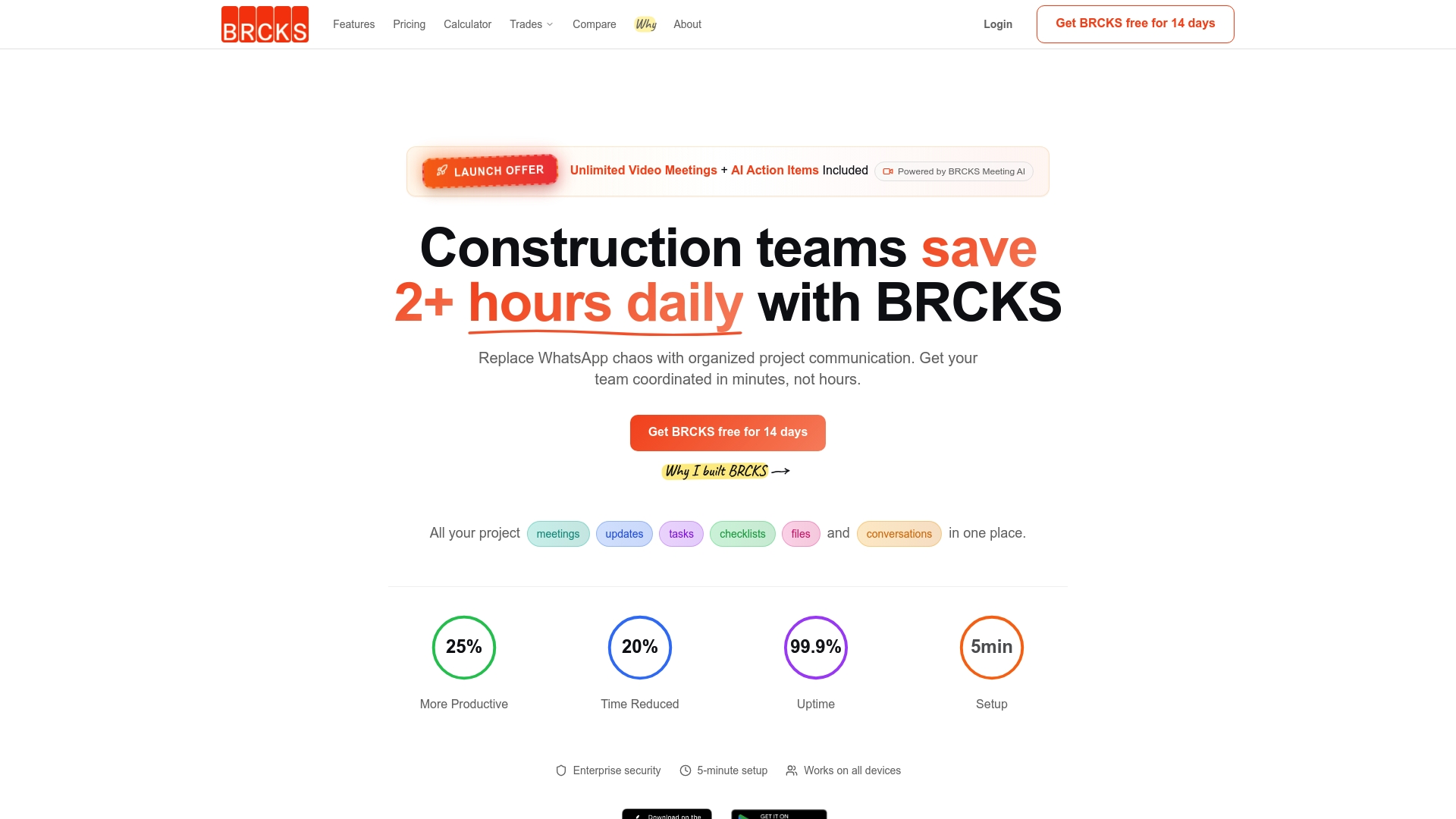
BRCKS is built specifically for UK construction teams, integrating with WhatsApp so your trades and subcontractors can log updates, RFIs, and delivery confirmations without switching to an unfamiliar system. Everything lands in a central, searchable log that gives you the audit trail your contracts and clients require. Whether you are managing construction communication software across multiple subcontractors or running a lean team of builders, BRCKS scales to fit. It supports client portals, meeting recordings, checklists, and file sharing in one place. For teams managing snag resolution and handover, the snag list software feature keeps defect records clear and accountable. Try it free for 14 days and see how much cleaner your daily communication becomes. Visit BRCKS for builders to find the plan that fits your operation.
Frequently asked questions
What is a site communication workflow in construction?
It is a structured process that manages how information is shared on site, ensuring clarity, timely updates, and coordination among all stakeholders to reduce errors and delays.
How often should daily huddles and subcontractor meetings occur on UK sites?
Daily huddles should happen every workday for quick coordination, while subcontractor meetings are typically held weekly to review short-term schedules and resolve coordination issues.
Why use a RACI matrix for managing RFIs?
A RACI matrix clearly assigns who is responsible, accountable, consulted, and informed for each RFI, preventing delays and confusion over ownership. Insiders recommend a RACI matrix in pre-construction meetings specifically to prevent two-week delays from unresolved queries.
How does the Monday commitment and Friday review meeting improve project accountability?
This cadence creates a weekly accountability loop where commitments are tracked on Monday and progress reviewed every Friday, keeping blockers visible and preventing tasks from drifting. The seven-day accountability loop is particularly effective because public commitments increase follow-through.
What are best practices for writing a daily site diary?
Make factual same-day entries structured by weather, workforce, activities, deliveries, and instructions, cross-referencing to RFIs and emails to support future claims or audits. Daily site diaries written the same day carry significantly more legal weight than retrospective summaries.
Recommended
- UK Construction Project Management Terminology Guide | BRCKS
- UK Construction Project Coordination Best Practices 2026 | BRCKS
- Construction Handover Documentation: The Complete Guide for UK Project Managers | BRCKS
- BRCKS | Construction Project Communication Software
How BRCKS Can Help
Mastering site communication is essential for keeping UK construction projects on track and avoiding costly misunderstandings. BRCKS simplifies this process by centralising your documentation and real-time updates into one intuitive platform, ensuring every stakeholder remains aligned from the ground up. By digitising your workflow, you can reduce administrative friction and focus on delivering high-quality results. We invite you to discover how BRCKS can transform your project management by exploring our features today. Learn more at BRCKS and explore our full feature set.