Data security in construction software: UK guide
A comprehensive guide for UK project managers on protecting sensitive blueprints, financial records, and client data from evolving cyber threats.
By James Shorter ·
Data security in construction software: UK guide
 A purpose-built construction snagging software keeps these items tracked through to sign-off.
TL;DR:
- Construction software security is essential for protecting sensitive blueprints, financial, and personal data.
- Key threats include ransomware, supply chain attacks, IoT risks, and social engineering.
- Implementing strong features like MFA, encryption, and regular vendor reviews enhances project cybersecurity.
A single UK construction project can generate thousands of documents, from signed contracts and subcontractor agreements to employee records and client payment details. Yet many project managers still assume their sites sit below the radar of serious cyber threats. That assumption is dangerously wrong. Construction software protects sensitive data such as blueprints, financial records, and client details from threats like ransomware, and understanding how it does so is now a core responsibility for every UK project manager and business owner.
Table of Contents
- What exactly is data security in construction software?
- Key threats facing construction project data today
- Core security features to expect from reputable construction software
- Practical data security strategies for UK projects
- Why typical IT security advice falls short for UK construction
- Strengthen your projects with trusted construction software
- Frequently asked questions
Key Takeaways
| Point | Details |
|---|---|
| Sensitive data is everywhere | Construction software manages confidential information like blueprints and payments, making it a high-value target for cyber attacks. |
| UK threats need tailored defences | AI-driven attacks, remote site vulnerabilities, and GDPR obligations mean UK projects need security beyond standard IT measures. |
| Demand strong security features | Require end-to-end encryption, MFA, UK data hosting, and ISO 27001 compliance from every construction software provider. |
| Protect your team and partners | Implement security training, vendor audits, and incident response policies across all subcontractors and stakeholders. |
What exactly is data security in construction software?
Data security, in plain terms, means controlling who can access your project information, how it is stored, and what happens if something goes wrong. In a construction context, this covers far more than just locking a filing cabinet.
Modern construction software holds a remarkable range of sensitive information. Construction software holds blueprints, financial records, HR data, and more, making it a prime target for cyber threats. Think about what sits inside a typical platform on any active UK project:
- Architectural blueprints and structural drawings that competitors or bad actors could exploit
- Contract terms and payment schedules tied to real financial values
- Employee and subcontractor HR records, including National Insurance details
- Client personal data, which falls squarely under GDPR obligations
- Supplier pricing lists and procurement records
- Site access credentials and biometric data
Each of these categories carries a different level of risk and legal responsibility. Losing control of even one category can trigger regulatory fines, project disruption, or reputational damage that takes years to repair.
The distinction between general IT security and construction-specific security matters here. General IT security focuses broadly on network perimeters and device management. Construction software security must go further, accounting for document control in construction, version integrity of drawings, and the reality that dozens of external parties, from architects to ground workers, often need varying levels of access at different project stages.
Regulatory exposure adds another layer. GDPR fines for mishandling personal data can reach £17.5 million or 4% of annual global turnover, whichever is higher. For a mid-sized UK contractor, that figure is not abstract. It is existential.
Pro Tip: When evaluating any construction software, ask the vendor specifically how they handle data separation between projects and clients. A platform that stores all client data in a shared environment without logical separation represents a serious risk.
Key threats facing construction project data today
Now that you know what is at risk, it is vital to understand which cyber threats construction businesses need to prioritise.
Construction has historically been viewed as a low-tech sector, which paradoxically makes it an attractive target. Attackers know that defences are often weaker than in financial services or healthcare. AI-powered threats, IoT device risks, supply chain attacks, and data breaches targeting biometric and GDPR data are all active concerns in the sector today.
Here are the key threat categories every UK construction manager should know:
- Ransomware attacks: Malicious software encrypts project files and demands payment for restoration. Construction firms with tight delivery deadlines are especially vulnerable to paying quickly.
- Supply chain attacks: A subcontractor or supplier with weak security becomes your weak point. Attackers exploit third-party access to reach your core systems.
- IoT and mobile device risks: Site sensors, access control systems, and workers’ mobile phones all create entry points if not properly managed. Guidance on construction site monitoring increasingly includes digital threat awareness alongside physical safety.
- AI-powered social engineering: Attackers now use AI to craft convincing phishing emails that mimic project managers or clients, tricking staff into revealing credentials.
- Insider threats: Disgruntled employees or departing subcontractors with lingering access rights can deliberately or accidentally expose sensitive data.
“The construction sector’s increasing reliance on digital tools has expanded its attack surface considerably, with third-party relationships representing one of the most exploited vulnerabilities.”
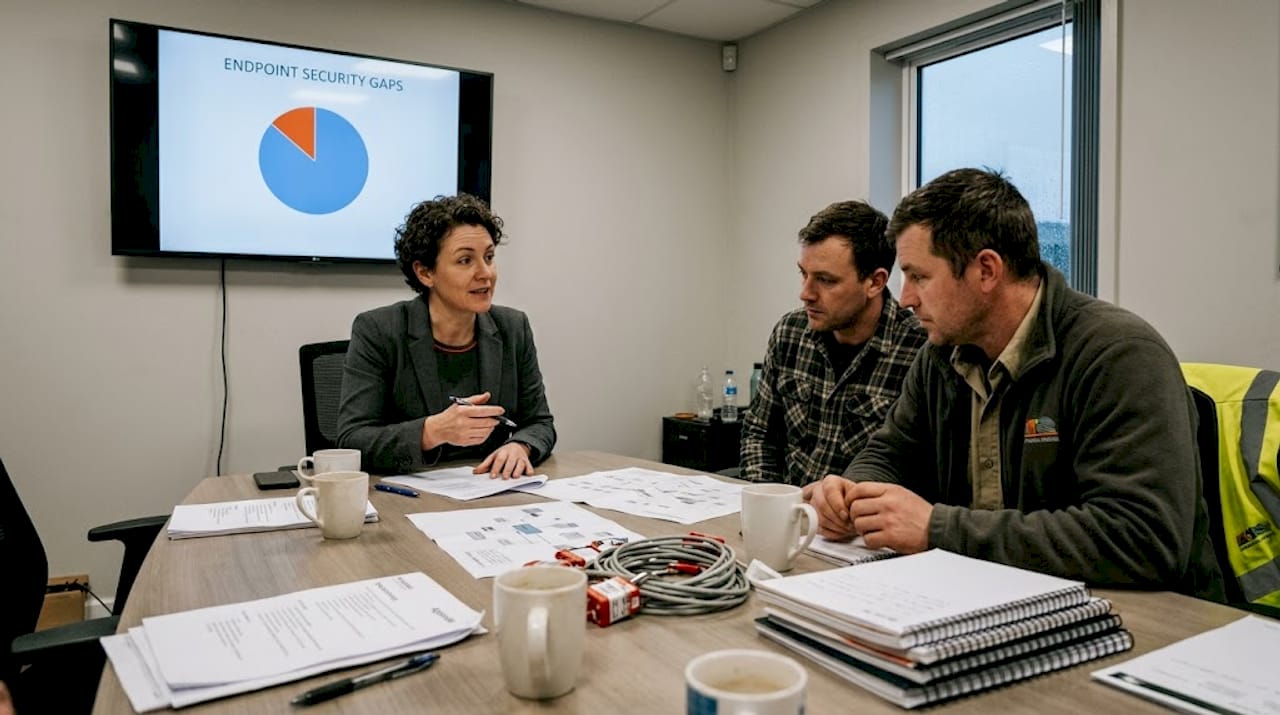
The statistics are sobering. Over 50% of construction firms lack endpoint security and incident response plans, leaving the majority of the industry exposed without a clear recovery path. The challenge of managing subcontractors in UK projects is no longer just about labour coordination. It now includes vetting the digital security posture of every partner you bring onto a project.
Core security features to expect from reputable construction software
With threats ever-evolving, choosing the right software features is your front line of defence.
Not all construction platforms are built with security at the core. Before committing to any tool, you need a clear checklist of non-negotiable features. MFA reduces breach risk by 99%, and UK regulations now favour Zero Trust models, incident response plans, and regular vulnerability scans as best practice.
| Security feature | What it does | Why it matters for UK construction |
|---|---|---|
| Multi-factor authentication (MFA) | Requires a second verification step at login | Reduces breach risk by 99% |
| End-to-end encryption | Scrambles data in transit and at rest | Protects files even if intercepted |
| Role-based access control (RBAC) | Limits data access by job role | Prevents over-sharing within teams |
| ISO 27001 certification | International security management standard | Demonstrates independent audit of controls |
| UK-based data hosting | Stores data within UK borders | Ensures GDPR compliance post-Brexit |
| Audit trails | Logs all user actions with timestamps | Essential for breach investigation |
| Vulnerability scanning | Regular automated checks for weaknesses | Identifies gaps before attackers do |
UK project managers should prioritise ISO 27001 certification, end-to-end encryption, UK-based hosting, and granular RBAC when selecting a platform. These are not optional extras. They are baseline requirements.
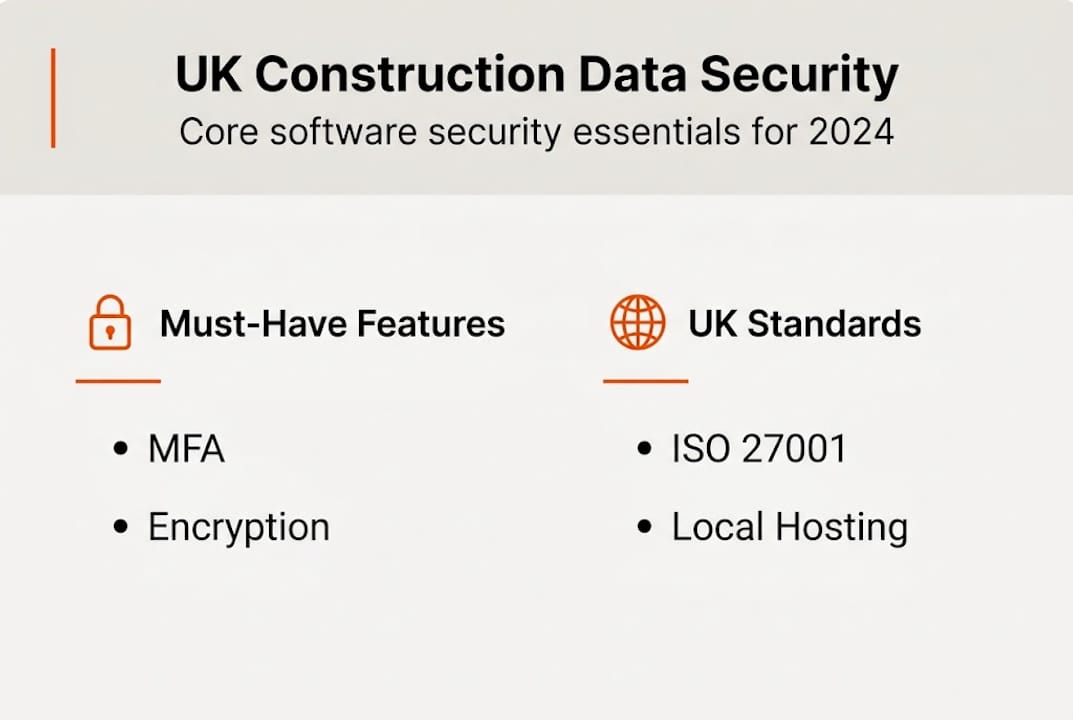
Beyond the checklist, look at whether the vendor aligns with software security standards for UK construction and can demonstrate their compliance with evidence, not just marketing claims.
Pro Tip: Request a vendor’s most recent penetration test report and their data breach response timeline before signing any contract. A credible provider will share this without hesitation. One that deflects or delays should raise immediate concern.
The benefits of secure digital solutions go beyond risk mitigation. Secure platforms build client trust and can become a genuine differentiator when tendering for larger contracts.
Practical data security strategies for UK projects
So how do you ensure your project, team, and data are truly protected? Apply these hands-on security steps.
Knowing which features to look for is one thing. Putting a working security strategy into practice is another. Here is a structured approach you can begin implementing immediately.
- Audit your current software stack. List every tool your team uses to store or share project data. Identify which have MFA enabled, which are cloud-based, and which have had no security review.
- Enforce MFA across all platforms. Only 65% of construction firms have adopted MFA, and post-breach planning sits below 50%, while data breach losses now average $4.88M globally. Closing this gap starts with a simple policy change.
- Define access roles before a project starts. Map out who needs access to what, and assign RBAC permissions accordingly. Review and revoke access at each project milestone.
- Train your team and subcontractors. A single staff member clicking a phishing link can undo every technical control. Short, regular training sessions are far more effective than annual compliance tick-boxes.
- Create an incident response plan. Define exactly who does what if a breach is suspected. This includes isolating affected systems, notifying the ICO within 72 hours as required by GDPR, and communicating with affected clients.
- Vet your software vendors annually. Technology changes. A vendor that was compliant last year may have gaps today. Make vendor security reviews a scheduled part of your project governance.
Addressing hidden data security risks in your software choices often revealsgaps that are cheap to fix early but costly to ignore. Combining this with strong project coordination security best practices gives you a complete picture of where your exposure lies.
| Action | Timeframe | Difficulty |
|---|---|---|
| Enable MFA on all tools | Immediate | Low |
| Conduct access rights audit | Within one week | Low |
| Deliver phishing awareness training | Within one month | Medium |
| Draft incident response plan | Within one month | Medium |
| Complete full vendor security review | Quarterly | Medium |
Why typical IT security advice falls short for UK construction
Generic IT security guidance is built for office environments with stable networks, controlled hardware, and a fixed employee base. Construction projects are none of those things. You have rotating subcontractors, temporary site offices, mobile devices connecting over public networks, and data flowing between dozens of organisations simultaneously.
This is why applying a standard IT security template to a construction project creates a false sense of protection. Construction’s remote sites and fragmented supply chains demand tailored Zero Trust approaches and careful third-party management. Zero Trust means treating every access request as potentially hostile, regardless of whether it comes from inside or outside your network. That philosophy fits construction perfectly, because your network boundary is constantly shifting.
The harder lesson we have observed in the industry is that security decisions are often deferred until after project launch, treated as an IT concern rather than a project management one. That has to change. Security governance needs to sit alongside programme planning and budget controls from day one. Reviewing latest security practices for builders is a practical starting point, but the mindset shift matters more than any single tool or certification.
Strengthen your projects with trusted construction software
Understanding data security in construction software is the first step. Acting on it is what separates high-risk operations from resilient ones. If you are ready to upgrade your project security, BRCKS is built specifically for construction teams who need secure, centralised, and easy-to-use project management.
With BRCKS, your team, subcontractors, and clients work within a single secure platform designed for the realities of UK construction. From file sharing and task management to client portals and team chat, everything is built to reduce communication chaos while keeping your data protected. Explore secure construction software for builders or learn more about how our construction communication software keeps your projects moving safely. Get BRCKS free for 14 days and see the difference a purpose-built platform makes.
Frequently asked questions
What types of data are most at risk in construction software?
Blueprints, financial records, employee details, and client information are prime targets for cyber threats in construction software. These data types carry both commercial and regulatory sensitivity.
Which security features should UK construction software always provide?
Look for MFA, end-to-end encryption, ISO 27001 certification, granular RBAC, and UK data hosting as standard features in any reputable platform.
How do regulations like GDPR affect construction software?
Biometric and personal data handling in construction software falls under GDPR, requiring secure storage, defined access controls, and a documented breach response plan ready to activate within 72 hours.
How common are data breaches in UK construction?
Over 50% of construction firms have gaps in endpoint security, and breaches are rising with average global losses reaching $4.88 million per incident, making robust protection a financial necessity, not a luxury.
Recommended
- Digital Solutions in UK Construction: 5 Key Gains | BRCKS
- BRCKS | Construction Project Communication Software
- Construction Document Management: Solving the £21bn Problem | BRCKS
- BRCKS | Construction Project Communication Software
How BRCKS Can Help
Prioritising data security is no longer optional in the modern UK construction landscape, but managing these risks shouldn't hinder your project's progress. BRCKS is designed with these rigorous standards in mind, providing a secure, centralised platform that protects your sensitive site data while streamlining everyday workflows. By integrating robust protection directly into your management processes, BRCKS ensures your firm remains compliant and resilient against evolving digital threats. We invite you to book a demo today to see how our secure infrastructure can safeguard your next project. Learn more at BRCKS and explore our full feature set.