Boost site productivity: 5 actionable tips for UK managers
UK construction output is declining, but site managers can reverse the trend using digital tools, early supply chain engagement, and smart sequencing.
By James Shorter ·
Boost site productivity: 5 actionable tips for UK managers
 A purpose-built construction snagging software keeps these items tracked through to sign-off.
UK construction has a productivity problem. ONS data shows that output per hour declined by 1.8% in 2024, even as project complexity and client expectations continue to rise. For site managers and project leaders, this gap between effort and output is a daily frustration. The good news is that proven, practical strategies exist to reverse this trend. This article walks you through a clear framework for selecting the right productivity tips, from digital tools and supply chain coordination to modular construction and smart sequencing, so you can make informed decisions that suit your site.
Table of Contents
- Set clear criteria for productivity improvement
- Embrace digital tools for real-time visibility
- Engage the supply chain early for seamless coordination
- Harness modularisation and offsite construction
- Sequence site operations for maximum output
- Review and compare productivity strategies
- Take your site productivity further with BRCKS
- Frequently asked questions
Key Takeaways
| Point | Details |
|---|---|
| Digital tools lead improvements | Platforms offering real-time visibility and data sharing deliver the biggest productivity gains. |
| Early collaboration is crucial | Engaging the supply chain early creates trust and prevents costly bottlenecks. |
| Modularisation boosts output | Volumetric and panellised methods consistently outperform traditional construction in productivity. |
| Sequencing impacts workflow | Tailoring site task sequencing maximises output and minimises delays. |
| Comparison guides decision | Assessing all strategies by clear criteria ensures the most suitable approach is chosen for each project. |
Set clear criteria for productivity improvement
Before adopting any new strategy, you need a way to judge whether it is worth your time. Not every tip suits every site. A large commercial build has different constraints than a residential development of twelve units, and applying the wrong approach wastes both money and momentum.
Start by setting measurable targets. Vague goals like “improve efficiency” are impossible to track. Instead, define specific outcomes: reduce rework by 15%, cut material waiting time by two hours per day, or complete groundworks three days ahead of schedule. These targets give you something concrete to measure against.
Next, consider your workflow management framework before selecting tools or methods. A structured framework helps you identify where delays actually occur, rather than where you assume they do. Use the following criteria to evaluate any productivity strategy:
- Does it address a measurable bottleneck on your specific site?
- Can it be implemented without disrupting current workflows significantly?
- Is there evidence of results from comparable projects?
- Does it integrate with your existing tools and processes?
- What is the realistic timeline to see a return?
Frameworks like the WLC model demonstrate that structured approaches deliver over 30% productivity gains when applied consistently. That figure is not accidental. It reflects disciplined target-setting, regular review, and a willingness to adapt based on real site data.
Embrace digital tools for real-time visibility
With a framework in place, digital solutions offer some of the fastest productivity gains available to site managers today. The key is knowing which tools address your actual pain points rather than adding complexity for its own sake.
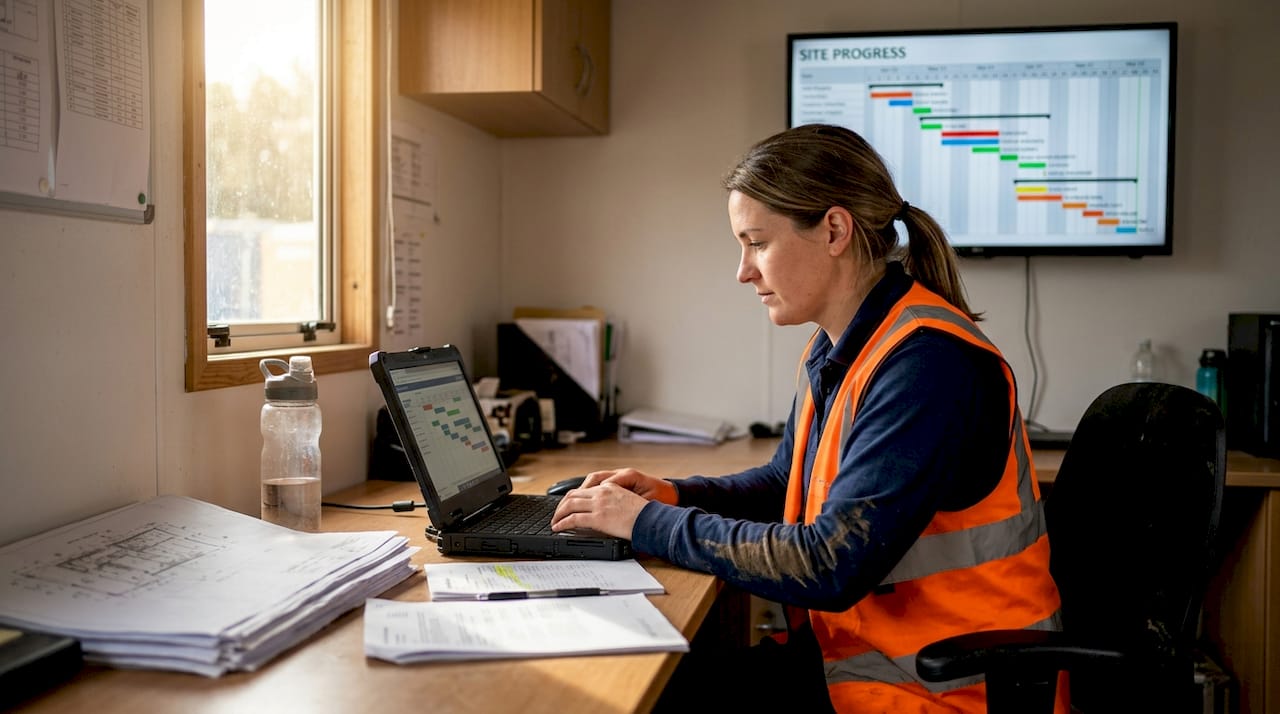
Real-time visibility is where digital tools deliver the most immediate value. When you can see what is happening across your site at any moment, you can respond to problems before they become delays. Access control, crane telematics, and IoT monitoring are three areas where technology is already transforming site operations across the UK.
Here is what each of these tools can do for your site:
- Access control systems track workforce attendance and location in real time, reducing time lost to manual sign-ins and improving safety compliance
- Crane telematics monitor asset utilisation, flagging idle time and enabling better scheduling of lifts across the working day
- IoT environmental sensors measure temperature, humidity, and noise levels, helping you protect workers and avoid weather-related stoppages
- Open data sharing between teams and subcontractors reduces errors caused by outdated drawings or miscommunication
- Digital platforms for builders consolidate task management, file sharing, and team communication into a single interface
Pro Tip: Integrate the Last Planner System into your digital platform. This collaborative scheduling method, where the people doing the work plan the work, pairs well with real-time data tools and consistently reduces programme slippage on complex sites. You can find practical guidance in our site monitoring guide.
Engage the supply chain early for seamless coordination
Digital solutions are most effective when your supply chain is aligned with your project goals from the outset. Waiting until construction begins to involve key subcontractors and suppliers is one of the most common and costly mistakes on UK sites.
Early engagement means bringing supply chain partners into the conversation during the design phase, not just before mobilisation. When subcontractors understand the project sequence, material lead times, and key milestones early, they can plan their own resources accordingly. This reduces last-minute scrambles, material shortages, and the kind of fragmented communication that causes delays.
Early supply chain engagement builds trust and operational efficiency simultaneously. The practical steps include:
- Share project sequencing and programme updates as soon as they are confirmed
- Invite key subcontractors to pre-construction planning meetings
- Establish clear communication channels so queries are resolved quickly
- Agree on material delivery windows that align with site readiness
“Open data sharing and trust between site teams and supply chain partners are among the most reliable ways to reduce delays and improve output on complex UK projects.”
Fragmentation across the supply chain is a well-documented problem in UK construction. When each trade operates in isolation, small delays compound into significant programme overruns. A money-saving project management approach treats supply chain coordination as a core productivity lever, not an afterthought.
Harness modularisation and offsite construction
With supply chain strategies in place, modularisation offers some of the most measurable productivity improvements available to UK site managers. The principle is straightforward: build more in a controlled factory environment and install faster on site.
The productivity data is compelling. Panellised systems deliver 4% gains over traditional housebuilding, while volumetric modular approaches achieve up to 14% improvement. These are not marginal gains. On a 50-unit residential scheme, a 14% productivity improvement translates directly into reduced programme duration and lower preliminaries costs.
| Method | Productivity gain vs traditional | Best suited for |
|---|---|---|
| Traditional build | Baseline | All project types |
| Panellised systems | +4% | Internal fit-out, wall systems |
| Volumetric modular | +14% | Residential, student accommodation |
The gains come from reduced weather dependency, better quality control, and faster installation on site. Fewer wet trades working simultaneously also means less coordination overhead for your team. If you are managing modular elements, snagging tools for modular builds help you maintain quality standards during installation without slowing the programme.
Sequence site operations for maximum output
After exploring modularisation, it is worth focusing on how you order work on site. Even the best digital tools and supply chain relationships will underperform if your sequencing is poorly planned. Sequencing is the backbone of site productivity.
The right sequence depends on your project type, site constraints, and workforce composition. There is no universal answer, but there are common pitfalls that consistently cause delays across UK sites.
| Sequencing pitfall | Likely outcome |
|---|---|
| Starting groundworks before utilities are confirmed | Rework, programme delay |
| Overlapping wet and dry trades in the same zone | Quality defects, rework costs |
| Delivering materials before storage areas are ready | Damage, double handling |
| Scheduling inspections without buffer time | Failed inspections cause knock-on delays |
Use workflow sequencing advice and digital workflow mapping tools to visualise your programme before work begins. Site plan examples from comparable projects can also help you stress-test your sequence before committing to it. Be aware of hidden workflow costs that poor sequencing can introduce over time.
Site-specific sequencing is consistently identified as a key driver of optimal productivity. Key actions include:
- Map your critical path before mobilisation and share it with all trades
- Identify float in your programme and protect it deliberately
- Align material deliveries with installation windows, not just availability
Pro Tip: Review your sequencing after each major milestone, not just at the end of the project. Mid-project reviews catch drift early and give you time to recover programme without crisis management.
Review and compare productivity strategies
Bringing all strategies together allows you to make a more informed decision about where to focus your effort. Not every approach suits every site, and fragmentation studies show no consistent correlation between firm size and productivity gains. What matters is fit.
| Strategy | Best for | Key benefit | Consideration |
|---|---|---|---|
| Digital tools | Complex, multi-trade sites | Real-time visibility | Requires training and buy-in |
| Supply chain engagement | All project types | Reduces delays and rework | Needs early planning |
| Modularisation | Residential, repetitive builds | Up to 14% productivity gain | Upfront design investment |
| Site sequencing | All project types | Reduces compounding delays | Must be site-specific |
Here is a practical guide to applying these strategies in order:
- Set measurable productivity targets before selecting any strategy
- Audit your current workflows to identify the biggest bottlenecks
- Engage your supply chain during design, not at mobilisation
- Evaluate whether modular or offsite methods suit your project type
- Map and review your site sequence at every major milestone
- Use digital tools to monitor progress and share data across teams
For broader project management insights, revisiting your approach after each project helps you build a library of what works for your team and site conditions.
Take your site productivity further with BRCKS
The strategies above give you a strong foundation, but putting them into practice consistently requires the right tools. BRCKS is a construction project management platform built specifically for UK builders, project managers, and site teams who want to reduce communication chaos and keep projects moving.

With BRCKS, you get task management, file sharing, team chat, client portals, and meeting recordings all in one place. The platform integrates with WhatsApp, uses AI-powered search, and saves teams over two hours daily through automation. Whether you are managing a small residential scheme or a large commercial project, construction software for builders like BRCKS scales with your needs. Explore project communication tools designed for construction, or see how BRCKS compares to everyday tools in our comparison with WhatsApp. Get BRCKS free for 14 days and see the difference on your next project.
Frequently asked questions
What is the most effective productivity tip for UK site managers?
Adopting digital tools for real-time visibility, including access control, crane telematics, and IoT monitoring, offers the largest measurable improvement, particularly on complex multi-trade sites.
Does modular construction always improve productivity?
Modular methods generally outperform traditional builds, with volumetric approaches achieving up to 14% productivity improvement, though site-specific factors such as design complexity and logistics will influence actual results.
How can site managers reduce workflow delays?
Early supply chain engagement and transparent sequencing are two of the most reliable ways to minimise delays, as they address the root causes of fragmentation and miscommunication before work begins.
Are digital platforms difficult to implement?
Most digital platforms require an initial period of training and process adjustment, but once embedded into site routines they deliver consistent benefits in visibility, communication, and task management.
Recommended
- BRCKS | Construction Project Communication Software
- BRCKS | Construction Project Communication Software
- BRCKS | Construction Project Communication Software
- BRCKS | Construction Project Communication Software
- Manufacturing productivity checklist for efficiency in 2026
- Effective ways to improve focus at work in 2026
How BRCKS Can Help
Implementing these productivity strategies will help your site run more smoothly, but managing the moving parts of a busy project remains a significant challenge. BRCKS is designed specifically to streamline these workflows, providing UK managers with the real-time visibility needed to eliminate bottlenecks and keep teams on schedule. By integrating our intuitive tools into your daily routine, you can spend less time on paperwork and more time delivering high-quality results. We invite you to discover how BRCKS can transform your site management by exploring our platform today. Learn more at BRCKS.