Why adopt digital solutions in UK construction: 5 key gains
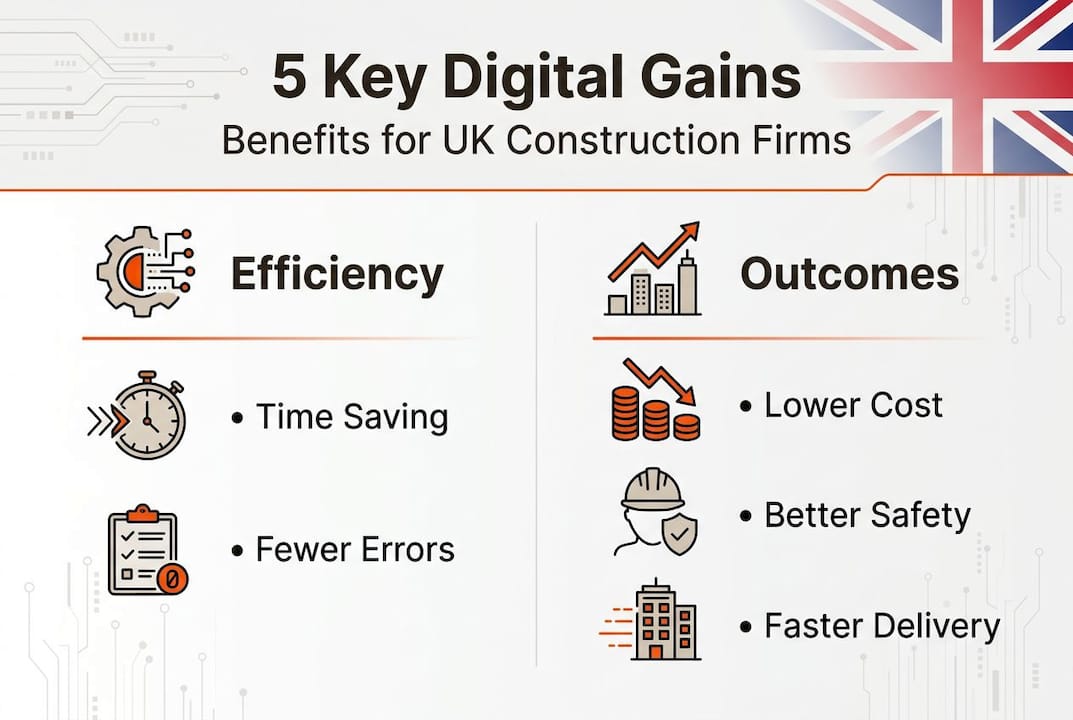
Digital tools can reduce construction admin time by up to 90% and cut rework significantly. Learn how to modernise your workflows and protect your margins.
By James Shorter ·
Why adopt digital solutions in UK construction: 5 key gains
TL;DR:
- Digital tools can reduce construction admin time by up to 90% and cut rework significantly.
- Real-time collaboration and digital records improve safety, compliance, and reduce project errors.
- Adoption barriers include connectivity, skills gaps, and resistance; starting small aids implementation.
Paper-based processes are quietly draining UK construction budgets. One case study found that going paperless can deliver a 90% admin time reduction and save site managers roughly £4,500 per year in lost productivity. Those are not marginal gains. They represent real money and real hours that could be redirected towards delivering better projects. This guide breaks down the specific, evidence-backed benefits of digital adoption, addresses the barriers that hold UK firms back, and gives you practical steps to act on what you learn here.
Table of Contents
- How digital tools revolutionise construction efficiency
- Reducing errors and rework through real-time collaboration
- Benchmarks: Costs, time, and productivity improvements proven by UK data
- Unlocking safety, compliance, and dispute protection
- Adoption challenges: UK-specific barriers and the path to ROI
- Our perspective: Why data, not just tech, is the game-changer in UK construction
- Next steps: Take your construction project digital with confidence
- Frequently asked questions
Key Takeaways
| Point | Details |
|---|---|
| Major time savings | Digitising admin tasks can reduce workload by over 50%, freeing managers for higher-value activity. |
| Lower costs and errors | Adopting digital platforms slashes rework, cuts project risk, and yields up to 15% lower costs. |
| Boosted collaboration | Cloud and mobile tools keep on-site and remote teams aligned and act as a single source of truth. |
| Improved safety and compliance | Real-time digital records enhance legal protection, safety audit tracking, and project transparency. |
| Actionable for all firm sizes | Even small firms can see fast ROI by starting with high-impact digital tools like forms and communication apps. |
How digital tools revolutionise construction efficiency
The efficiency case for digital tools is no longer theoretical. Digital tools drive between 50% and 70% admin time reduction across typical construction workflows, with some case studies showing reductions as high as 90%. For project managers juggling multiple sites and subcontractors, that difference is transformative.
Consider what Flannery achieved: by digitising their forms, they saved 100 hours per week across their operations. That is not a rounding error. It is the equivalent of nearly three full-time employees freed from paperwork.
The tools driving these results fall into a few clear categories:
- Building Information Modelling (BIM): Centralises design data and reduces clashes before work begins on site
- Cloud-based platforms: Enable cloud-based construction admin from any device, keeping remote and on-site teams aligned
- IoT sensors and monitoring: Provide live site data without requiring manual checks
- Paperless form and document systems: Replace slow, error-prone paper trails with instant, searchable records
For remote project managers especially, cloud platforms are the single biggest lever. You gain visibility without being physically present, and your team avoids the back-and-forth of chasing updates by phone or email.
| Tool type | Primary benefit | Typical time saving |
|---|---|---|
| BIM | Clash detection, design accuracy | Up to 30% rework reduction |
| Cloud platforms | Remote access, real-time data | 50%+ admin reduction |
| Digital forms | Speed, accuracy, compliance | 70-90% form processing time saved |
| IoT monitoring | Live safety and progress data | Fewer manual site checks |
Pro Tip: Start with digital forms and safety documentation before investing in complex systems. These deliver fast, visible wins that build team confidence and reduce resistance to wider adoption.
The project communication platform benefits compound quickly when systems are integrated from the outset. Siloed tools create their own inefficiencies, so plan your digital stack with connectivity in mind.
Reducing errors and rework through real-time collaboration
Rework is one of the most expensive problems in UK construction. Rework costs 5-10% of total project value, and much of it stems from miscommunication, outdated drawings, or instructions that never reached the right person. Digital platforms that act as a single source of truth cut through this directly.
When every team member accesses the same live documents, drawings, and task lists, the risk of someone working from an old version drops sharply. UK error reduction evidence shows that structured information sharing can cut errors by over 70% on live projects.
“The shift to real-time digital collaboration does not just speed things up. It fundamentally changes accountability. Everyone sees the same information at the same time, and that removes the ambiguity that causes most errors.” — Construction technology analyst
Here is how traditional and digital workflows compare:
| Workflow element | Traditional approach | Digital approach |
|---|---|---|
| Drawing distribution | Printed, manually updated | Live, version-controlled cloud access |
| Issue reporting | Phone calls, paper forms | Instant in-app notifications |
| Task assignment | Verbal or email | Tracked, timestamped, accountable |
| Subcontractor updates | Weekly meetings | Real-time shared dashboards |
The features that matter most for reducing rework include:
- Centralised document storage with version control
- Instant task assignment with photo evidence capture
- Automated notifications when critical updates are made
- Audit trails that show who actioned what and when
Platforms like OpenSpace demonstrate this in practice. Their collaboration approach enabled Sweet Projects to deliver data centres on time and with confidence, precisely because every stakeholder had consistent, current information. A solid rework reduction workflow and real-time updates are not luxuries. They are now baseline expectations for competitive UK firms.
Benchmarks: Costs, time, and productivity improvements proven by UK data
For decision-makers, the question is always the same: what does the data actually show? Here are the figures that matter.
A hospital MEP project using BIM demonstrated that BIM reduces project costs by up to £500,000, delivered the project 2.7% under budget, and improved productivity by more than twice the baseline. Separately, digital adoption averages a 15% cost reduction and 20% time reduction across construction projects studied in recent research. McKinsey’s analysis of UK infrastructure found that digital tools boost project manager productivity by as much as 80%.
2.5x productivity improvement is now a documented outcome for teams that fully integrate digital project management tools.
| Metric | Before digital adoption | After digital adoption |
|---|---|---|
| Admin time per week | 15-20 hours | 3-8 hours |
| Rework as % of project cost | 5-10% | 1-3% |
| Project delivery time | On average 20% over schedule | On or under schedule |
| Cost overrun frequency | Common | Significantly reduced |
To benchmark ROI for your own projects, follow these steps:
- Record your current weekly admin hours and multiply by your average hourly rate
- Calculate rework costs from your last three projects as a percentage of total value
- Set a baseline for on-time delivery performance before any digital change
- Pilot one digital tool for 60 days and measure the same metrics again
- Present the before-and-after comparison to stakeholders to build internal support
The project delivery improvements become visible quickly when you measure the right things. It is also worth reviewing the hidden costs of staying with fragmented systems, which often exceed the investment in a proper platform.
Unlocking safety, compliance, and dispute protection
Safety and compliance are areas where digital tools deliver value that goes well beyond efficiency. Research published in Nature confirms that digital tech links to improved safety outcomes through hierarchical management models that respond faster to on-site risks.
Real-time monitoring means a safety issue flagged at 9am can be resolved before lunch, rather than sitting in a paper report until the next site visit. That speed of response genuinely saves lives and prevents injuries.
On the compliance side, digital records provide:
- Automated checklists that prompt the correct actions at each project stage
- Tamper-proof audit trails that satisfy HSE requirements
- Instant retrieval of inspection records during audits or investigations
- Timestamped photographic evidence linked directly to specific tasks
“Digital records do not just support compliance. They become critical evidence when disputes arise, protecting firms from costly legal challenges.” — Site Manager AI
Digital records support compliance and provide the kind of structured evidence that holds up in formal dispute resolution. This matters enormously in a sector where contractual disagreements are common and expensive.
Pro Tip: Before committing to any digital platform, confirm it allows easy record export in standard formats and supports offline access. Sites with poor connectivity still need reliable documentation.
Avoiding the pitfalls that undermine digital compliance is equally important. Understanding collaboration pitfalls and following a structured communication improvement guide will help you build a system that actually holds up under scrutiny.
Adoption challenges: UK-specific barriers and the path to ROI
Despite the evidence, only 33% of UK SME construction firms currently use digital tools. The barriers are real: upfront costs, poor site connectivity, skills shortages, and straightforward resistance to change.
The Technology-Organisation-Environment (TOE) framework is a useful lens here. It asks you to assess your firm’s readiness across three dimensions: the technology itself, your organisational capacity to adopt it, and the external environment including market pressure and regulation. Skills gaps and uneven maturity across UK firms mean that readiness varies enormously, even within the same company.
The key adoption challenges facing UK firms include inconsistent broadband on rural sites, a workforce that skews older and less tech-familiar, and procurement processes that do not yet reward digital capability.
Top tips for overcoming these barriers:
- Choose tools with offline functionality for sites with poor connectivity
- Involve site managers and trades in tool selection to reduce resistance
- Start with mobile app solutions that require minimal training
- Use free subcontractor access tiers to bring the whole supply chain on board without extra cost
- Explore digital tools for builders that are purpose-built for construction rather than adapted from other industries
A stepwise plan for building a data-driven culture:
- Identify one high-pain process (usually safety documentation or daily reporting)
- Digitise that process with a simple, low-cost tool
- Measure the time and cost saved over 30 days
- Share results visibly with the wider team
- Use that momentum to expand digital adoption to the next process
Pro Tip: Instant digital safety documentation is one of the fastest ways to win over sceptics. When a site manager sees a compliance report generated in minutes rather than hours, resistance tends to drop quickly. Information sharing done well becomes its own argument for change.
Our perspective: Why data, not just tech, is the game-changer in UK construction
Here is something the software vendors rarely say: buying a platform does not transform your business. Using it to measure outcomes does.
We see this pattern repeatedly. A UK firm invests in a digital tool, adoption is patchy, and leadership concludes the technology did not work. The real problem is almost always cultural. The tool was not embedded into daily workflows, outcomes were not tracked, and no one communicated the wins back to the team.
Many C-suite leaders genuinely overestimate their firm’s digital maturity. They count the number of tools purchased rather than the depth of usage. True transformation happens when project managers treat data as a management habit, not a reporting obligation.
The firms that see the strongest ROI are those that set clear baselines, measure consistently, and share results openly. Understanding why digital collaboration fails is just as important as understanding why it succeeds. Technology is the enabler. Culture and measurement are the actual drivers.
Next steps: Take your construction project digital with confidence
The evidence is clear. Digital tools reduce admin, cut rework, improve safety, and deliver measurable ROI across UK construction projects of every size. The question is no longer whether to adopt them, but where to start.
 BRCKS.io">
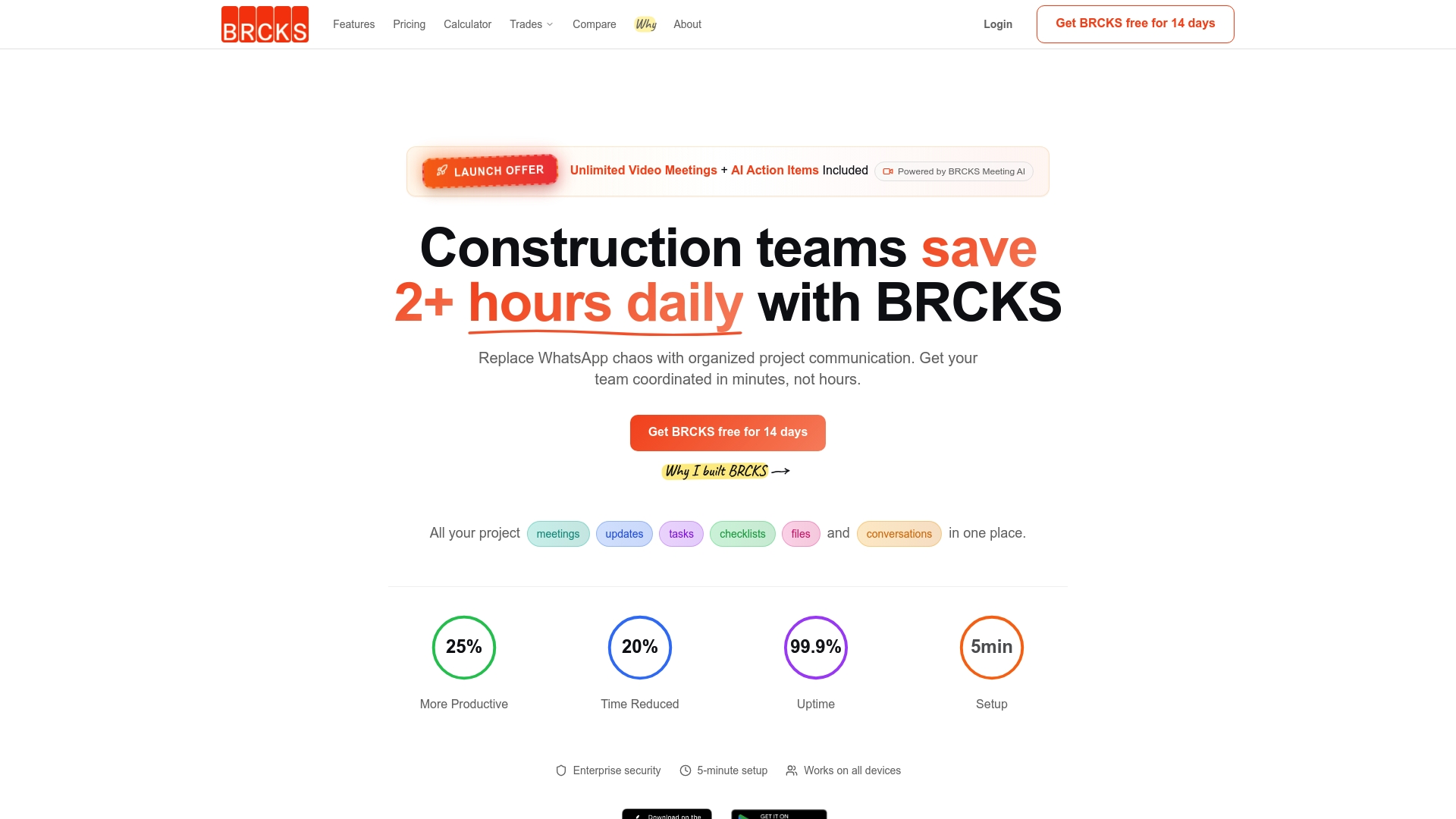
BRCKS is built specifically for construction teams in the UK, combining project updates, task management, team chat, file sharing, and client portals in one platform. Whether you manage a small team or a large multi-site operation, BRCKS for builders scales to fit. Explore the construction communication tools that teams are already using to save over two hours daily, and find out why BRCKS is the platform UK construction professionals trust. Start your 14-day free trial today.
Frequently asked questions
What is the biggest benefit of adopting digital solutions in construction?
Digital solutions cut admin time by up to 90%, reduce costly errors, and improve communication across teams, leading directly to more profitable and safer projects.
Are digital tools suitable for small construction firms in the UK?
Yes. Although only 33% of SMEs currently use digital tools, the cost savings and rapid impact make adoption worthwhile, particularly when starting with high-ROI options like digital forms or safety documentation.
Do digital construction tools help with safety compliance?
Definitely. Digital adoption supports improved safety outcomes, automates compliance documentation, and creates tamper-proof records that serve as evidence in formal dispute resolution.
How quickly can a UK project manager realise ROI from digital adoption?
Many teams see measurable time and cost savings within weeks. Digitising workflows and documents is typically the fastest entry point, with results visible before the end of the first month.
Recommended
- Construction Document Management: Solving the £21bn Problem | BRCKS
- 5 Benefits of Project Communication Platforms in Construction | BRCKS
- BRCKS | Construction Project Communication Software
- UK Construction Project Coordination Best Practices 2026 | BRCKS
How BRCKS Can Help
Adopting digital solutions is no longer a luxury but a necessity for UK firms looking to remain competitive and compliant in an evolving landscape. BRCKS simplifies this transition by centralising your project data and streamlining communication, ensuring these five key gains are felt across every site you manage. By removing the friction of manual processes, our platform allows your team to focus on quality delivery rather than administrative hurdles. We invite you to explore how BRCKS can transform your operational efficiency and help your business thrive in the digital age. Learn more at BRCKS and explore our full feature set.