Task delegation in construction: boost team efficiency
Poor delegation is a costly habit in construction. This guide provides a practical framework for UK project managers to delegate effectively and boost site productivity.
By James Shorter ·
Task delegation in construction: boost team efficiency
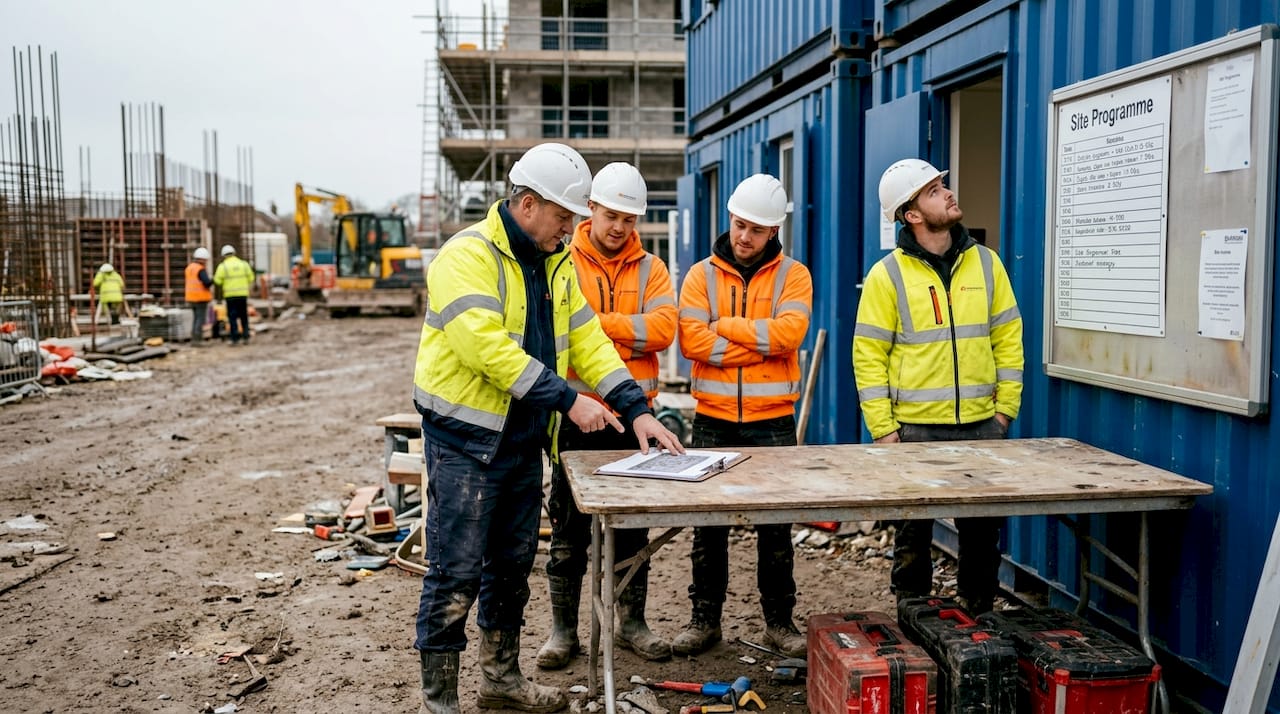
Poor delegation is one of the most expensive habits in construction management. A missed briefing, an unclear handover, or a task assigned to the wrong person can stall an entire project for days. UK construction project managers consistently report that communication breakdowns and role confusion are among the top causes of costly rework and delays. This guide gives you a practical, step-by-step framework for delegating effectively across your team, covering everything from setting up roles and KPIs to troubleshooting common failures. Whether you manage a small trades team or a large multi-contractor site, these strategies will help you delegate with confidence and get more done.
Table of Contents
- Identifying delegation needs and setting up the groundwork
- Establishing measurable outcomes and trust
- Practical delegation: Real scenarios from UK construction sites
- Continuous improvement and troubleshooting in delegation
- Our perspective: Why effective delegation is the real competitive edge
- Next steps: Tools to streamline your delegation
- Frequently asked questions
Key Takeaways
| Point | Details |
|---|---|
| Delegate with clear frameworks | Set out roles, use models like RACI, and prepare staff to take on responsibility. |
| Measure and check progress | Define KPIs and conduct regular reviews to ensure delegated tasks stay on track. |
| Embrace feedback and adapt | Use feedback loops and digital tools to refine delegation and spot issues early. |
| Balance trust with support | Empower teams but step in with guidance only when truly necessary. |
Identifying delegation needs and setting up the groundwork
Before you can delegate well, you need to understand what you are actually delegating and to whom. Many managers confuse leadership with management. Managers assign tasks. Leaders develop people who can own those tasks. Hiring leaders, not just workers is crucial for delegation success, because without capable, accountable people in place, even the best systems will break down.
Start by auditing your current workload. Which tasks require your direct input, and which can be handled by someone else with the right guidance? Common candidates for delegation include change order tracking, daily safety checks, materials documentation, and progress reporting. Tasks involving final sign-off, legal compliance, or client-facing decisions typically stay with you.
Once you know what to delegate, formalise the process with Standard Operating Procedures (SOPs). An SOP is simply a written, step-by-step guide for completing a task to a consistent standard. SOPs remove ambiguity and give your team something concrete to follow, which is especially important on sites where staff turnover is high.
For role clarity, use the RACI model for clarifying roles in delegation. RACI stands for Responsible, Accountable, Consulted, and Informed. Assigning each role to each task eliminates the confusion of who does what and who makes the final call.
Delegation preparation checklist:
- Audit your weekly tasks and identify what can be handed over
- Write or update SOPs for each delegated task
- Assign RACI roles for every task on the project
- Confirm each team member has the skills and access they need
- Set a brief handover meeting before delegation begins
| Task type | Delegate to | Keep with manager |
|---|---|---|
| Daily safety checks | Site foreman | Final safety sign-off |
| Change order tracking | Site engineer | Client approval |
| Materials documentation | Junior site manager | Contract amendments |
| Progress reporting | Team leads | Stakeholder reporting |
For a broader view of how these steps fit into your overall processes, explore workflow management best practices and consider how optimised communication workflows can reduce rework from the outset. The APM delegation tips are also worth bookmarking as a reference.
Pro Tip: Create a simple one-page RACI chart for each project phase. Pin it somewhere visible on site so every team member can see who owns what at a glance.
Establishing measurable outcomes and trust
Delegation without clear outcomes is just offloading. For delegation to genuinely improve efficiency, every task you hand over needs a defined result, a timeline, and a way to measure success. Setting KPIs and regular check-ins are core to construction delegation that actually sticks.
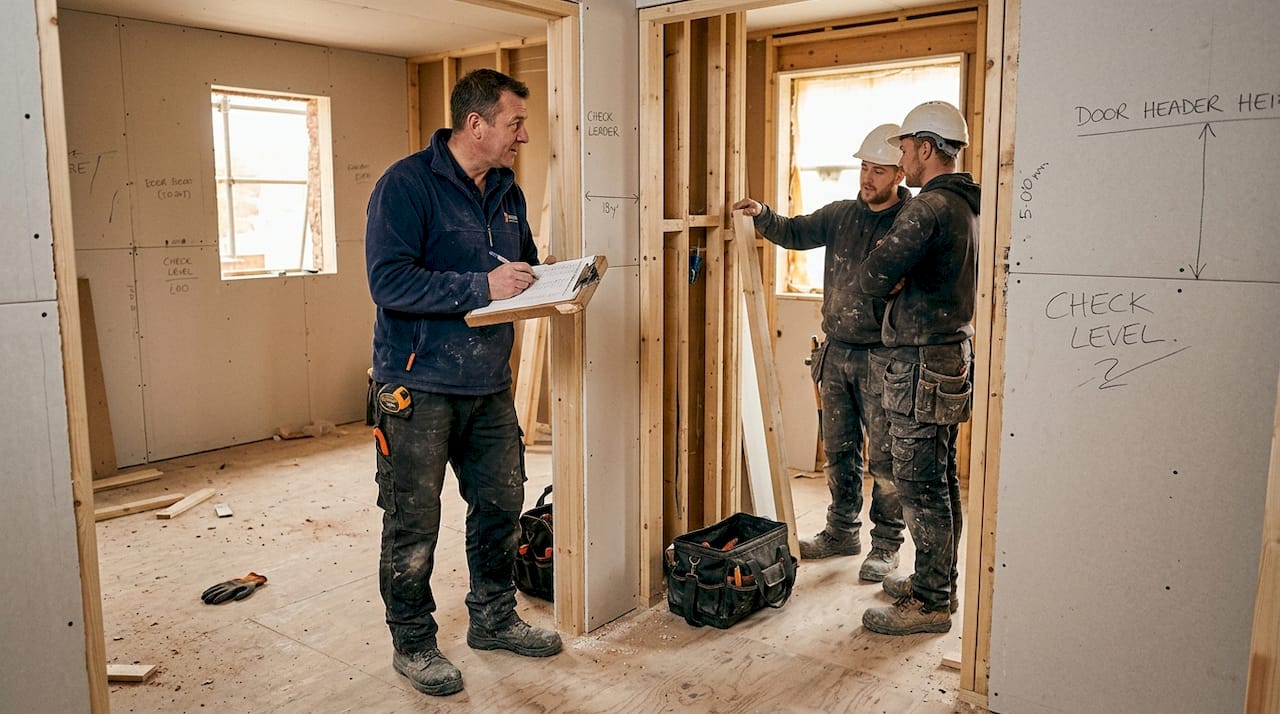
Start by defining what a successful outcome looks like for each task. For a site engineer managing change orders, that might mean all change orders logged within 24 hours and zero outstanding approvals at the weekly review. For a foreman running safety checks, it could be a completed checklist submitted by 8am daily. Specific, measurable targets remove guesswork.
Steps to communicate expectations clearly:
- State the goal in plain language, not jargon
- Confirm the deadline and any interim milestones
- Identify the reporting format (written, verbal, digital)
- Agree on when and how you will check in
- Ask the team member to repeat the brief back to you
Trust is the other side of this equation. A servant leadership mindset builds a culture of accountability, where people feel supported rather than monitored. The difference between trust and micromanagement often comes down to check-in frequency. Weekly reviews signal trust. Daily interruptions signal doubt.
| Approach | Effect on team | Best used when |
|---|---|---|
| Top-down delegation | Fast, clear direction | New team members or high-risk tasks |
| Bottom-up delegation | Higher ownership and buy-in | Experienced, self-sufficient team members |
| Hybrid approach | Balanced autonomy with oversight | Mixed-experience teams on complex projects |
Common blockers include unclear briefs, lack of access to tools or information, and team members who are reluctant to raise problems. Address these early by creating a culture where questions are welcomed, not penalised. Refer to measuring project KPIs to understand which metrics matter most, and use an efficiency savings guide to quantify the gains. The PRINCE2 guide also offers a structured approach to empowering teams.
Pro Tip: At the start of each project phase, hold a 15-minute delegation brief. Cover the task, the outcome, the deadline, and how you will support the person. It takes less time than fixing a misunderstanding later.
Practical delegation: Real scenarios from UK construction sites
Theory is useful. But what does good delegation actually look like on a busy UK construction site? Here are four role-specific scenarios that show delegation working in practice.
Delegation by role:
- Site engineer: Delegate change order management with a clear SOP. The engineer logs, prices, and tracks each change, submitting a weekly summary. The project manager reviews and approves.
- Site foreman: Delegate daily safety checks with a digital checklist. The foreman completes and submits the form by 8am. Any flagged issues trigger an automatic notification to the project manager.
- Junior site manager: Delegate materials take-offs and delivery scheduling. The junior manager coordinates with suppliers and updates the shared tracker. The project manager reviews stock levels weekly.
- Site administrator: Delegate document control, including drawing revisions, RFI logs, and subcontractor correspondence. The administrator maintains version control and flags outstanding items.
In each case, the key is clear checkpoints for delegated tasks, not just a one-off handover. Without checkpoints, small errors compound into large problems.
A common failure scenario: a foreman is told to manage a subcontractor’s programme but is not given authority to make scheduling decisions. The subcontractor misses a slot. The foreman waits for the project manager to intervene. Two days are lost. The fix is simple: define the foreman’s authority level upfront.
“The biggest delegation failures we see are not about competence. They are about authority. People know what to do but are not sure if they are allowed to do it.” This is why written role definitions and SOPs matter so much.
Signs that delegation is working well:
- Team members proactively flag issues before they escalate
- Handovers happen without prompting
- Weekly reviews are brief because problems are resolved at team level
- You spend more time on strategy and less on firefighting
Digital tools play a significant role here. Shared checklists, real-time document access, and instant messaging keep everyone aligned without requiring constant face-to-face contact.
Continuous improvement and troubleshooting in delegation
Even well-designed delegation systems need regular maintenance. The construction environment changes constantly, and your delegation approach needs to keep pace.
Common pitfalls to avoid:
- Reverting to micromanagement when a project hits pressure points
- Delegating without confirming the team member has the right competence
- Failing to update SOPs when processes change
- Ignoring feedback from team members about what is not working
- Treating delegation as a one-off event rather than an ongoing practice
Under pressure, support team members instead of taking over delegated tasks. Taking back a task signals distrust and discourages future ownership. Instead, coach the person through the problem.
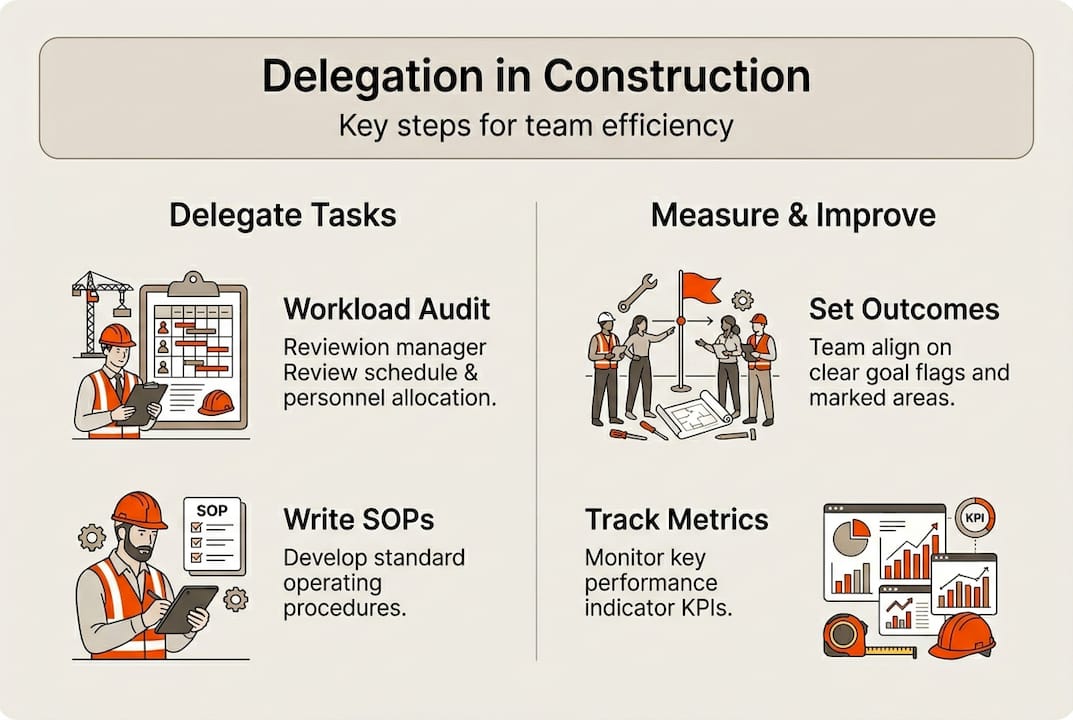
Feedback loops are essential. After each project phase, hold a short retrospective. Ask what worked, what did not, and what would make delegation easier next time. Use that input to update your SOPs and RACI charts before the next phase begins.
Digital training is a practical lever for improving delegation capacity. Digital training improves productivity by 17.2 units on average, compared to 6.8 units for traditional training methods. Investing in short, targeted digital modules helps team members build the skills they need to take on delegated tasks with confidence.
Statistic: Monte Carlo simulation optimises repetitive planning up to 92% efficiency, demonstrating how data-driven approaches can transform construction planning and delegation.
Not everythingshould be delegated. Tasks requiring specialist professional judgement, legal sign-off, or direct client accountability must stay with the project manager. Use delegation troubleshooting tips to identify edge cases, and consult edge cases and training guidance for competence requirements.
For tracking improvement, monitor these metrics: task completion rate against deadline, number of escalations per week, rework incidents linked to delegation errors, and team member confidence ratings from monthly check-ins. Mobile app adoption and site monitoring tools can automate much of this tracking. Review your workflow refinement strategies regularly to keep your delegation system sharp.
Pro Tip: Set a monthly 30-minute calendar block specifically to review your delegation system. Check your metrics, update your SOPs, and ask one team member for honest feedback. Small, consistent reviews prevent large, costly failures.
Our perspective: Why effective delegation is the real competitive edge
Most guidance on construction delegation focuses on process: RACI charts, SOPs, KPIs. These are genuinely useful. But in our experience, the teams that delegate best are not the ones with the most polished systems. They are the ones with the most adaptable mindsets.
Conventional wisdom often frames delegation as a binary choice: either you control everything, or you hand it over and hope for the best. The reality is more nuanced. Self-organising teams excel at adaptability, while centralised delegation improves initial efficiency. The best construction teams blend both, adjusting their approach based on project complexity, team experience, and risk level.
What we see consistently is that rigid delegation frameworks fail when conditions change, and conditions always change on a construction site. The managers who perform best treat their delegation system as a living tool, not a fixed document. They update it, question it, and involve their teams in shaping it.
If you want to move beyond process and build a genuinely high-performing team, start by addressing collaboration roadblocks that prevent your team from self-organising effectively. The system supports the mindset. The mindset drives the results.
Next steps: Tools to streamline your delegation
Putting these delegation strategies into practice is far easier when your team is working from a single, connected platform.
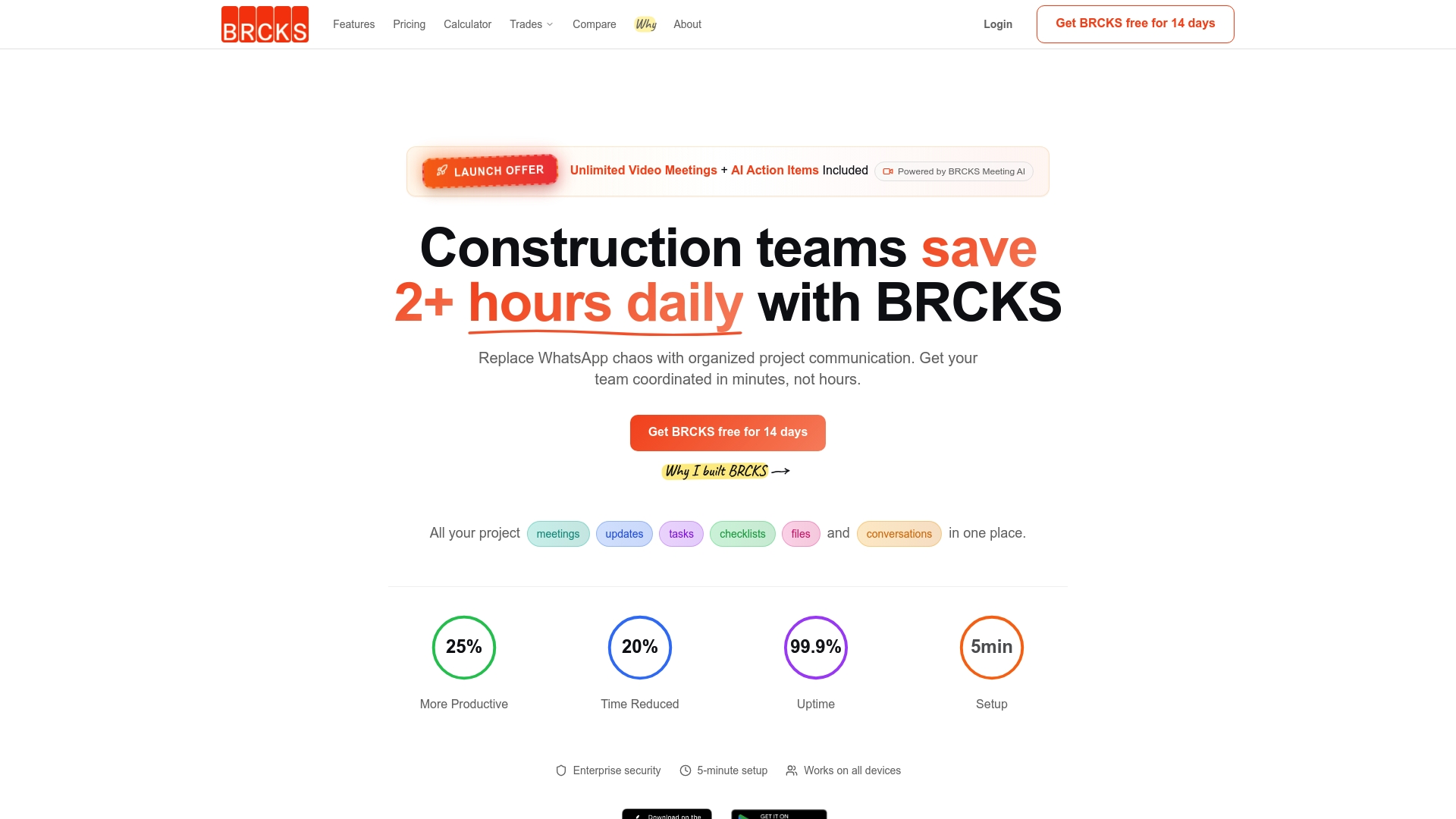
BRCKS is built specifically for UK construction teams, bringing together task management, digital checklists, file sharing, team chat, and client portals in one place. Whether you are a builder managing a small crew or a project manager overseeing multiple subcontractors, software for builders gives you the visibility and control to delegate with confidence. Our communication platforms reduce the back-and-forth that slows teams down, saving over two hours daily. Try BRCKS free for 14 days and see how much smoother delegation becomes when everything is in one place.
Frequently asked questions
What are the most common delegation mistakes on UK construction sites?
The most common mistakes include unclear role boundaries, insufficient checkpoints, and intervening too quickly when problems arise. Using a RACI model for roles and setting clear expectations from the start prevents most of these issues.
Which tasks should never be delegated in construction?
Tasks affecting overall project safety, legal compliance, or requiring specialist professional judgement must stay with the project manager. Non-delegable tasks require clarity upfront so team members know the boundaries of their authority.
How can technology help with task delegation in construction?
Construction-specific software improves accountability, tracks progress in real time, and reduces rework through instant updates and shared documentation. Digital training boosts productivity by 17.2 units compared to traditional methods, showing a clear return on investment.
What are the best models for defining delegation roles?
The RACI model (Responsible, Accountable, Consulted, Informed) is the most widely recommended framework for clear team role allocation. It ensures every task has a defined owner and removes ambiguity about who makes final decisions, as outlined in the PRINCE2 delegation guide.
Recommended
- BRCKS | Construction Project Communication Software
- BRCKS | Construction Project Communication Software
- Construction Mobile Apps: Reduce Material Waste by 25% | BRCKS
- BRCKS | Construction Project Communication Software
- Formation BTP WhatsApp | ENGAGE
- Role of designers in construction projects explained
How BRCKS Can Help
Effective task delegation is the cornerstone of a productive site, but it requires the right tools to ensure nothing falls through the cracks. By centralising communication and providing real-time updates, BRCKS empowers project managers to assign responsibilities with total clarity and confidence. Our platform simplifies the complexities of team coordination, allowing you to focus on delivering quality results rather than chasing status reports. We invite you to discover how BRCKS can transform your operational efficiency by exploring our features today. Learn more at BRCKS.