Why real-time updates transform construction success
Waiting until the end of the day to discover site issues is a decision made six hours too late. Learn how real-time updates and digital frameworks prevent compounding costs.
By James Shorter ·
Why real-time updates transform construction success
TL;DR:
- Real-time updates prevent costly delays by providing instant issue visibility.
- Digital frameworks like RealCONs and digital twins improve project speed and accuracy.
- Successful adoption requires process change, team training, and accountability alongside technology.
Waiting until end of day to find out a subcontractor hit an unexpected obstruction is not a minor inconvenience. It is a decision made six hours too late, with knock-on effects that ripple through schedules, budgets, and client trust. On UK construction sites, outdated communication methods remain stubbornly common, and the costs are rarely visible until they compound into something serious. This article breaks down exactly why real-time updates matter, which frameworks deliver results, and how project managers can apply these principles to build faster, leaner, and with far fewer surprises.
Table of Contents
- The hidden costs of delayed updates in construction
- How real-time updates change the game: visibility, speed, and decision-making
- Frameworks and technologies enabling real-time updates
- Practical impacts: real-world gains and lessons from UK projects
- A hard-won truth: why technology alone won’t fix communication gaps
- Power your projects with real-time communication solutions
- Frequently asked questions
Key Takeaways
| Point | Details |
|---|---|
| Delayed updates cost time and money | Relying on old communication methods can lead to expensive errors and project overruns. |
| Real-time tools boost visibility | Instant project updates help teams spot and fix issues before they escalate. |
| Modern frameworks add accuracy | Digital twins and platforms like RealCONs cut reporting errors by over 80 per cent. |
| Human skill still matters | Even with the best tech, teams need clear processes and training for success. |
The hidden costs of delayed updates in construction
Most project managers know that poor communication causes problems. What is less obvious is how delayed updates specifically create a cascade of compounding costs that are difficult to trace back to their source. When your team relies on end-of-day reports, WhatsApp voice notes from the previous evening, or a whiteboard that was last updated on Tuesday, you are not managing a live project. You are managing a reconstruction of what happened hours ago.
Consider a typical scenario: a groundworks crew encounters unexpected utility lines. Without a live reporting channel, the site manager learns about it at the 5pm briefing. By then, the concrete pour scheduled for the next morning cannot be rescheduled in time. The ready-mix lorry is already booked. You pay the cancellation fee, lose a day, and push the entire programme back. One six-hour information gap has now cost you two days and several hundred pounds.
“Late problem discovery and rework remain among the most significant cost drivers in UK construction, with delayed reporting identified as a key contributing factor.” — Construction Leadership Council biennial report
Common pain points from lagging updates on UK sites include:
- Missed emails and unread group chats that leave subcontractors working from outdated instructions
- Out-of-date whiteboards and paper-based RFIs that create version control chaos
- Slow approval chains where a single unanswered query halts an entire trade package
- Reactive rather than proactive site management, where issues are dealt with after the damage is done
The financial impact is well documented. Poor information sharing cuts errors significantly, yet many teams still rely on fragmented tools. The construction communication problems facing UK sites are not new, but the tolerance for them is shrinking as margins tighten. Understanding the real-time update risks of sticking with legacy methods is the first step towards meaningful change.
With the need for better communication established, we turn to how real-time updates fundamentally shift these outcomes.
How real-time updates change the game: visibility, speed, and decision-making
In 2026, “real-time” in construction does not mean checking a dashboard once an hour. It means every change, delay, or instruction is visible to the right people within seconds of it being logged. That shift in speed changes how decisions get made at every level of a project.
The benefits are direct and measurable. Digital technologies like BIM, IoT sensors, and real-time analytics lead to a 12% decrease in average project completion time, primarily through faster issue resolution and better resource optimisation. That figure translates into real savings on labour, plant hire, and preliminaries.
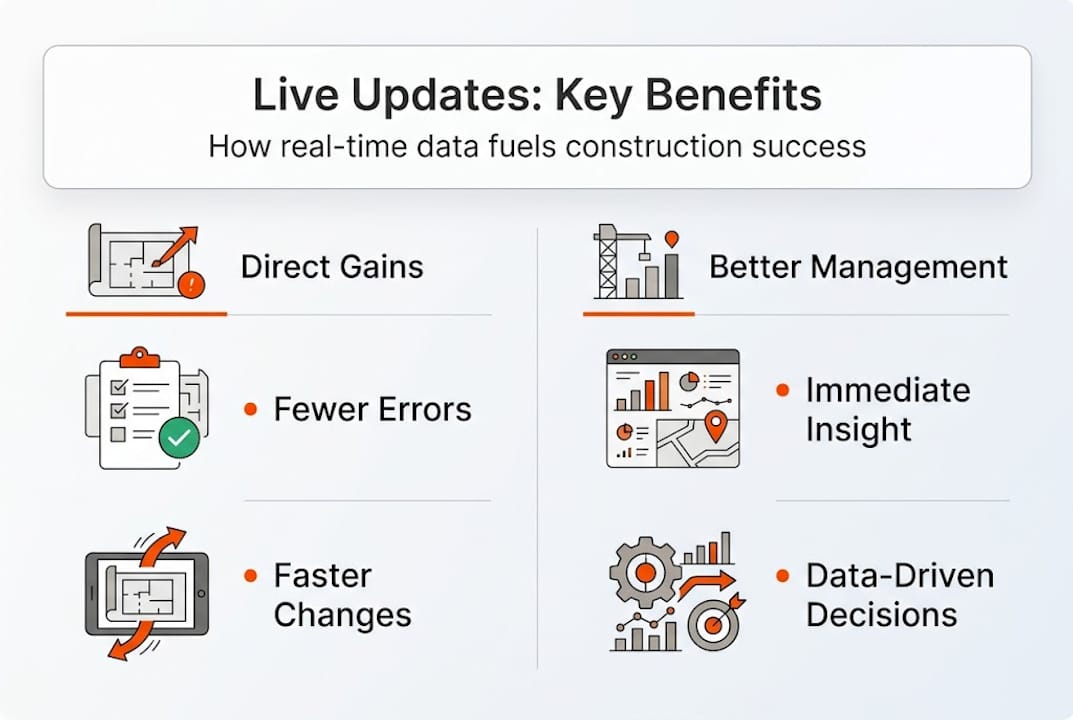
Here is how instant update benefits play out across a typical UK project:
| Area | Without real-time updates | With real-time updates |
|---|---|---|
| Issue discovery | End of day or next morning | Within minutes of occurrence |
| Schedule changes | Manual re-issue of programme | Automatic notification to all parties |
| Budget tracking | Weekly finance meetings | Live cost dashboards |
| Client communication | Formal weekly reports | On-demand access to project status |
| Rework rate | High, due to outdated instructions | Significantly reduced |
Key advantages for construction managers include:
- Faster decisions because information is not filtered through multiple handovers
- Fewer surprises for clients, which protects relationships and reduces disputes
- Lower risk of rework caused by teams working from stale data
- Greater accountability as every update is timestamped and attributed
Following UK project coordination best practices means integrating live data into your daily rhythm, not treating it as an add-on. Teams that improve construction communication consistently report fewer disputes and faster sign-offs.
Pro Tip: Pair your morning stand-up with a live digital dashboard review. Five minutes of shared visibility at the start of the day eliminates the need for multiple chaser calls throughout it.
Once the value of live updates is clear, we can examine the leading digital frameworks making this possible.
Frameworks and technologies enabling real-time updates
Knowing that real-time updates matter is one thing. Knowing which tools and frameworks to adopt is another. The construction industry now has several well-tested approaches, each suited to different project scales and complexity levels.
RealCONs is a structured framework that applies Rational Unified Process (RUP) and Unified Modelling Language (UML) to construction data flows. It automates daily report generation and validates data in real time. The results are significant: the RealCONs framework improves daily report generation by 32.2% and reduces reporting errors by 84%. For site managers drowning in manual paperwork, that is a transformative shift.
Digital twins take things further by integrating BIM, IoT sensors, and GIS data into a live 3D model of the site. Every physical change is reflected digitally in near real time. A digital twin case study showed a 28% time reduction when BIM and IoT monitoring were combined, driven by tighter production control and faster issue escalation.
The technological approaches available today span a wide range of budgets and technical requirements:
| Framework | Best suited for | Key benefit |
|---|---|---|
| RealCONs | Mid to large projects | Automated reporting, error reduction |
| Digital twins (BIM + IoT) | Complex, long-duration builds | Live 3D monitoring, predictive alerts |
| CLC Information Management | All UK project types | Standardised digital skills baseline |
| Cloud-based PM platforms | Small to enterprise teams | Centralised communication and updates |
Adopting a real-time framework does not need to be overwhelming. A practical sequence:
- Audit current tools and identify where information gaps occur most frequently
- Select a platform that fits your project scale and team’s digital confidence
- Train your team before go-live, not after problems emerge
- Define update protocols so everyone knows what to log, when, and how
- Review and iterate after the first month based on actual usage data
For teams focused on streamlining daily reporting, the right framework removes friction rather than adding it. A solid live monitoring guide can help you map the right approach to your site’s specific conditions.
With technologies mapped out, the next question is their measurable, on-the-ground impact and practical application.
Practical impacts: real-world gains and lessons from UK projects
Frameworks and platforms only matter if they deliver results on the ground. Across UK construction projects, the evidence is building steadily.
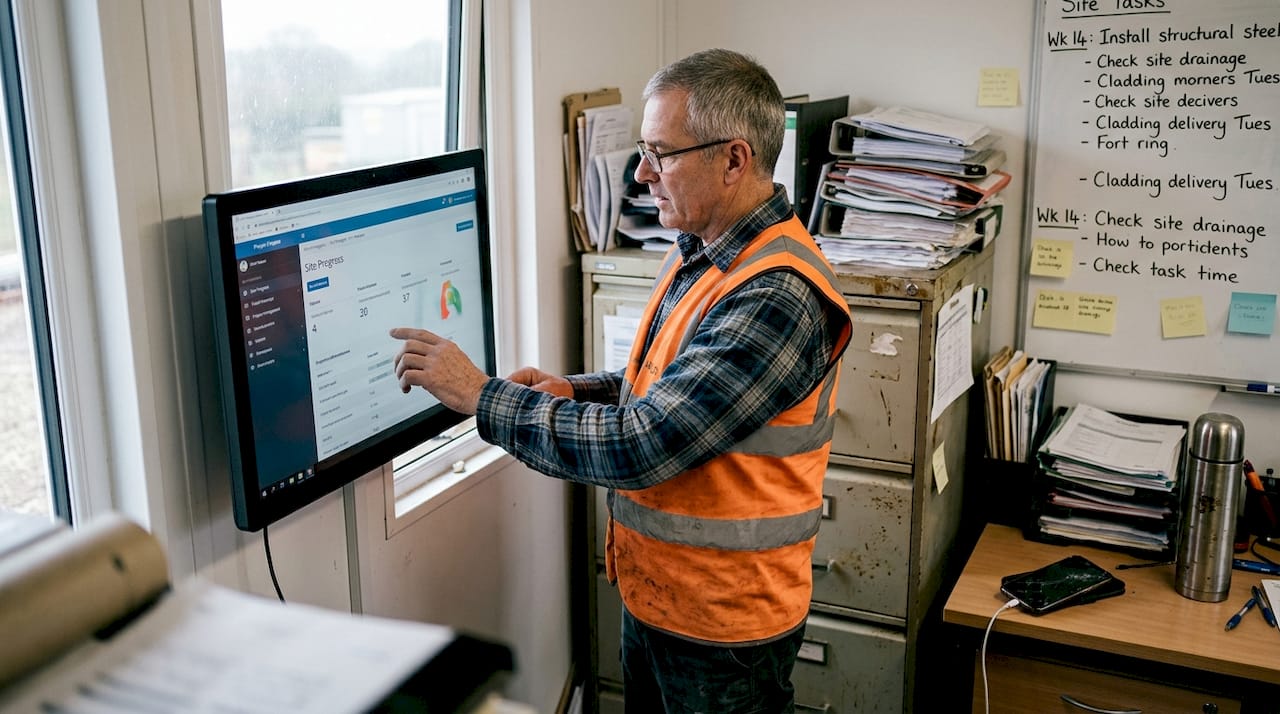
Lean techniques with real-time digital dashboards reduced excavation duration by 15% and total project time by 2.06% in documented case studies. Those numbers may sound modest, but on a £5 million project, a 2% time reduction represents significant savings in preliminaries, plant costs, and management overhead.
The practical gains reported across UK sites include:
- Faster issue escalation reducing average response time from hours to minutes
- Fewer RFIs because live data reduces ambiguity before it becomes a formal query
- Improved subcontractor coordination when all parties share the same live programme
- Stronger client confidence through on-demand access to project status rather than waiting for weekly reports
Pro Tip: Establish KPIs tied directly to update frequency. Track how often updates are logged per day per team, and correlate that with rework rates and programme slippage. The data will quickly show you where communication gaps are costing you most.
The most common pitfall is treating technology as a substitute for process change. Teams that adopt a live dashboard but continue to run their workflows the same way see limited gains. The platform surfaces information faster, but if no one has been assigned to act on it, the speed advantage disappears. Money-saving best practices consistently point to the combination of digital tools and clear accountability structures as the real driver of savings.
After seeing the real-world results, it is time to reflect on what most guides miss and what project managers must know to succeed.
A hard-won truth: why technology alone won’t fix communication gaps
Here is the uncomfortable reality that most technology vendors will not tell you: a real-time platform installed on top of a broken communication culture will simply surface your problems faster. It will not solve them.
The biggest mistake we see on UK sites is the “tech first, process later” approach. A new platform is rolled out, the team gets a brief walkthrough, and within three weeks half the team is back on WhatsApp and the other half is logging updates inconsistently. The data becomes unreliable, and the tool gets blamed.
The collaboration pitfalls that derail digital adoption are almost always cultural and procedural, not technical. The Construction Leadership Council’s emphasis on digital skills development alongside tool adoption is not a bureaucratic nicety. It is the difference between a platform that transforms your workflow and one that collects dust.
The highest-performing teams we work with share three habits: they define clear update ownership before launch, they tie platform use to existing accountability structures, and they treat actionable insight as the goal rather than data volume. More data is not better communication. Faster, clearer, accountable communication is.
Power your projects with real-time communication solutions
The research is clear and the frameworks are proven. Real-time updates reduce errors, shorten programmes, and protect margins. The next step is choosing a platform built specifically for construction teams rather than adapted from generic project management software.
 BRCKS.io">
BRCKS is designed for exactly this. BRCKS for builders brings live project updates, task management, file sharing, and team chat into a single platform that your whole team can use from day one, including subcontractors at no extra cost. Teams using BRCKS report saving over two hours daily by eliminating the back-and-forth that slows sites down. If you are ready to move from reactive to responsive site management, explore BRCKS construction communication software and start a free 14-day trial today.
Frequently asked questions
How do real-time updates reduce project delays on UK sites?
Real-time updates enable instant visibility of issues and changes, allowing project managers to make faster decisions and intervene before small problems become costly overruns.
What frameworks are most effective for live updates on construction projects?
Frameworks like RealCONs and digital twins combining BIM, IoT, and GIS automate data capture and reporting, delivering up-to-the-minute accuracy across all project stakeholders. Digital twin case studies show up to 28% faster project delivery when these approaches are applied.
Is technology alone enough to ensure effective communication?
No. Tools must be paired with defined processes, proper training, and a team culture that values accountability. The Construction Leadership Council consistently emphasises digital skills development alongside tool adoption for this reason.
What real evidence supports the impact of live updates?
UK case studies show 28% faster delivery with real-time monitoring and 84% fewer reporting errors using the RealCONs framework, alongside measurable reductions in rework and programme slippage across multiple project types.
Recommended
- Construction Project Management Insights | BRCKS Blog
- BRCKS | Construction Project Communication Software
- Construction Mobile Apps: Reduce Material Waste by 25% | BRCKS
- BRCKS | Construction Project Communication Software
How BRCKS Can Help
In an industry where delays can derail an entire project, the ability to act on live data is no longer a luxury but a fundamental requirement for growth. BRCKS bridges the gap between the site and the office by centralising communication and providing the instant visibility needed to keep every stakeholder aligned. By integrating these real-time insights into your daily workflow, you can mitigate risks before they escalate and ensure your projects remain on schedule and within budget. We invite you to discover how BRCKS can streamline your operations and help you build with greater confidence. Learn more at BRCKS and explore our full feature set.