Project updates explained for UK construction teams
Discover how structured project updates can enhance communication for UK construction teams, keeping programmes on track and avoiding costly disputes.
By James Shorter ·
Project updates explained for UK construction teams
TL;DR:
- Effective project updates focus on reporting what has changed, upcoming tasks, and responsible owners to maintain trust and programme control on UK construction sites.
- Consistency, brevity, and structured communication—using templates, real-time tools, and clear action ownership—are key to avoiding common failures and delays.
- Tools like Brcks facilitate clear, traceable updates by integrating with familiar platforms, fostering habits that prevent costly disputes and rework.
A project update is a structured communication that tells stakeholders what has changed since the last report, what is planned next, and what decisions or actions are required. On UK construction sites, where subcontractors, site managers, surveyors, and clients all operate on different schedules and with different information needs, the quality of project update communication directly determines whether a project runs to programme or descends into costly rework and disputes. Tools like Brcks, construction daily logs, and structured status reports each serve a distinct role in keeping teams aligned. The core principle behind any clear project updates guide is simple: say what changed, say what comes next, and say who owns what.
What are the essential components of a project update report?
A project update report is built around the “delta” principle. Effective progress summaries answer “what changed” since the last update rather than restating the full project status from scratch. This distinction matters enormously on a busy site: a reader scanning a 400-word activity log learns far less than one reading a 150-word delta summary with clear ownership on every action.
The core components of a meaningful update are:
- RAG status indicator. Red, Amber, or Green gives every reader an instant health signal before they read a single line of detail.
- Completed work. A brief, factual list of what was finished since the last update, referenced by location or trade where relevant.
- Upcoming tasks. What is planned for the next reporting period, with responsible parties named.
- Risks and blockers. Any issue that could affect programme, cost, or quality, with a named owner and a proposed resolution.
- Budget and resource snapshot. A one-line summary of spend against forecast, flagging any variance above an agreed threshold.
- Action items. Every action listed with a named owner and a due date. No anonymous actions.
Recommended summaries under 200 words improve mobile readability, which matters when your site manager is reading updates on a phone between trades. Keeping updates concise is not about cutting corners. It is about respecting the reader’s time and making it harder to miss critical information buried in prose.
Tiered update content combining an executive summary, a detailed delivery section, and an issue log reduces audience confusion and supports quicker stakeholder action. A client does not need the same depth as your groundworks subcontractor. Structuring updates in tiers means each audience reads only what is relevant to them.
Pro Tip: Frame every update around decisions needed, not just activities completed. If a reader finishes your update and does not know whether they need to do anything, the update has not done its job.
How often should you send project updates?
Frequency is not a matter of preference. It is a risk management decision. Construction status reporting commonly follows a tiered cadence: weekly written updates for the core delivery team, fortnightly or monthly steering reviews for executives and clients, and immediate escalation for critical issues regardless of the scheduled cycle.
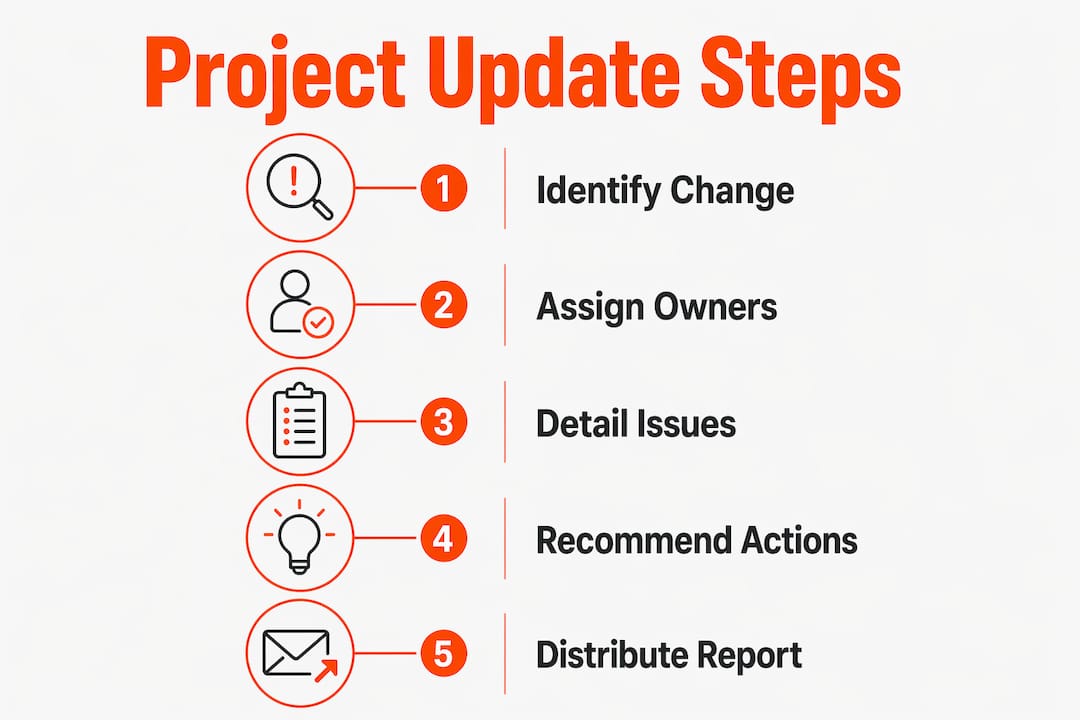
Getting this cadence right requires four practical steps:
- Map your stakeholders by information need. A site manager needs daily visibility on crew, weather, and deliveries. A client needs weekly progress against programme milestones. Conflating these audiences with a single update format wastes everyone’s time.
- Fix the day and time. Predictable timing builds trust and improves decision-making, particularly in steering meetings. When stakeholders know an update arrives every Monday at 08:00, they plan their week around it. Irregular updates create anxiety and prompt chasing calls.
- Increase frequency during high-risk phases. Groundworks, structural frame, and pre-handover snagging are phases where conditions change rapidly. Daily written updates during these windows prevent small problems from becoming programme-critical ones.
- Reduce frequency in stable periods without losing the thread. A project in a steady fit-out phase may only need fortnightly written updates, but the communication channel must remain open and the format consistent.
For critical issues, the situation, impact, options, and recommendation framework is the most reliable escalation structure in UK construction. You state the situation factually, describe the impact on programme or cost, present realistic options, and make a clear recommendation. This gives decision-makers everything they need without forcing them to ask follow-up questions.
Pro Tip: Tailor the depth and frequency of updates to the audience, not to your own comfort level. Sending weekly detailed reports to a client who only needs a monthly summary trains them to stop reading.
Which format works best for construction project updates?
No single format suits every situation. The right choice depends on the audience, the project phase, and the urgency of the information. The table below compares the most common formats used on UK construction projects.
| Format | Pros | Cons | Best use case |
|---|---|---|---|
| Written status report | Structured, searchable, auditable | Time-consuming to produce | Weekly core team and client updates |
| Dashboard (digital PM tool) | Real-time, visual, low effort to update | Requires all parties to log in | Ongoing programme monitoring |
| Construction daily log | Legally defensible, detailed | High volume, not strategic | Site-level record keeping |
| Presentation slides | Clear for steering meetings | Static, quickly outdated | Monthly executive reviews |
| WhatsApp-native tools (e.g. Brcks) | Fast, familiar, mobile-first | Needs structure to avoid chat chaos | On-site team communication |
The construction daily report deserves particular attention. Daily reports must include arrival and departure times, weather conditions, crew workforce numbers, equipment on site, work completed by location, deliveries received, and open actions. Missing any of these fields creates gaps that become significant during claims or disputes months later.
A daily report functions as the factual memory of the project, and it must be treated as a defensible evidence trail. Entries anchored by time, measurable quantities, geotagged photos, and a named, accountable author carry far more weight in a dispute than a narrative summary written from memory at the end of the week.
An organised project repository with consistent naming conventions and version control means information is retrievable when it is needed, not just when it was filed. On a two-year residential development, a poorly named folder structure can cost a surveyor hours of retrieval time during a final account dispute. The benefits of digital communication platforms in construction include centralised storage that removes this problem entirely.
Pro Tip: For site teams already working in WhatsApp, Brcks adds structure to those conversations without forcing a platform change. Updates, photos, and decisions stay in one place and are searchable.
What are the most common project update mistakes?
The most common reason project updates fail is that they do not communicate what changed or what the reader should do next. They read as activity logs rather than decision-support documents. This is a structural problem, not a writing problem, and it is fixed by using a consistent template.
The specific pitfalls that cause the most damage on UK construction sites are:
- Generic updates. “Work continues on schedule” tells a client nothing. It erodes trust rather than building it, because it signals the author is not engaging with the detail.
- Inconsistent scheduling. Missed updates create a vacuum that stakeholders fill with assumptions. Missed updates erode trust and increase project risk. One missed weekly report is an inconvenience. Three in a row is a governance failure.
- Delayed bad news. Escalating issues early with realistic options builds more trust than waiting for a full solution. On a compressed construction programme, a two-week delay in reporting a groundworks problem can eliminate the options available to the project manager.
- Anonymous actions. An action without a named owner is not an action. It is a wish. Every item in an update must have a person responsible and a date.
- No communication plan. A communication plan acts as the execution roadmap for all project communications, including monitoring whether updates are actually meeting stakeholder needs. Without one, teams default to ad hoc updates that vary in quality and frequency.
“Delivering bad news early, honestly, and with options builds more trust than delaying until a full solution is available, especially on construction projects with compressed timelines.”
The impact of poor communication on UK construction sites is measurable in rework costs, programme delays, and strained client relationships. The fix is not more communication. It is better-structured communication delivered on a predictable schedule.
Key takeaways
Effective project updates are structured, delta-based communications that report what changed, who owns each action, and what decisions are needed. They are the single most reliable tool for maintaining trust and programme control on UK construction sites.
| Point | Details |
|---|---|
| Use the delta approach | Report what changed since the last update, not the full project status from scratch. |
| Keep updates under 200 words | Short, mobile-readable updates with RAG status and bullet points improve stakeholder response rates. |
| Fix your cadence | Weekly for core teams, fortnightly or monthly for executives, and immediate escalation for critical issues. |
| Treat daily logs as evidence | Construction daily reports must be time-anchored, signed, and include geotagged photos to hold up in disputes. |
| Name every action owner | An action without a named person and due date will not be completed. |
Why I think most construction teams are one template away from better updates
I have reviewed communication records on dozens of UK construction projects, and the pattern is almost always the same. The teams with the fewest disputes and the smoothest handovers are not the ones with the most sophisticated software. They are the ones with the most consistent habits. A simple weekly update template, sent at the same time every week, with a RAG status and named action owners, outperforms a beautifully designed dashboard that nobody fills in reliably.
The cultural dimension matters too. On many UK sites, there is a reluctance to report problems early because it feels like admitting failure. The reality is the opposite. A site manager who flags a potential delay three weeks before it becomes critical is giving the project team options. One who waits until the delay is confirmed has removed them. The construction communication problems that cause the most damage are almost always ones that could have been surfaced earlier.
Technology like Brcks genuinely helps here, not because it automates the thinking, but because it removes the friction. When updates, photos, and decisions live in one place that the whole team already uses, the barrier to sending a timely update drops significantly. The teams I have seen adopt a WhatsApp-native tool for structured updates report that the consistency of their communication improves almost immediately, simply because the tool is already open on everyone’s phone.
The best advice I can give is to treat your communication plan as a living document. Review it at each project phase gate. Ask your stakeholders whether they are getting what they need. Adjust the format and frequency based on feedback. The goal is not perfect updates. It is updates that are good enough, often enough, to keep everyone aligned.
— James
How Brcks helps construction teams send clearer updates
Keeping every stakeholder informed without drowning your team in admin is exactly the problem Brcks was built to solve. As a construction communication tool designed specifically for UK builders, Brcks integrates with WhatsApp so your team does not need to learn a new platform. Structured project updates, photo sharing, decision tracking, and client-facing portals all sit within a single environment that works on any device, on any site.
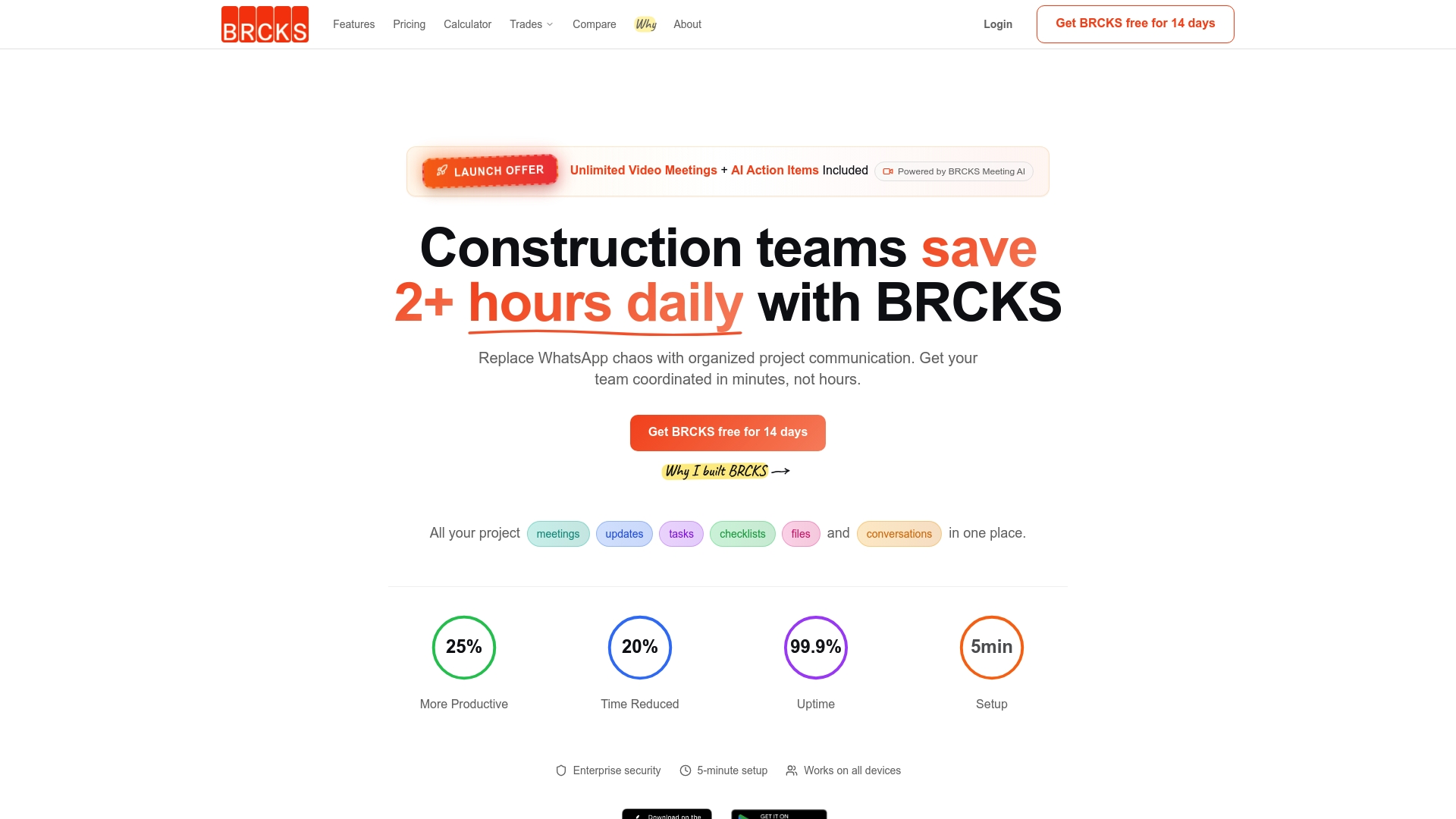
For site managers and project managers who need updates to be consistent, traceable, and accessible, Brcks removes the manual effort that makes good communication habits hard to sustain. The platform saves teams over two hours daily by consolidating the tools that currently sit across email, WhatsApp, and spreadsheets. If you are ready to bring structure to your construction project updates, Brcks offers a 14-day free trial with no setup complexity.
FAQ
What is a project update in construction?
A project update is a structured communication that reports recent progress, upcoming tasks, risks, and required actions to keep the delivery team and stakeholders aligned. It focuses on what has changed since the last report rather than restating the full project status.
How long should a construction project update be?
Updates for core teams and clients should be under 200 words for mobile readability, using a RAG status indicator and bullet points. Daily site logs are longer by necessity, as they must capture crew, weather, deliveries, and incidents in full.
How often should project updates be sent?
Weekly written updates suit core delivery teams, while fortnightly or monthly reviews work for executives and clients. Critical issues should be escalated immediately using a situation, impact, options, and recommendation structure, regardless of the regular schedule.
Why do project updates fail?
Updates fail when they report activity rather than change, omit named action owners, or are sent inconsistently. Generic updates and delayed bad news are the two most damaging habits on UK construction projects.
What must a construction daily report include?
A construction daily report must include arrival and departure times, weather conditions, crew numbers, equipment on site, work completed by location, deliveries received, and open actions. It should be signed by a named author and include geotagged photos to serve as defensible evidence in any future dispute.
Recommended
- Real-Time Updates in Construction: Boosting Project Success | BRCKS
- UK Construction Project Management Terminology Guide | BRCKS
- Top Construction Schedule Software for UK Builders 2025 | BRCKS
- Top Construction Reporting Tools for UK Sites Compared | BRCKS
How BRCKS Can Help
Effective project updates are the backbone of any successful build, ensuring that every stakeholder remains aligned and informed from start to finish. By centralising your site data and automating reporting, BRCKS simplifies this process, removing the administrative burden from your site teams while maintaining complete transparency. Our platform is designed specifically to help UK construction firms bridge the communication gap and keep projects moving forward without the usual paperwork headaches. We invite you to see how BRCKS can transform your project management by booking a demo or exploring our features today. Learn more at BRCKS and explore our full feature set.