Improving workflow for electricians: 2026 guide
Discover how electrical contractors can recover lost revenue and eliminate administrative bottlenecks using phased automation and digital tools.
By James Shorter ·
Improving workflow for electricians: 2026 guide

TL;DR:
- Improving electrical workflows involves identifying and fixing repetitive administrative bottlenecks to recover lost revenue and increase efficiency.
- Implementing phased automation for tasks like dispatch, change orders, and permit tracking enhances reliability without replacing skilled electrician work.
Improving workflow for electricians is defined as the systematic process of identifying, documenting, and fixing the administrative and operational bottlenecks that cost electrical businesses time and money on every job. In the electrical trade, this is often called operational process optimisation, and the gap between shops that practise it and those that do not is significant. 32% of total project revenue is lost as unbilled change orders in electrical contracting alone. Tools like Tradify, AI workflow agents from OpenClaw, and project communication platforms like BRCKS are now making it practical for electricians to recover that revenue without adding headcount.
What are the main workflow bottlenecks electricians face?
Most workflow problems in electrical contracting are not technical. They are administrative, and they repeat on every job. The first step to fixing them is knowing exactly where the leaks are.
The most common bottlenecks fall into four categories:
- Change order capture. Work gets done on site, but the paperwork does not follow. Verbal approvals are forgotten, and the invoice goes out without the extras. This is the single largest source of lost revenue in the trade.
- After-hours dispatch. Emergency calls arrive outside office hours, get missed or mishandled, and the job goes to a competitor. Without an automated triage system, every missed call is a missed contract.
- Permit tracking. Chasing permit status manually across multiple jobs creates scheduling delays and compliance risk. One permit held up can stall an entire crew.
- Bid takeoff delays. Estimators spending four or five days on a single commercial bid cannot scale. AI bid takeoff reduces that from five days to four hours on standard commercial projects, tripling bid throughput and improving accuracy.
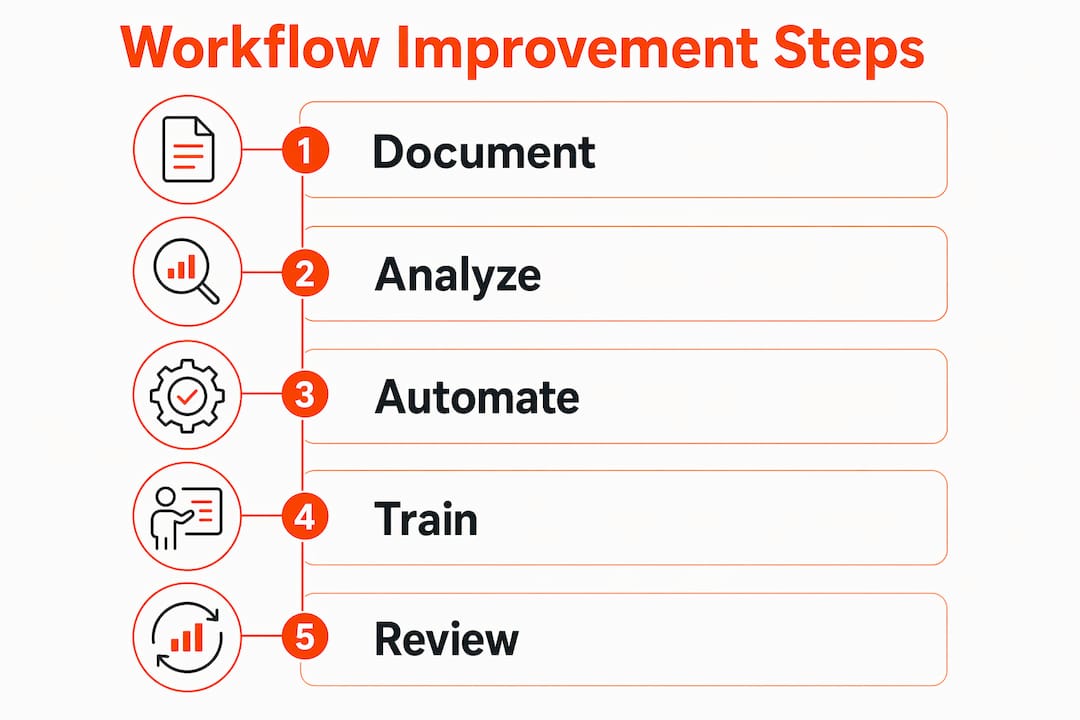
Before you change anything, document what you currently do. Walk through a typical job from first enquiry to final invoice and write down every step, every handoff, and every tool involved. Digitising a broken process only replicates the inefficiency at higher speed.
Pro Tip: Map your last five jobs on a single sheet of paper. Mark every point where information was delayed, lost, or had to be chased. Those marks are your workflow priorities.
How can workflow automation improve admin without affecting skilled work?
Workflow automation should focus on administrative tasks such as scheduling and permit tracking, not on automating skilled electrical installation. This distinction matters. Automation is not a replacement for the judgement and expertise of a qualified electrician. It is a way to remove the administrative noise that surrounds that expertise.
Here is what automation handles well for electrical businesses:
- Crew scheduling. Automated scheduling tools match available engineers to jobs based on location, certification, and availability, reducing the back-and-forth that typically costs a dispatcher an hour or more each morning.
- Material ordering. Trigger-based ordering systems flag when stock falls below threshold and raise purchase requests automatically, cutting the reactive scramble that delays jobs.
- Permit application tracking. Automated permit workflows monitor permit status continuously and notify teams only when manual intervention is required. This removes the daily status-checking that adds no value.
- Customer updates. Automated SMS or email notifications keep clients informed at key milestones without requiring a phone call from the site manager.
The result is a measurable reduction in admin time, fewer scheduling conflicts, and a crew that arrives on site with the right materials and the right paperwork. The electrician’s skilled work remains entirely human. The system around it becomes far more reliable.
What software tools and AI agents are available for electricians?

The market for electrician workflow software has matured considerably in 2026. The most effective approach is not to find one all-in-one platform, but to deploy specialised AI agents plugged into your existing estimating and job management stack. Each agent targets a specific bottleneck rather than attempting to replace your entire operation.
| Tool | Primary function | Best for | Approximate cost |
|---|---|---|---|
| Tradify | Job management, invoicing, scheduling | Small to mid-size UK electrical firms | £34/month |
| OpenClaw | AI agents for change orders, dispatch, NEC permit tracking | Mid-size shops with 4+ vehicles | $12,000–$22,000 setup |
| BRCKS | WhatsApp-integrated communication, site diaries, variation logs | UK electrical contractors on active sites | Free 14-day trial |
Tradify is worth examining closely for UK electricians. Saving roughly 37 minutes of admin time weekly covers the full cost of the software at £34 per month for an electrician charging £55 per hour. That is a low bar to clear, and most users report saving considerably more than that.
OpenClaw operates differently. It provides AI workflow agents for specific tasks: quote follow-up on higher-value jobs, emergency dispatch handling, and NEC permit tracking. Implementing these agents costs between $12,000 and $22,000 for an eight-truck shop, but the typical payback period is 30 to 90 days. That return is driven primarily by recovering unbilled change orders and capturing emergency jobs that would otherwise be lost.
Pro Tip: Start with quote follow-up automation on your three highest-value job types. This delivers the fastest payback and builds confidence in the technology before you expand to other workflows.
How to implement improved workflow for electricians step by step
The most common reason workflow improvement projects fail is that businesses try to change everything at once. A phased approach, starting with the highest-impact bottleneck and moving methodically through the others, produces far better results.
Phased rollout starting with emergency dispatch, then change order capture, then bid takeoff, and finally compliance tracking yields the best adoption outcomes. Here is how to structure that in practice:
- Document your current workflow. Before touching any software, map every process from enquiry to invoice. Identify the three points where time or money is most consistently lost.
- Pilot emergency dispatch automation. This is the highest-urgency bottleneck. Set up an automated triage system for after-hours calls. Test it for four weeks and measure how many jobs are captured versus the previous period.
- Implement change order capture. Introduce a digital change order process on site. Every verbal approval gets logged immediately via a mobile form or WhatsApp message captured by your project management tool.
- Accelerate bid takeoff. Once your operational workflows are stable, introduce AI-assisted estimating. Feed it your real shop labour data rather than generic industry figures to improve bid accuracy from the first use.
- Automate compliance tracking. Add permit status monitoring as the final phase. By this point, your team is comfortable with digital processes and adoption is straightforward.
| Implementation phase | Focus area | Expected impact |
|---|---|---|
| Phase 1 | Emergency dispatch | Fewer missed jobs, faster response |
| Phase 2 | Change order capture | Reduced unbilled work, higher invoice accuracy |
| Phase 3 | Bid takeoff | Faster estimates, higher bid volume |
| Phase 4 | Compliance tracking | Fewer permit delays, reduced scheduling risk |
Train your team at each phase before moving to the next. Resistance to new tools is almost always a training problem, not a technology problem. Give people time to build confidence with one system before adding another.
Common mistakes to avoid when improving electrical workflow
Most workflow improvement efforts stall not because the technology is wrong, but because the implementation approach is. Knowing the common failure points in advance saves considerable time and money.
- Skipping process documentation. Buying software before mappingyour current workflow is the most expensive mistake in this space. Digitising a broken process only replicates inefficiency at higher speed. Always document first.
- Implementing too many changes at once. Introducing scheduling software, a new invoicing system, and AI agents simultaneously overwhelms teams and makes it impossible to identify what is working.
- Ignoring offline capability. Software without offline modes creates serious problems for electrical teams working in basements, rural areas, or locations with poor connectivity. Check this before committing to any tool.
- Treating AI as an all-in-one fix. AI is most effective as a set of targeted agents addressing specific bottlenecks, not as a replacement for your entire operation. Expecting one tool to solve every problem leads to disappointment and wasted investment.
Pro Tip: Before signing any software contract, ask the vendor specifically about offline functionality and how the tool handles change order capture on site. These two features separate genuinely useful tools from ones that look good in a demo.
Key takeaways
Improving electrician workflow delivers the highest return when you fix specific revenue leakage points first, automate administrative tasks in phases, and document processes before introducing any software.
| Point | Details |
|---|---|
| Fix revenue leaks first | Unbilled change orders account for 32% of lost project revenue; capture them digitally on site. |
| Automate admin, not skilled work | Use automation for scheduling, permit tracking, and customer updates to free up technical time. |
| Phase your implementation | Start with emergency dispatch, then change orders, then bid takeoff, then compliance tracking. |
| Check offline capability | Any tool used on site must function without a reliable internet connection. |
| Document before you digitise | Map your current workflow before buying software to avoid replicating existing inefficiencies. |
Why I think most electricians are solving the wrong problem
I have spent a long time watching electrical businesses invest in software and see little change in their actual results. The pattern is almost always the same: the business buys a tool, the team uses it inconsistently, and within six months everyone is back to WhatsApp messages and spreadsheets.
The issue is not the software. It is that most electricians are trying to improve individual productivity rather than system-wide workflow. Training one estimator to work faster does not fix a broken change order process. Buying a scheduling app does not help if the dispatch system is still handled by whoever picks up the phone first.
The shops I have seen make genuine, lasting improvements all started in the same place: they drew out their current workflow on paper before touching any technology. They found the two or three points where jobs consistently went wrong, and they fixed those first. Everything else followed from that.
The technology available in 2026 is genuinely good. Tradify, OpenClaw, and BRCKS each solve real problems for electrical businesses. But none of them work as a substitute for process thinking. They work as amplifiers of a process that already makes sense. Get the process right first, then let the tools do their job.
— James
How BRCKS helps electricians work more efficiently
BRCKS is built for construction professionals who need their communications, site records, and project updates to stay connected without adding more admin to the day.

For electricians, BRCKS captures WhatsApp messages and site updates in real time, turning them into structured site diaries, variation logs, and RFI records automatically. That means change orders get documented the moment they happen, not reconstructed at the end of the week. The client portal keeps customers informed without interrupting your crew. BRCKS saves users over two hours of manual effort daily, and the 14-day free trial requires no commitment. If you are looking for construction software for electricians that fits how your team already communicates, BRCKS is worth exploring today.
FAQ
What is the biggest workflow problem for electricians?
Unbilled change orders are the most costly workflow problem in electrical contracting, with research indicating they account for 32% of total project revenue lost. Capturing change orders digitally on site is the single highest-impact fix available.
How much admin time does workflow software save electricians?
Saving roughly 37 minutes of admin time per week covers the full monthly cost of tools like Tradify at £34 per month for an electrician charging £55 per hour. Most users report saving significantly more once the tool is fully adopted.
Does workflow automation replace electricians’ skilled work?
No. Workflow automation targets administrative tasks such as scheduling, permit tracking, and customer communications. Skilled electrical installation and technical judgement remain entirely human responsibilities.
What is the best order to implement workflow improvements?
A phased approach works best: start with emergency dispatch automation, then move to change order capture, followed by bid takeoff acceleration, and finish with compliance and permit tracking.
Do electrician workflow tools work without internet access?
Not all of them. Offline capability is a critical requirement for electrical teams working in basements, rural sites, or areas with poor connectivity. Always confirm offline functionality before committing to any software.
Recommended
- Construction Software for Electricians | BRCKS
- Plumber Job Scheduling Guide: Boost Site Efficiency
- BRCKS | Construction Project Communication Software
- Streamline Plumbing Project Workflows | BRCKS | BRCKS
How BRCKS Can Help
Optimising your electrical workflows is essential for staying competitive as the industry evolves towards 2026. By integrating BRCKS into your daily operations, you can eliminate administrative bottlenecks and ensure your site teams remain connected through real-time data. Our platform is purpose-built to simplify project management, allowing you to focus on high-quality installations rather than paperwork. We invite you to discover how BRCKS can transform your efficiency by exploring our features today. Learn more at BRCKS and explore our full feature set.