Construction productivity checklist 2026: key tools and practices
Discover how to evaluate and select the right digital tools to boost efficiency on UK residential projects with our comprehensive 2026 productivity checklist.
By James Shorter ·
Construction productivity checklist 2026: key tools and practices

Selecting the right productivity tools for your construction team shouldn’t feel like guesswork. Research shows firm size doesn’t determine success, yet many managers still chase the wrong solutions. This checklist cuts through the noise by focusing on what actually works: integration, digital collaboration, and workforce training. You’ll learn how to evaluate tools against proven criteria, compare practical options, and make informed decisions that boost your team’s efficiency on UK residential projects in 2026.
Table of Contents
- Defining Criteria For Construction Productivity Tools
- Key Tools And Practices To Boost Construction Productivity
- Comparing Productivity Tools: A Checklist Summary
- Making The Right Productivity Decisions In UK Residential Construction
- Explore Construction Productivity Software By BRCKS
Key takeaways
| Point | Details |
|---|---|
| Firm size myth | Larger firms don’t automatically achieve higher productivity in construction projects. |
| Integration wins | Greater internal integration consistently outperforms heavy subcontracting for productivity gains. |
| Digital tools matter | Collaboration software and workforce training reduce errors and streamline communication effectively. |
| Checklist approach | Structured evaluation criteria help managers select tools that genuinely fit their team’s needs. |
Defining criteria for construction productivity tools
Before investing in any productivity solution, you need clear evaluation criteria. The construction industry has long assumed bigger firms perform better, but UCL research highlights integration over fragmentation as the real productivity driver. Your checklist should prioritise how well a tool supports internal coordination rather than simply managing external relationships.
Start by assessing the balance between integration and subcontracting. Tools that enhance internal workflows and reduce handoff complexity deliver measurable gains. Look for platforms that centralise communication rather than add another app to your existing stack. Your team already juggles enough systems.
Digital collaboration features form the second critical criterion. Evaluate whether a tool offers real-time updates, task visibility, and seamless file sharing. Construction projects generate massive information flows, and productivity suffers when data sits in silos. The best solutions make information instantly accessible to everyone who needs it, from site managers to subcontractors.
Workforce training and adoption ease matter just as much as features. A sophisticated platform means nothing if your team won’t use it. Prioritise tools with intuitive interfaces and quick setup times. Five minutes to get started beats five hours of training videos. Consider whether the vendor offers proper onboarding support and whether the learning curve fits your team’s technical comfort level.
Data sharing efficiency and error reduction potential complete your evaluation framework. Tools should actively prevent miscommunication, not just document it after the fact. Look for features like automated action items, centralised project feeds, and version control that eliminate the rework caused by outdated information. These capabilities directly translate to time saved and costly mistakes avoided.
Pro Tip: Test any tool with a small pilot team before rolling it out across projects. Real world usage reveals friction points that demos never show.
Your criteria checklist should include:
- Integration capabilities that reduce external dependencies
- Centralised communication replacing fragmented channels
- Intuitive design requiring minimal training investment
- Real-time data sharing that prevents information lag
- Error prevention features that catch issues early
Explore additional construction project management insights to refine your evaluation process further.
Key tools and practices to boost construction productivity
Once you’ve established your criteria, specific tools and practices emerge as clear winners. integrated communication software sits at the top of the list. Platforms that consolidate WhatsApp chats, emails, and project updates into a single feed eliminate the constant context switching that drains productivity. Practitioner guides stress digital tools and training to enhance productivity, and the evidence supports this focus.
Workflow management tools provide the second major productivity boost. These platforms handle task sequencing, deadline tracking, and resource allocation in ways spreadsheets simply can’t match. When everyone sees what needs doing and when, projects move faster. Dependencies become visible, bottlenecks get addressed proactively, and teams stop waiting for information.

Training programmes deserve equal investment alongside technology. Your team needs skills to maximise any tool’s potential. Structured onboarding ensures consistent adoption, while ongoing training keeps everyone current as features evolve. The productivity gains from proper training often exceed the software’s direct benefits. A construction communication workflow case study demonstrates how combining tools with training cuts rework dramatically.
Reducing excessive subcontracting represents a practice shift rather than a tool purchase, but it matters enormously. Research consistently shows that firms maintaining higher internal asset proportions and doing more work in-house achieve better productivity outcomes. This doesn’t mean eliminating subcontractors entirely, but rather being strategic about what you outsource and how you manage those relationships.
Pro Tip: Map your current communication flows before selecting tools. You’ll spot redundancies and gaps that inform which features you actually need.
Practical tools worth evaluating include:
- All-in-one communication platforms replacing multiple apps
- Task management systems with mobile accessibility
- Video meeting tools with automated action item generation
- Document sharing with version control and permissions
- Training resources integrated into your workflow
Review this construction workflow management guide for deeper implementation strategies.
Comparing productivity tools: a checklist summary
A structured comparison helps you weigh options against your specific project needs. The table below summarises how different approaches stack up across key productivity dimensions.
| Approach | Key Benefits | Potential Drawbacks | Best For |
|---|---|---|---|
| Integrated communication platform | Centralises all project information, reduces app switching, saves 2+ hours daily | Requires team buy-in and initial setup investment | Teams managing multiple concurrent projects |
| Workflow management software | Improves task visibility, prevents bottlenecks, tracks dependencies | Can feel rigid for highly variable project types | Projects with complex sequencing requirements |
| Enhanced internal capacity | Higher asset proportion correlates with productivity gains | Requires capital investment and workforce development | Firms ready to reduce subcontracting reliance |
| Subcontractor management tools | Streamlines external coordination, tracks compliance | Doesn’t address internal communication gaps | Projects heavily dependent on specialist trades |
Integrated platforms deliver the broadest impact because they address the root cause of most productivity losses: fragmented information. When project updates, files, and conversations live in one place, your team stops wasting time hunting for details. The upfront effort of migrating to a unified system pays back quickly through reduced rework and faster decision making.
Workflow tools excel when project complexity demands strict coordination. They make invisible dependencies visible and help you sequence work logically. However, they work best alongside strong communication platforms rather than as standalone solutions. The combination creates a productivity multiplier effect.
Building internal capacity represents a longer term strategy with substantial payoff. Firms that maintain their own skilled workforce and equipment achieve consistently better productivity than those outsourcing most work. This approach requires investment but builds competitive advantage. Learn more about managing subcontractors when you do need external support.
Evaluate which combination suits your situation:
- Small teams benefit most from simple, integrated communication tools
- Medium-sized firms gain from combining communication with workflow management
- Growing businesses should consider capacity building alongside digital tools
Explore construction software for builders to see how integrated solutions address multiple needs simultaneously.
Making the right productivity decisions in UK residential construction
Your final decisions should align tool selection with your team’s actual constraints and opportunities. Start by abandoning the assumption that larger operations automatically perform better. No size-productivity link challenges the ‘bigger is better’ myth that drives many misguided investments. Focus instead on how well you integrate work internally, regardless of your firm’s size.
Prioritise integration and digital collaboration over adding more specialised point solutions. Each additional app creates friction. Your ideal state involves fewer, more capable platforms that handle multiple functions well. This consolidation reduces training burden, simplifies workflows, and eliminates data synchronisation headaches.
Invest meaningfully in team training alongside any new tools. Budget time and resources for proper onboarding, not just software licences. The productivity gains materialise when your team actually uses features effectively, which requires more than a quick demo. Consider appointing internal champions who can support colleagues and share best practices.
Monitor your subcontractor involvement carefully. Track what percentage of work you’re outsourcing and whether that proportion serves your productivity goals. Sometimes bringing capabilities in-house makes strategic sense, even if it requires initial investment. Other times, specialist subcontractors deliver value you can’t replicate internally. The key is making conscious choices rather than defaulting to outsourcing.
Pro Tip: Review your productivity metrics quarterly. Track time saved, rework reduced, and communication efficiency to validate your tool choices and identify adjustment opportunities.
Follow this decision framework:
- Audit your current communication and workflow pain points honestly
- Define must-have features based on your specific project types
- Test shortlisted tools with pilot teams before full commitment
- Plan comprehensive training that extends beyond initial rollout
- Measure actual productivity impact and iterate your approach
Check out software for builders and this construction project management money saving guide for additional implementation guidance.
Explore construction productivity software by BRCKS
Now that you understand what makes productivity tools effective, consider how BRCKS addresses these criteria specifically for UK residential construction. The platform consolidates communication, project management, and collaboration into one intuitive system that your team can start using in five minutes.
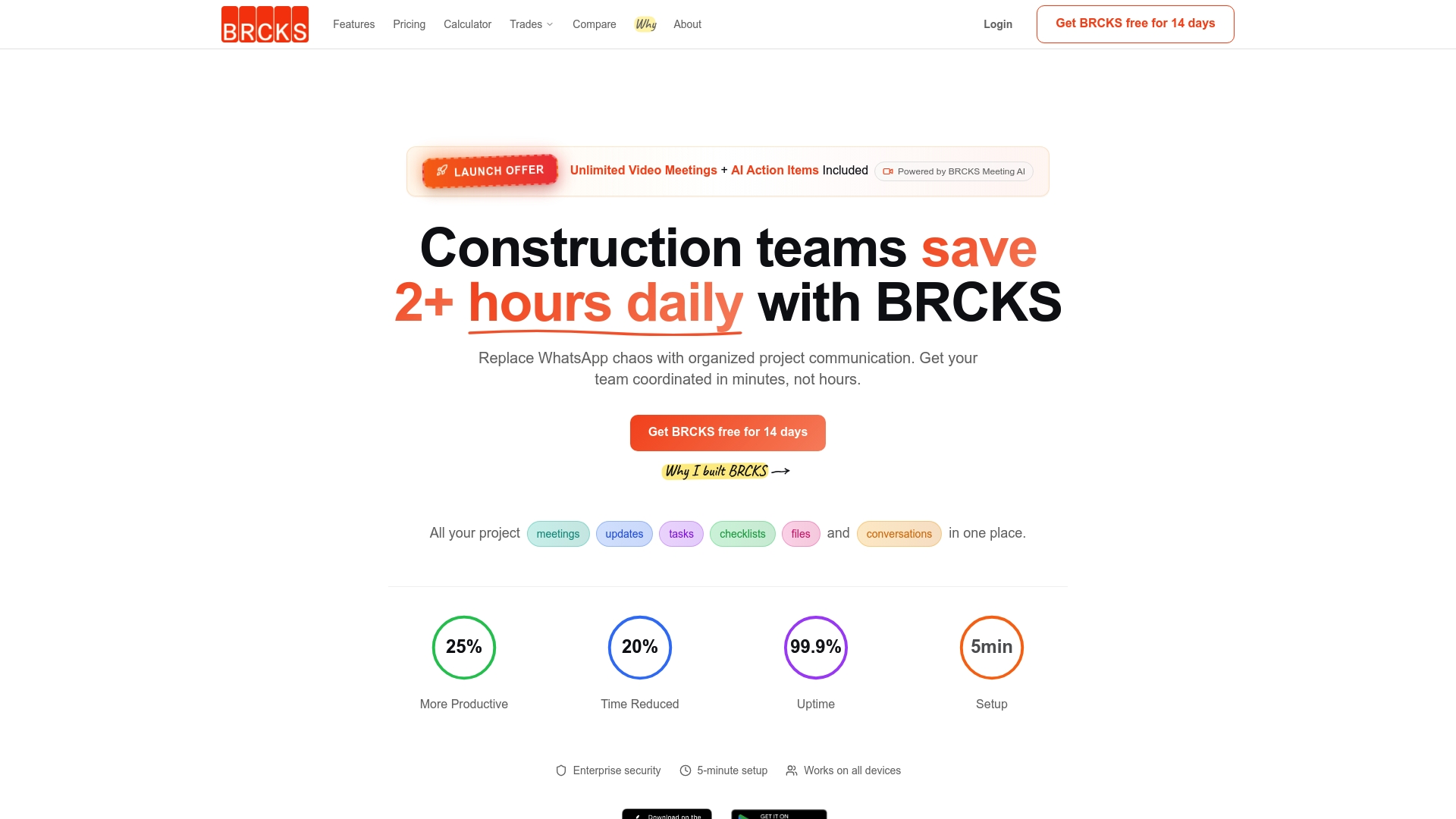
BRCKS replaces the chaos of WhatsApp groups, scattered emails, and multiple apps with a centralised hub. You’ll save over two hours daily through features like unlimited video meetings with AI-generated action items, unified project feeds, and mobile apps that work seamlessly on-site and in the office. The platform is designed for construction professionals who need powerful functionality without complex setup.
Explore construction software for builders, review options for construction software for plumbers, or learn more about the complete BRCKS construction project communication software platform. A 14-day free trial lets you test the system with your actual projects before committing.
What is the most important factor for construction productivity in 2026?
Integration and effective communication consistently emerge as the top productivity factors for UK residential construction. Research demonstrates that how well you coordinate internal work matters far more than your firm’s size or the sophistication of individual tools. Teams that centralise project information and reduce communication fragmentation see measurable efficiency gains. Focus on platforms that bring scattered conversations, files, and tasks into one accessible location rather than adding more specialised apps to your stack.
How does subcontracting affect productivity in UK residential projects?
High asset ownership and internal work integration improve productivity more reliably than heavy subcontracting. Firms that maintain their own skilled workforce and equipment achieve better coordination and fewer handoff delays. This doesn’t mean eliminating subcontractors entirely, but rather being strategic about what you outsource. When you do use subcontractors, manage those relationships carefully with clear communication channels and defined responsibilities. Learn practical strategies for managing subcontractors effectively.
What role do digital tools play in boosting construction productivity?
Digital tools and training enhance team efficiency and reduce errors by streamlining communication and making project information instantly accessible. Platforms that centralise updates, automate action items, and provide real-time task visibility prevent the rework caused by outdated information or miscommunication. However, tools only deliver results when your team actually adopts them, which requires intuitive design and proper training. Review this construction communication workflow case study to see quantified productivity improvements from the right digital approach.
How can I decide which productivity tools suit my team?
Assess your team size, integration needs, and training capacity before evaluating specific tools. Small teams benefit most from simple, all-in-one platforms that reduce app switching, while larger operations might need more sophisticated workflow management alongside communication tools. Use structured checklists to evaluate whether a platform offers the features you actually need, not just impressive capabilities you’ll never use. Test shortlisted options with pilot teams to reveal real-world friction points that demos don’t show. This construction workflow management guide provides additional evaluation frameworks.
Recommended
- BRCKS | Construction Project Communication Software
- BRCKS | Construction Project Communication Software
- Construction Project Management Insights | BRCKS Blog
- BRCKS | Construction Project Communication Software
- Project Management Checklist Template for Success – Optio Station: Best Project Management App for Prioritisation
How BRCKS Can Help
Improving construction productivity in 2026 requires a proactive approach to adopting modern workflows and integrated digital tools. BRCKS simplifies this transition by centralising your project data and streamlining communication, ensuring your team remains focused on delivery rather than administrative delays. By implementing these key practices through our intuitive platform, you can eliminate inefficiencies and drive better margins across every site. We invite you to discover how BRCKS can transform your operational output by exploring our features today. Learn more at BRCKS.