Construction Communication Workflow Cuts Rework by 52% UK 2026
Discover a proven construction communication workflow designed for UK project managers to eliminate fragmented messaging and reduce expensive rework by over 50%.
By James Shorter ·
Construction Communication Workflow Cuts Rework by 52% UK 2026

Fragmented communication across WhatsApp groups, emails, and disconnected apps costs UK residential construction teams over two hours daily in lost productivity. Disjointed messaging leads to missed updates, conflicting instructions, and expensive rework that erodes profit margins. This guide presents a proven communication workflow designed specifically for UK construction project managers, delivering step-by-step protocols to centralise messaging, enforce consistency, and achieve measurable improvements in efficiency and safety compliance.
Table of Contents
- Prerequisites: Tools And Knowledge Needed
- Step 1: Establish A Standardised Communication Protocol
- Step 2: Centralise All Communication And Documentation
- Step 3: Foster An Open Communication Culture
- Step 4: Align Communication Workflow With Safety And Regulatory Compliance
- Step 5: Monitor, Troubleshoot, And Continuously Improve
- Expected Results And Success Metrics
- Streamline Your Construction Communication With BRCKS
- FAQ
Key Takeaways
| Point | Details |
|---|---|
| centralised communication | Reduces rework by over 50% through unified messaging and documentation. |
| Standard protocols | Ensure consistent messaging across teams and accelerate decision-making by 40%. |
| Open culture and training | Improve morale and lower communication errors through regular feedback and active listening. |
| UK safety alignment | Enhances compliance with CDM 2015 and reduces safety incidents by 25%. |
| Continuous monitoring | Drives ongoing workflow improvements through metrics tracking and protocol refinement. |
Prerequisites: Tools and Knowledge Needed
Before implementing a streamlined communication workflow, your team needs the right foundation. Start by selecting a centralised, mobile-first platform designed for construction work. Traditional tools like email and WhatsApp scatter messages across multiple channels, making it impossible to maintain a single source of truth. Construction software tailored for builders consolidates messaging, tasks, files, and meetings into one accessible location.
Every team member requires basic training in construction communication principles. This includes understanding how to document decisions, escalate issues promptly, and maintain clear audit trails. Mobile device access for both on-site and office personnel is non-negotiable, as field teams need instant access to updates and the ability to report issues in real time.
A clear understanding of UK regulations like CDM 2015 for safety compliance is key. Your workflow must align with legal requirements for documenting safety communications and maintaining records. Before launching your new system, ensure you have:
- A mobile-friendly centralised platform that replaces fragmented tools
- Completed basic communication training for all team members
- Mobile devices provisioned for field and office staff
- Documentation of UK CDM 2015 regulations relevant to your projects
- Leadership commitment to enforce new protocols consistently
Pro Tip: Schedule a kickoff session where leadership demonstrates the new platform and explains why consistency matters. Teams adopt new workflows faster when they understand the business case and see management actively using the tools.
Step 1: Establish a Standardised Communication Protocol
Inconsistent communication channels create chaos. One team member sends updates via WhatsApp, another uses email, and critical information gets lost in the noise. Implementing a standard communication protocol improves consistency and reduces miscommunication across your projects.
Define which channels serve which purposes. Project feeds handle updates and announcements, direct messaging addresses urgent questions, and video meetings tackle complex discussions requiring real-time collaboration. Establish clear response time expectations: urgent safety issues require immediate attention, while routine queries can wait up to four hours during work days.
Create written documentation that outlines your clear communication protocols. Specify where teams log decisions, how they escalate problems, and what information must be recorded for compliance. This becomes your single source of truth, eliminating conflicting versions of project details.
Key protocol elements include:
- Designated channels for announcements, questions, and urgent alerts
- Maximum response times for different message types
- Required documentation for decisions and changes
- Escalation paths for unresolved issues
- Weekly compliance checks to ensure protocol adherence
Train every team member on these protocols during onboarding and provide refresher sessions quarterly. Compare your current fragmented approach with the comparison between WhatsApp and BRCKS to see how centralised platforms enforce protocols automatically through their design.
Step 2: Centralise All Communication and Documentation
Scattered information across multiple apps destroys productivity. Centralising communication reduces lost information and enables task follow-up via AI-generated action items. Move everything into a single centralised communication platform where messages, files, tasks, and meeting notes live together.
Real-time messaging linked directly to project tasks keeps everyone synchronised. When a site issue arises, field teams photograph the problem, tag relevant personnel, and attach it to the corresponding task. Office staff see updates instantly and can dispatch resources or approve changes without delays. This effective communication centralisation eliminates the information lag that causes costly mistakes.

Organise files with clear naming conventions and folder structures. Every document should have a single authoritative version, preventing teams from working off outdated plans. Mobile access ensures field workers can pull up specifications, submit daily reports, and receive safety alerts without returning to the office.
Modern platforms use AI to automatically generate action items from meeting transcripts and flag overdue tasks. This automation saves managers hours of administrative work while ensuring nothing falls through the cracks.
| Centralisation Benefit | Impact | Timeframe |
|---|---|---|
| Reduced information search time | 70% faster document retrieval | Immediate |
| Automated task tracking | 85% fewer missed follow-ups | Within 2 weeks |
| Mobile field access | 60% faster issue resolution | Within 1 week |
| Single source of truth | 52% reduction in rework | Within 4 weeks |
Pro Tip: Start by migrating your most active project first. Use it as a pilot to identify workflow issues before rolling out company-wide. Early adopters become internal champions who help train other teams.
Step 3: Foster an Open Communication Culture
Technology alone does not fix communication problems. Regular feedback and active listening reduce errors and improve morale among construction teams. Schedule weekly check-ins where team members share progress, raise concerns, and discuss blockers without fear of blame.
Create psychological safety by modelling respectful dialogue during meetings. When someone raises an issue, acknowledge it constructively and focus on solutions rather than assigning fault. This approach encourages early problem reporting, preventing small issues from becoming expensive delays.
Cross-train teams in both construction basics and communication skills. Site workers who understand project sequencing communicate more effectively with planners. Office staff who spend time on site appreciate field constraints and provide more realistic timelines. This mutual understanding builds respect and reduces friction.
Recognise contributions publicly. When a team member identifies a potential issue early or suggests a process improvement, highlight their initiative during team meetings. Recognition reinforces the behaviours you want to see and boosts engagement across the board. Explore additional communication culture insights for practical implementation strategies.
Follow these steps to build openness:
- Schedule weekly 30-minute team feedback sessions with rotating facilitators
- Train managers in active listening and feedback techniques
- Implement anonymous suggestion channels for sensitive issues
- Rotate office staff through field assignments quarterly
- Celebrate communication wins in company-wide updates
Pro Tip: Pair experienced workers with new hires for the first two weeks. This mentorship builds communication habits from day one and transfers institutional knowledge that prevents repeated mistakes.
Step 4: Align Communication Workflow with Safety and Regulatory Compliance
Safety communications cannot be afterthoughts. Linking communication to health and safety incident logging supports legal compliance and safer sites. Embed safety updates directly into your daily communication flows so teams receive critical information through their primary work channels.
Document every safety protocol change with clear explanations and required acknowledgements. Use construction safety communication software that tracks who has read safety bulletins and completed required training. This audit trail proves compliance during inspections and protects your business legally.
Connect safety communications directly to incident and hazard logs. When a near-miss occurs, the reporting tool should automatically notify relevant supervisors and trigger a root cause investigation workflow. This integration ensures issues get addressed promptly rather than buried in email threads.
Regularly review how communication impacts safety metrics. Are incident rates declining? Do teams report hazards proactively? Are safety briefings reaching 100% of site personnel? Use these data points to refine your approach and demonstrate ROI to stakeholders. Ensure your systems meet CDM 2015 compliance requirements for record retention and accessibility.
“Effective safety communication is not about more messages, it is about the right information reaching the right people at the right time through channels they actually use daily.”
Integrate these safety elements:
- Daily safety briefings sent via primary communication platform
- Mandatory read receipts for critical safety alerts
- Direct links from communications to incident reporting forms
- Automated escalation for unacknowledged safety messages
- Monthly safety communication effectiveness audits
Step 5: Monitor, Troubleshoot, and Continuously Improve
No workflow is perfect at launch. Ongoing monitoring of delayed or missed messages and protocol adherence drives measurable workflow improvements. Track communication delays, response times, and message scattering across channels to identify bottlenecks.
Analyse where teams deviate from established protocols. Are certain crew members still using WhatsApp for project updates? Do office staff bypass the centralised system for quick questions? These violations fragment your communication and undermine the benefits of standardisation. Address deviations promptly through retraining or protocol adjustments.
Identify training gaps by reviewing communication quality and completeness. If site reports lack critical details or teams misunderstand instructions frequently, targeted training sessions can close these gaps. Use real examples from your projects to make training relevant and actionable.
Measure improvements using concrete metrics. Calculate time saved per team member, reduction in rework incidents, and accelerationin decision cycles. Share these wins with your team to maintain momentum. Review monitoring communication effectiveness strategies and adapt your approach based on feedback. Access project communication analytics tools that visualise trends over time.
Key monitoring activities:
- Weekly reviews of average message response times
- Monthly audits of protocol compliance rates
- Quarterly surveys measuring team satisfaction with communication tools
- Biannual analysis of rework incidents linked to communication failures
| Metric | Measurement Method | Review Frequency |
|---|---|---|
| Average response time | Platform analytics | Weekly |
| Protocol compliance | Spot checks and reports | Monthly |
| Team satisfaction | Anonymous surveys | Quarterly |
| Communication-related rework | Incident analysis | Monthly |
Update your workflows based on what the data reveals. If response times spike during certain project phases, add resources or adjust expectations. If teams request features your current platform lacks, evaluate alternatives that better serve your needs.
Expected Results and Success Metrics
Implementing a structured communication workflow delivers measurable benefits. UK construction teams using centralised platforms report reducing communication-related rework by over 50% within the first month. These gains translate directly to improved profit margins and faster project delivery.
Time savings compound quickly. Teams save more than two hours daily per member by eliminating information hunting, redundant status meetings, and clarification loops. Over a 12-week project with ten team members, that equals 1,200 hours returned to productive work. Project delays decrease by up to 30% when decisions flow smoothly and issues get escalated promptly.
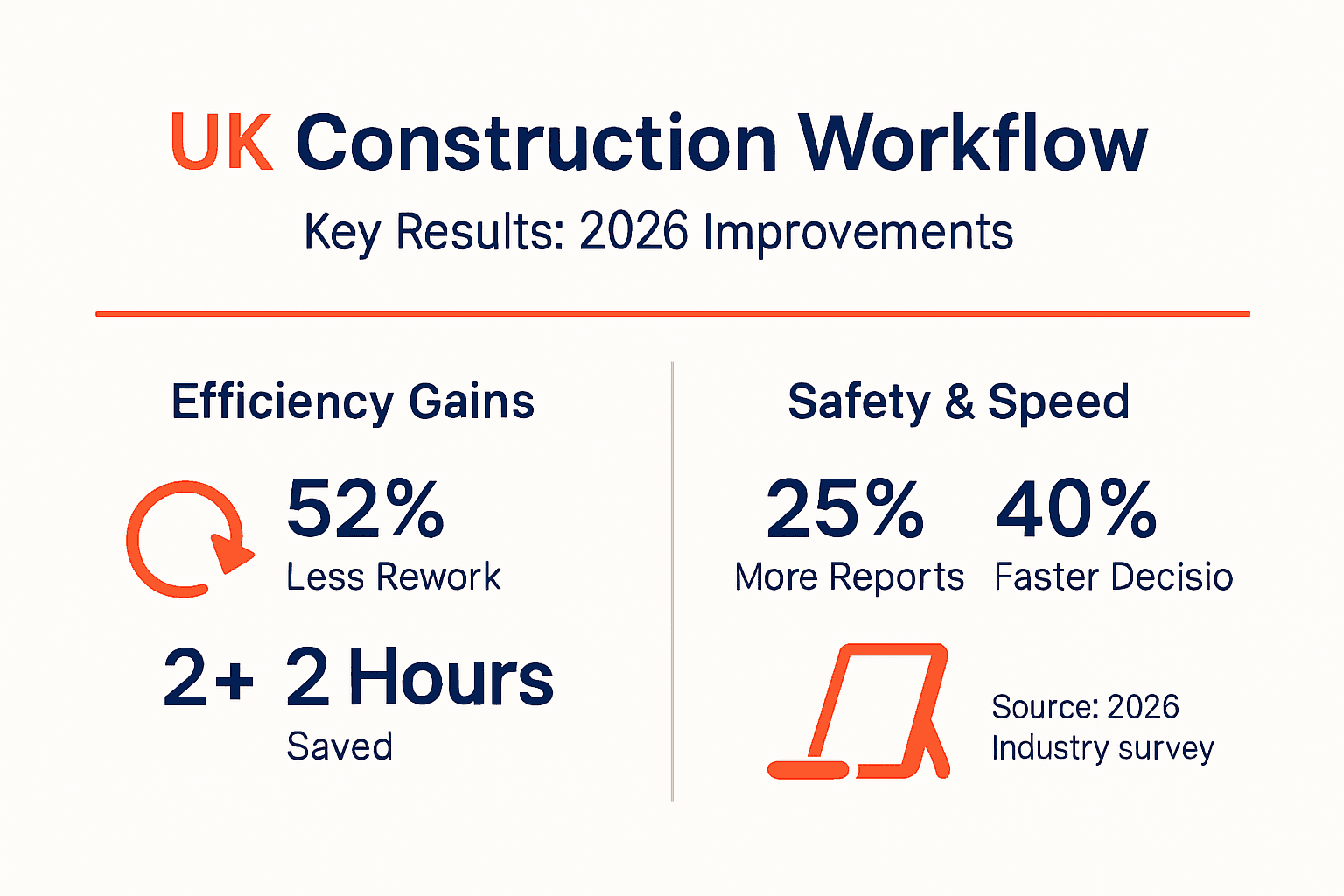
Safety performance improves measurably. Incident reporting increases by 25% as teams feel empowered to flag hazards through easy-to-use mobile tools. Paradoxically, actual incidents decline because problems get addressed before they cause harm. Compliance documentation becomes effortless with automatic audit trails.
Decision-making accelerates by 40% when stakeholders access the same real-time information. Approvals that once took days now happen in hours. This velocity keeps projects moving and prevents costly idle time for crews waiting on answers.
| Success Metric | Realistic Target | Measurement Period |
|---|---|---|
| Rework reduction | 50-55% decrease | 4-8 weeks |
| Daily time savings | 2+ hours per person | 2-4 weeks |
| Project delay reduction | 25-30% decrease | 8-12 weeks |
| Safety reporting increase | 25% more incidents logged | 4-6 weeks |
| Decision speed improvement | 40% faster approvals | 4-6 weeks |
Track these metrics from your baseline before implementation. Use them to calculate ROI and justify continued investment in your communication infrastructure. Calculate your team’s savings from streamlined communication using your actual project data.
Benchmark your progress:
- Document current rework rates and time spent on communication
- Set specific improvement targets for each metric
- Review progress monthly and adjust tactics as needed
- Share wins with stakeholders to maintain support
- Use data to identify which protocol changes deliver the most impact
Streamline Your Construction Communication with BRCKS
Ready to eliminate fragmented communication on your UK residential projects? BRCKS software for builders replaces the chaos of WhatsApp groups, emails, and disconnected apps with one mobile-friendly platform built specifically for construction teams. Designed with CDM 2015 compliance in mind, BRCKS centralises messaging, task management, video meetings, and document sharing in a system your crews will actually use.
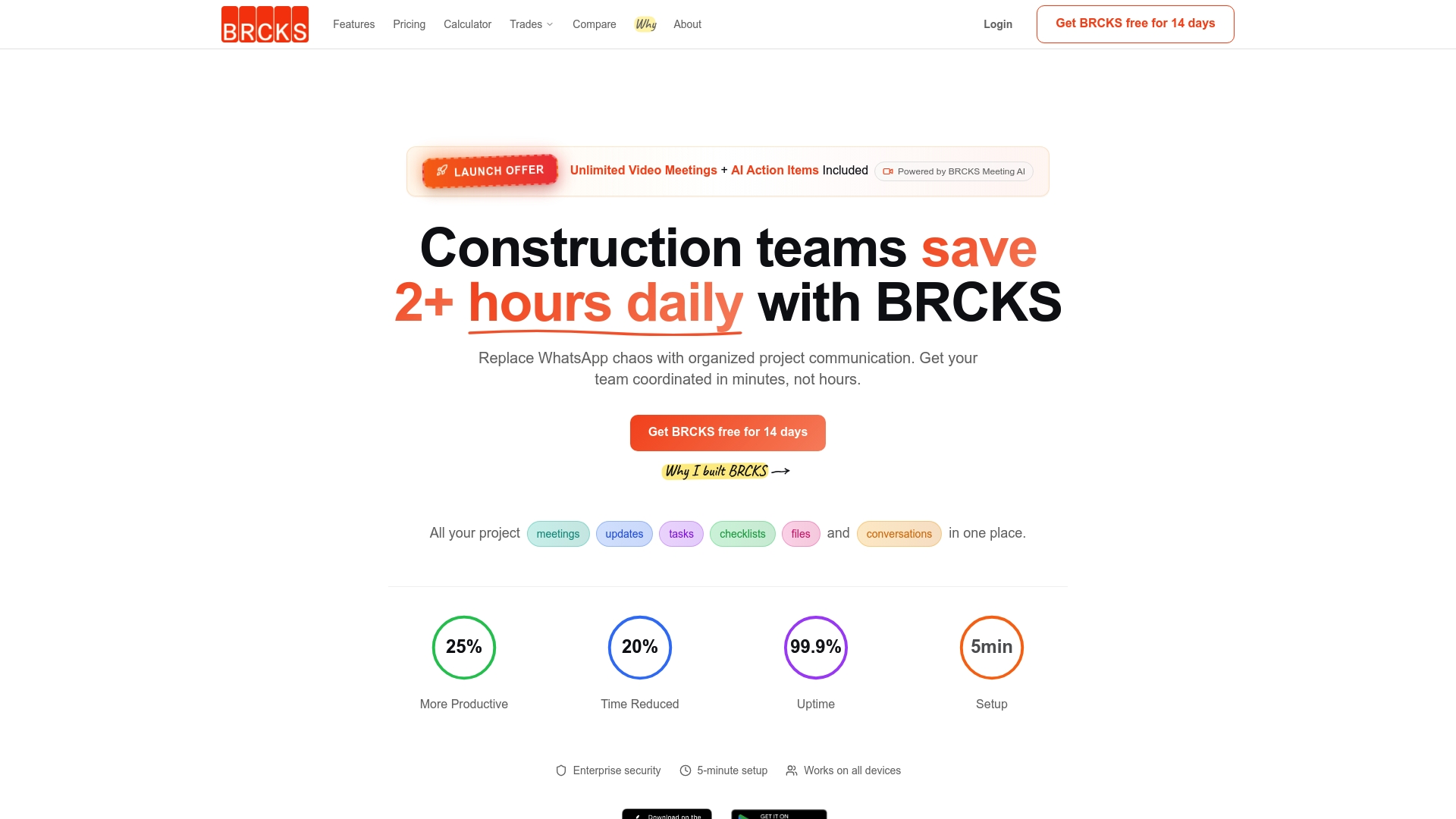
Hundreds of UK construction teams already save over two hours daily with BRCKS. Unlimited video meetings generate AI-powered action items automatically, ensuring nothing gets missed. The unified project feed keeps everyone synchronised whether they are on site or in the office. Compare the WhatsApp versus BRCKS comparison to see how purpose-built construction software outperforms general messaging apps. Setup takes just five minutes, and our 14-day free trial lets you test the platform risk-free on your next project. Visit BRCKS official platform to start cutting rework and accelerating delivery today.
FAQ
How do I start implementing a standardised communication protocol?
Begin by defining your preferred channels for different message types and setting clear response time expectations. Train all team members on these protocols and use a centralised platform like BRCKS to enforce adherence automatically. Document your protocols in writing and conduct weekly compliance checks during the first month.
What common communication mistakes should UK construction teams avoid?
The biggest error is scattering messages across multiple apps like WhatsApp, email, and text, which creates information silos and lost updates. Many teams also neglect proper training, assuming everyone instinctively knows how to communicate effectively. Implement clear protocols and centralised tools to eliminate these issues. Review common communication pitfalls for detailed prevention strategies.
How can I measure the success of a new communication workflow?
Track quantifiable metrics including rework reduction percentages, daily time saved per team member, project delay decreases, and safety incident reporting improvements. Compare decision-making speeds before and after implementation by measuring approval cycle times. Use communication savings calculators to translate these improvements into financial ROI that justifies your investment to stakeholders.
Does a centralised platform work for both office and field teams?
Yes, mobile-first platforms ensure field teams access the same information as office staff in real time. Site workers use smartphones or tablets to receive updates, submit reports, photograph issues, and participate in video meetings without returning to the office. This accessibility is critical for keeping everyone synchronised regardless of location.
How long does it take to see results from improved communication workflows?
Most teams notice immediate time savings within the first week as information becomes easier to find. Measurable reductions in rework and project delays typically appear within four to eight weeks once protocols become habitual. Safety and compliance improvements manifest within the first month as reporting barriers disappear and audit trails strengthen.
Recommended
- Construction Software for Builders | BRCKS
- BRCKS | Construction Project Communication Software
- WhatsApp vs BRCKS | Built for Construction Projects
- Construction Project Management Insights | BRCKS Blog
How BRCKS Can Help
Streamlining communication is no longer just a strategy for efficiency but a necessity for staying competitive in the UK’s evolving construction landscape. BRCKS provides the centralised platform needed to eliminate data silos and ensure every stakeholder remains aligned from pre-construction through to completion. By integrating these workflows into your daily operations, you can significantly reduce costly errors and keep your projects on track for 2026 and beyond. We invite you to discover how BRCKS can transform your site communication and protect your margins today. Learn more at BRCKS.