Centralised task management for construction teams
Discover how consolidating project communications into a single platform can eliminate coordination overhead and significantly boost construction productivity.
By James Shorter ·
Centralised task management for construction teams

TL;DR:
- Centralised task management consolidates project communications into a single platform, reducing missed deadlines and boosting productivity. It eliminates coordination overhead, prevents information fragmentation, and minimises burnout by making task ownership and priorities clear. Successful implementation depends on team discipline, full adoption, and choosing scalable, user-friendly systems like BRCKS.
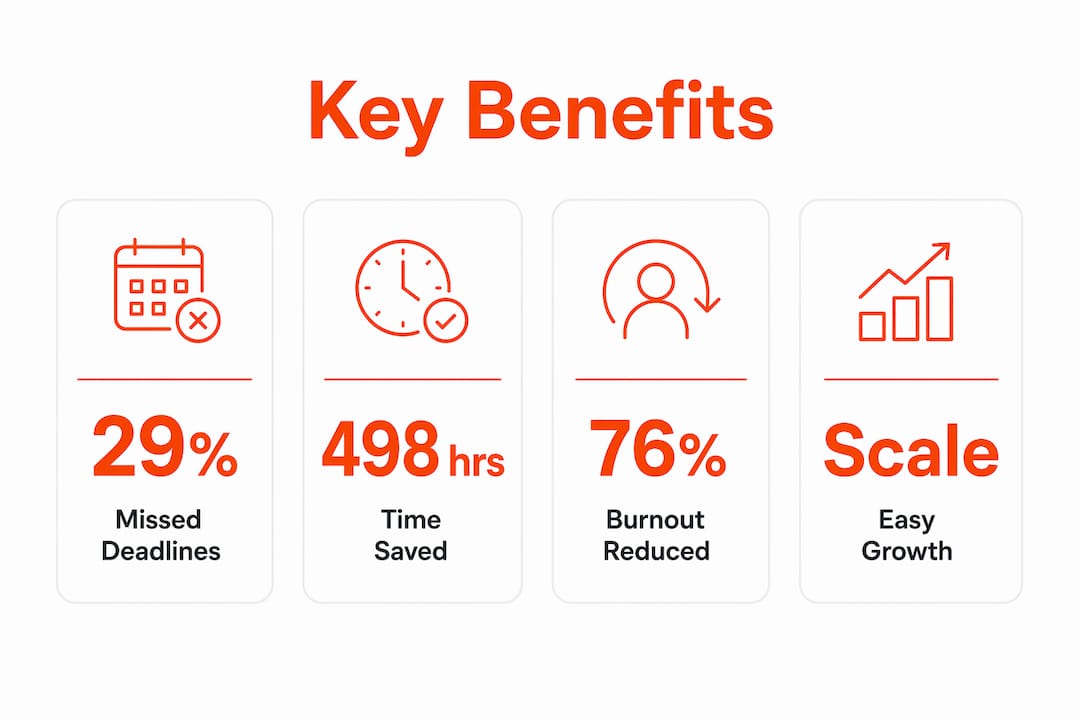
Centralised task management is the process of consolidating all project tasks, communications, and workflows into a single platform accessible to every member of your team. For construction project managers juggling multiple trades, subcontractors, and client demands, the importance of centralised task management cannot be overstated. Research shows organisations using centralised systems report 29% fewer missed deadlines and 34% higher productivity, saving an average of 498 hours per employee per year. That is not a marginal gain. On a live construction site, it is the difference between a project that delivers on time and one that haemorrhages cost.
What are the key benefits of centralised task management for construction projects?
Centralised task management delivers measurable gains across three areas that matter most to construction teams: deadline performance, team productivity, and worker well-being.
Fewer missed deadlines and clearer task visibility
When tasks live across WhatsApp threads, email chains, and paper-based snag lists, nothing has a single owner. Centralised platforms assign clear ownership and deadlines to every task, making it immediately visible when something is at risk. The 29% reduction in missed deadlines reported by organisations using unified systems reflects exactly this shift. Visibility replaces assumption, and project managers spend less time chasing status updates.
Productivity gains that compound over time
The productivity improvement from centralisation is not a one-off benefit. Teams that consolidate tasks into a single system stop duplicating effort, stop re-entering data across tools, and stop holding unnecessary progress meetings. The 34% productivity increase cited in 2026 research translates directly to more work completed per day on site and in the office. For a construction firm running three or four concurrent projects, that compounding effect is significant.
Reduced burnout across site and office teams
76% of employees report burnout linked to unclear expectations and unmanageable workloads. In construction, this is amplified by the sheer number of moving parts: RFIs, variations, subcontractor schedules, client approvals. Centralised task management alleviates this by making priorities explicit and ownership unambiguous. When every team member knows exactly what they are responsible for and when, the cognitive load drops substantially.
| Point | Details |
|---|---|
| Missed deadlines | Centralised systems reduce missed deadlines by 29% through clear task ownership |
| Productivity | Teams report 34% higher productivity and save up to 498 hours per employee annually |
| Burnout reduction | Clear priorities and ownership reduce the burnout experienced by 76% of workers |
| Project success rate | Fragmented communication causes 70% of project failures; centralised visibility reverses this |
Pro Tip: Before selecting a task management platform, audit where your team currently records tasks. If the answer involves more than two tools, you already have a fragmentation problem worth solving.
How does centralised task management solve coordination challenges in construction?
Construction projects are structurally prone to coordination failure. You have architects, structural engineers, main contractors, electricians, plumbers, and finishing trades all working to overlapping schedules, often communicating through different channels.
The hidden cost of fragmented tools
Teams waste roughly 73% of their time coordinating work across multiple tools rather than performing core tasks. This is what researchers call “coordination overhead.” It is the time spent asking “where are we with this?” instead of actually moving the work forward. On a construction project, coordination overhead shows up as duplicated phone calls, repeated site visits to clarify scope, and variation requests that get lost between WhatsApp and email.
“The biggest productivity killer in construction is not slow workers. It is the time spent figuring out what needs to happen next and who is responsible for it.”
Centralised task management eliminates this by making status visible without requiring anyone to ask. When a task is updated, everyone with access sees it. When a dependency is blocked, the system flags it. The single source of truth principle means no team member is working from an outdated version of the project plan.
Reducing meetings and duplication of effort
One of the most underappreciated advantages of task centralisation is the reduction in meetings. When task status is visible to all, the daily “catch-up” becomes redundant. Teams that adopt centralised platforms consistently report fewer status meetings and less duplication of effort across trades. This is particularly relevant for UK construction teams managing communication across multiple sites, where the cost of a poorly coordinated handover between trades can run into thousands of pounds in rework.
Pro Tip: Map your current communication flow before implementing any new platform. Identify the three most common points where tasks get lost or delayed. These are the exact gaps your centralised system needs to close first.
Centralised task management systems versus spreadsheets: what construction teams need to know
Many construction teams still manage tasks through spreadsheets, shared drives, and group chats. This approach works at very small scale. It fails predictably as project complexity grows.
Why spreadsheets break down on live projects
Spreadsheets lack the automation and automatic notifications that dynamic project tracking requires. A spreadsheet cannot tell you when a predecessor task has slipped and your scheduled work is now at risk. It cannot send a reminder to a subcontractor the day before a deadline. It cannot flag a dependency conflict between two trades booked for the same area on the same day. These are not edge cases in construction. They are daily occurrences.
The distinction between a simple task tracker and a proper workflow management system matters here. A task tracker is a list. A workflow system manages dependencies, automates transitions, and sends active notifications. Construction projects need the latter.
| Feature | Spreadsheets | Centralised task management software |
|---|---|---|
| Automatic notifications | No | Yes, triggered by task status changes |
| Dependency tracking | Manual, error-prone | Built-in, with conflict flagging |
| Real-time visibility | Requires manual updates | Updated instantly by all users |
| Audit trail | None by default | Full history of changes and comments |
| Scalability | Degrades with complexity | Designed to scale with team size |
| Integration with comms tools | None | Connects with email, WhatsApp, and site apps |
Pricing models and scalability for construction teams
Per-seat pricing models penalise team growth. When adding a subcontractor or a new site manager to your platform costs money, teams create workarounds. Those workarounds fragment coordination and undermine the entire purpose of centralisation. Construction teams should prioritise platforms with flexible pricing that does not create a financial disincentive to full adoption. The hidden costs of construction project management software are often found precisely here, in the workarounds that emerge when per-seat costs get too high.
Pro Tip: When evaluating platforms, ask specifically how pricing changes as your team grows. A tool that costs £10 per seat per month sounds reasonable for five people. At fifty people across multiple projects, it becomes a significant overhead.
How to implement centralised task management in your construction projects
Choosing the right platform is only half the challenge. The other half is getting your team to actually use it consistently.
-
Start with a pilot project. Select one active project and migrate all task tracking to the new platform. Resist the temptation to run the old system in parallel. Parallel systems guarantee fragmentation.
-
Secure buy-in from site managers first. Site managers are the gatekeepers of daily task flow. If they trust the system, the rest of the team follows. If they revert to WhatsApp and paper, adoption collapses.
-
Define what “a task” means for your team. Ambiguity about what gets logged as a task is one of the most common reasons centralisation fails. Agree on a standard: every action with a deadline and an owner gets logged.
-
Integrate with your existing communication channels. Construction teams communicate through WhatsApp, phone calls, and site visits. A platform that captures those communications automatically removes the manual logging burden. BRCKS, for example, integrates directly with WhatsApp to capture updates in real time, which removes a major adoption barrier.
-
Review and reinforce in the first four weeks. Partial adoption undermines centralisation more than any technical limitation. Weekly reviews in the first month, focused on what is and is not being logged, establish the habit before it has a chance to slip.
-
Choose a platform that scales without punishing growth. Flexible cost structures are not a nice-to-have. They are a prerequisite for genuine team-wide adoption on multi-trade construction projects.
Pro Tip: Treat the first two weeks of implementation as a data collection exercise, not a performance review. The goal is to understand where the gaps are, not to judge the team for using the old system.
Key takeaways
Centralised task management works because it replaces fragmented, multi-tool coordination with a single visible system that assigns clear ownership, automates status updates, and scales with your team.
| Point | Details |
|---|---|
| Deadline performance | Centralised systems cut missed deadlines by 29% through task ownership and visibility. |
| Productivity and time | Teams save up to 498 hours per employee annually by eliminating coordination overhead. |
| Burnout and clarity | Clear priorities reduce the burnout affecting 76% of workers in fragmented environments. |
| Spreadsheets fall short | Spreadsheets lack dependency tracking and notifications critical for live construction projects. |
| Adoption determines success | Team-wide trust in one system matters more than the feature count of the platform chosen. |
Why centralisation changed how I think about construction project delivery
I spent years watching construction projects struggle not because the teams were incompetent, but because the information was always in the wrong place at the wrong time. A site manager would have the latest version of the programme on his phone. The subcontractor would be working from a printout from three weeks ago. The project manager would be chasing updates by phone while standing in a site office surrounded by paperwork.
The shift I have seen in teams that genuinely commit to centralised task management is not subtle. It is structural. The conversations change. Instead of “what is the status of X?” the conversation becomes “I can see X is blocked. Here is how we fix it.” That is a fundamentally different way of working, and it is only possible when everyone is looking at the same information.
The misconception I encounter most often is that centralisation requires a sophisticated, expensive platform. It does not. What it requires is discipline and full adoption. A simple system that everyone uses beats a feature-rich platform that half the team ignores. The importance of centralised project information is not about the technology. It is about the commitment to one version of the truth.
The future of construction project delivery will be defined by teams that treat task management as a discipline, not an afterthought. The data from 2026 is unambiguous: fragmented communication causes 70% of project failures. That is not a technology problem. It is a coordination problem, and centralisation is the solution.
— James
How BRCKS helps construction teams centralise tasks and communication
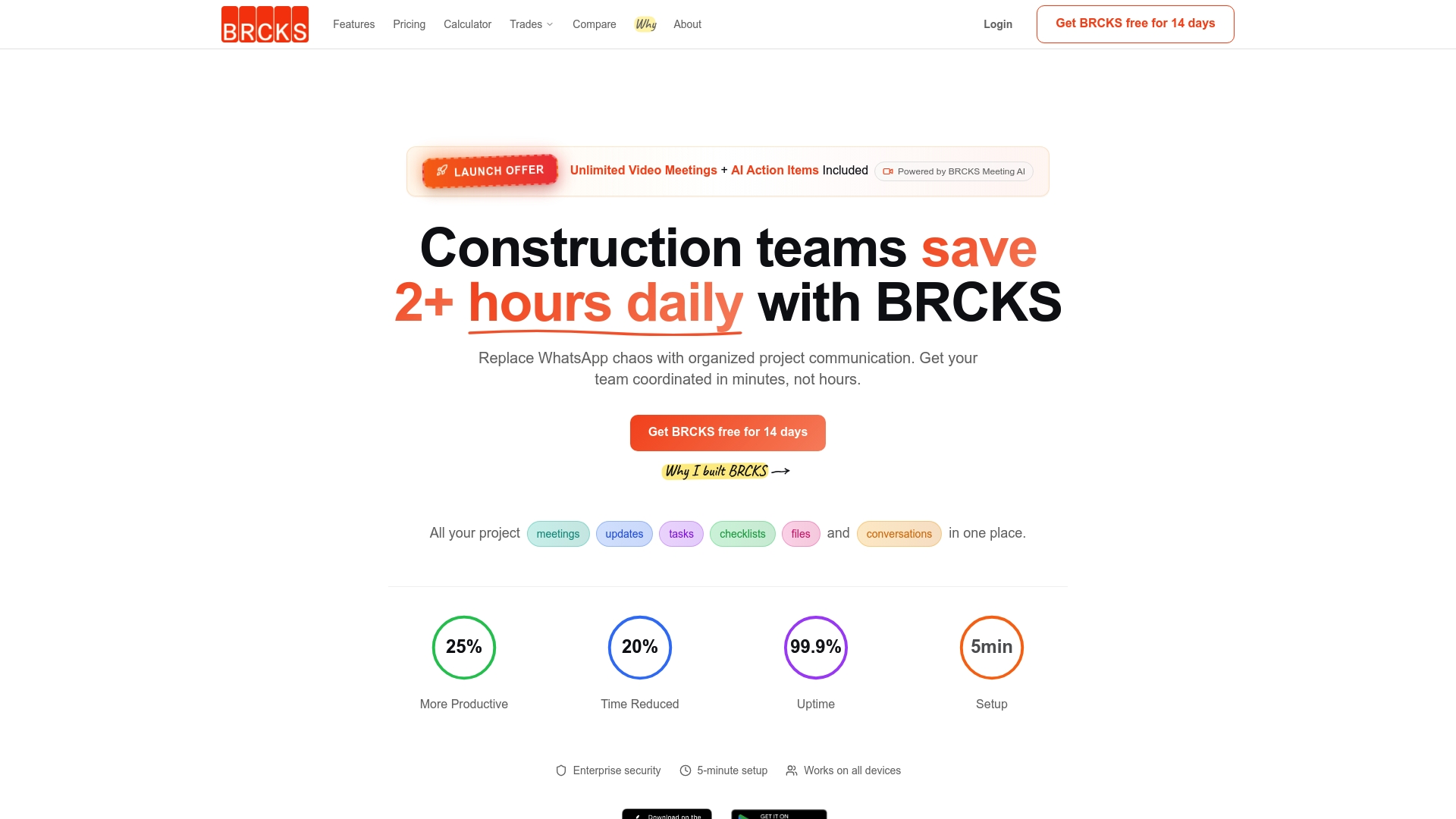
BRCKS is built specifically for construction teams who need to consolidate tasks and communications without adding administrative burden. By integrating directly with WhatsApp, BRCKS captures site updates, RFIs, and variation requests in real time, feeding them into a structured project record automatically. There is no manual logging, no chasing updates, and no lost messages. Features including automated site diaries, a structured variation log, and dedicated client portals give project managers full visibility without disrupting the way trades already communicate on site. BRCKS saves users over two hours of manual effort daily. If you are ready to put centralised task management into practice, explore BRCKS for builders and start a free 14-day trial today.
FAQ
What is centralised task management in construction?
Centralised task management is the practice of consolidating all project tasks, communications, and workflows into a single platform accessible to the entire team. In construction, this means site managers, subcontractors, and project managers all work from the same task list with shared visibility.
How much time can centralised task management save?
Organisations using centralised systems save an average of 498 hours per employee per year, according to 2026 research. This saving comes primarily from eliminating the coordination overhead that consumes up to 73% of team time in fragmented, multi-tool environments.
Why do spreadsheets fail for construction task management?
Spreadsheets lack automatic notifications, dependency tracking, and real-time status visibility. These limitations cause delays and manual errors on live construction projects where tasks are interdependent and schedules change daily.
What is the biggest risk when implementing a new task management system?
Partial adoption is the single greatest risk. When some team members continue using WhatsApp, email, or paper alongside the new platform, the system loses its value as a single source of truth and fragmentation continues.
How does centralised task management reduce construction project failures?
Fragmented communication is the cause of 70% of project failures. Centralised task management addresses this directly by making task status, ownership, and dependencies visible to all stakeholders, making teams 1.4 times more likely to exceed performance benchmarks.
Recommended
- Top Construction Schedule Software for UK Builders 2025 | BRCKS
- The Ultimate Guide to Construction Time Tracking | BRCKS
- Importance of Centralised Project Information in Construction | BRCKS
- Construction Software for Builders | BRCKS
How BRCKS Can Help
Transitioning to a centralised task management system is the most effective way to eliminate communication gaps and keep your site moving at pace. By integrating these workflows into a single, intuitive platform, BRCKS empowers construction teams to track progress in real time and reduce the administrative burden on project managers. This streamlined approach ensures everyone stays aligned, allowing you to focus on delivering quality builds rather than chasing updates. We invite you to explore how BRCKS can transform your daily operations and bring newfound clarity to your next project. Learn more at BRCKS and explore our full feature set.