Boost construction productivity: key metrics and strategies
UK construction productivity lags 13.5% behind the national average. Learn the key metrics and practical strategies to measure and improve site performance.
By James Shorter ·
Boost construction productivity: key metrics and strategies

TL;DR:
- UK construction productivity is 13.5% below the national average, costing billions annually.
- Measuring productivity accurately requires choosing relevant metrics and fostering a measurement culture.
- Strategies like workforce training, offsite construction, and digital tools significantly boost site output.
UK construction output per worker hour sits at £35.69, roughly 13.5% below the national average. That gap costs the sector billions annually, yet many project managers still assume more hours on site automatically means more work completed. It does not. Productivity in construction is far more nuanced than a simple headcount calculation, and the tools to measure it properly remain underused across the UK. This guide cuts through the confusion, explains what productivity actually means on a live site, and gives you practical strategies to drive measurable improvements, starting this month.
Table of Contents
- Defining construction productivity: what does it really mean?
- How is construction productivity measured? Benchmarks and UK data
- Key drivers of productivity on UK construction sites
- Challenges and real-world edge cases: what holds back productivity?
- What most productivity guides miss: a manager’s UK reality check
- Next steps: unlocking productivity gains with smarter tools
- Frequently asked questions
Key Takeaways
| Point | Details |
|---|---|
| No universal standard | Construction productivity definitions and metrics vary widely, so consistent internal benchmarking is essential. |
| Measure what matters | Track output per worker hour or built area for practical improvement at site level. |
| Skills drive gains | Upskilling teams and adopting modular methods can yield productivity boosts more reliably than technology alone. |
| Barriers still exist | Many firms struggle to measure productivity due to unclear KPIs and cultural resistance, but new tools make tracking easier. |
Defining construction productivity: what does it really mean?
With confusion about productivity widespread, it is vital to start with the fundamentals.
At its core, construction productivity measures output relative to input. Output could be square metres of floor area completed, number of structural elements installed, or project milestones achieved. Input is typically worker hours, cost, or both. The challenge is that, unlike manufacturing, construction sites vary enormously in scope, complexity, and context, so no single formula fits all.
As RICS notes, construction productivity is measured as output per unit of input, but no single metric is universally adopted by more than 30% of firms. That fragmentation makes benchmarking genuinely difficult.
Common productivity metrics used on UK sites:
- m² per worker hour: Useful for repetitive trades such as brickwork or drylining
- Earned value vs actual cost (EV/AC): Tracks whether money spent is generating proportionate progress
- Output per worker hour (ONS measure): A macroeconomic view useful for industry comparison
- Tasks completed per sprint: Helpful for phased or modular project delivery
Tracking essential construction KPIs consistently is what separates high-performing sites from those that rely on gut feel.
| Metric | Best used for | Limitation |
|---|---|---|
| m²/worker hour | Repetitive trade tasks | Poor for complex or unique scopes |
| Earned value | Budget and progress | Requires robust cost tracking |
| Output per worker hour | Industry benchmarking | Too broad for site decisions |
| Tasks per sprint | Phased delivery | Not standardised across firms |
“Productivity measurement without a clear definition is just noise. Pick the metric that reflects your actual site goals, not the one that looks best on a report.”
Why does a clear definition matter so much? Because without it, improvement strategies are aimed at the wrong target. A site manager optimising for hours worked might actually reduce productivity if those hours are poorly directed. Defining what you are measuring before you start is the single most important step.
How is construction productivity measured? Benchmarks and UK data
Once the basics are clear, the next step is understanding how to track productivity effectively, and where most UK firms fall short.
There are three broad approaches to measurement on UK sites: manual tracking using paper or spreadsheets, digital tracking using software or sensors, and benchmark-driven assessment that compares your output against industry standards. Most sites use a combination, though manual methods still dominate.
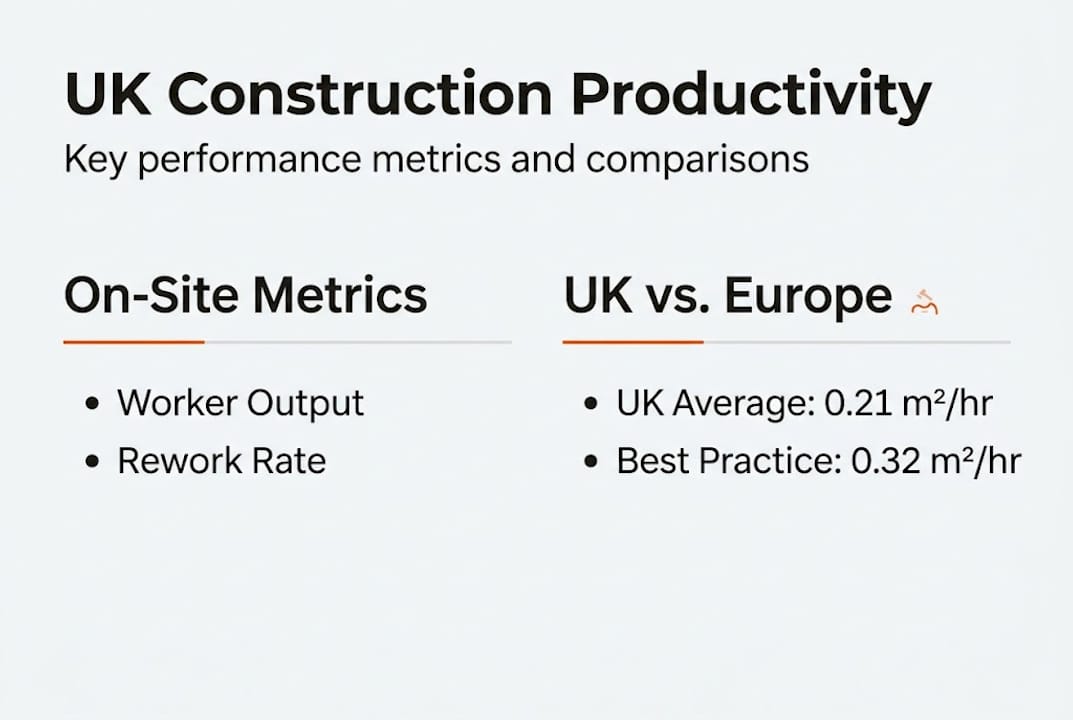
The numbers reveal a stark picture. The UK average sits at 0.21 m² per worker hour for typical construction tasks, while the Mace Timber Square pilot achieved 0.53 m²/worker hour using structured data collection and modern methods. That is more than double. Yet only 5% of UK firms use robust benchmarking processes to track and improve performance over time.
Perhaps more alarming: 22% of UK firms never measure productivity at all. That is one in five businesses operating with no baseline whatsoever.
What makes a metric useful on site versus useful for reporting?
On-site metrics need to be immediate, easy to collect, and directly tied to decisions a foreman or project manager can make the same day. Reporting metrics are broader and used to justify investment or demonstrate progress to clients and stakeholders. Confusing the two leads to data that looks good in a boardroom but does nothing to change site behaviour.
Barriers to consistent measurement include a lack of standard tools, low confidence in digital systems, and a cultural reluctance to be seen as underperforming. Many teams fear that tracking productivity will be used punitively rather than constructively.
For monitoring site productivity to work, the data needs to lead to action, not just reports.
Pro Tip: Set a simple monthly target: measure your primary metric on the same day each month, share results with the team, and agree one adjustment. Consistency beats sophistication every time.
Key drivers of productivity on UK construction sites
Understanding productivity measurement is half the battle. The next half is knowing which strategies have the biggest impact.
The RICS 2026 report identifies the top drivers clearly: workforce skills account for 37% of productivity gains, offsite construction methods can deliver up to 50% improvements, and digital tools including BIM, AI, and telematics are increasingly cited as critical enablers. Lean project delivery and collaborative contracting models round out the picture.
The biggest levers, in order of impact:
- Workforce upskilling: Training trades in new techniques, digital tools, and lean principles consistently delivers the strongest return
- Modern methods of construction (MMC): Offsite fabrication reduces weather dependency and on-site rework significantly
- Digital tools: BIM improves clash detection before work starts; AI-driven scheduling reduces idle time; real-time tracking flags delays early
- Lean and collaborative delivery: Reducing handover friction and involving subcontractors earlier cuts waste at every stage
- Early supply chain engagement: Bringing key suppliers in during design reduces costly late-stage changes
Adopting digital solutions for UK construction is no longer optional for competitive sites, but technology alone does not fix a skills gap or a culture that resists measurement.
The trust factor is often underestimated. Sites where subcontractors are engaged early and treated as partners rather than vendors consistently outperform those with adversarial contracting relationships. Coordination best practices matter as much as any software investment.
It is also worth looking beyond the UK. International productivity management approaches show that structured workflows and clear accountability frameworks are the common thread in high-performing construction markets, regardless of geography.
Pro Tip: Before investing in new technology, audit your current workflow management on site. Tools that layer onto broken processes rarely improve them.
Challenges and real-world edge cases: what holds back productivity?
Even with the best tools and policies, unique on-site challenges can halt progress unless addressed head-on.
The Mace Timber Square case study identified the most common blockers with precision: poor planning, slow decision-making, repetitive rework, weather disruption, and urban site constraints. What it also found, perhaps surprisingly, is that industry fragmentation is not directly linked to lower productivity. The assumption that smaller, fragmented supply chains are inherently less productive does not hold up under scrutiny.
The most common blockers UK project managers face:
- Incomplete or late design information arriving on site
- Decision-making bottlenecks where approvals sit with people who are off site
- Rework caused by poor communication between trades
- Weather disruption, particularly relevant in high-rise or exposed urban environments
- Optimism bias in planning, where programmes underestimate realistic durations
“The biggest productivity risk is not the storm or the late delivery. It is the meeting that should have happened three weeks earlier.”
Managing optimism bias is a skill most experienced project managers develop over time, but it is rarely taught formally. Data from previous projects is the antidote. Sharing site information in real time reduces the gap between what planners assume and what site teams actually encounter.
Cutting UK site rework often starts with better communication protocols rather than new equipment. And real-time project updates give decision-makers the visibility they need to act before a delay becomes a programme issue.
The data-driven approach does not eliminate challenges. It ensures that when they arise, you have enough information to respond quickly and learn from the experience.
What most productivity guides miss: a manager’s UK reality check
With practical challenges addressed, here is a candid look at whatmainstream advice misses entirely.
Most productivity guides lead with technology. Buy the right software, adopt BIM, use AI scheduling, and your productivity problems will solve themselves. That is simply not how UK sites work. The 22% of firms not tracking productivity at all are not failing because they lack access to tools. They are failing because measurement culture has not been established, and technology cannot substitute for that.
Cultural inertia is the real obstacle. Teams that have operated the same way for years do not change because a new app is introduced. They change when leaders model the behaviour, share data openly, and tie measurement to genuine learning rather than performance management.
The guides also underplay the compounding effect of small, consistent improvements. You do not need a 50% productivity gain overnight. You need two well-chosen KPIs, measured monthly, with findings shared honestly across the team. Over six months, that discipline creates the foundation for bigger improvements.
We see why digital construction tools fail repeatedly: the tech is sound, but the adoption process ignores the human side entirely. Invest in the team first. The tools will follow. For broader management insights on building that culture, the evidence is consistent: skills and measurement discipline outperform any single technology investment.
Next steps: unlocking productivity gains with smarter tools
Ready to move beyond theory and see what works in record time?
If you are serious about improving site productivity, the first step is getting your measurement and communication infrastructure in order. Specialist construction software for builders makes it straightforward to track KPIs, manage tasks, and keep every stakeholder aligned without adding to your admin load.
 BRCKS.io">
BRCKS brings together project updates, checklists, team chat, and client portals in one place, saving teams over two hours daily. Our construction communication tools are built for the realities of UK sites, and WhatsApp-based project management means your team does not need to learn a new system from scratch. Start your free 14-day trial and see the difference structured communication makes to your site’s output.
Frequently asked questions
What is a common metric for construction productivity in the UK?
The most widely used metric is output per worker hour, such as square metres built per hour, though no single benchmark is universally adopted across UK firms.
How can a project manager improve site productivity quickly?
Focusing on workforce upskilling, measuring KPIs monthly, and adopting modular construction methods can yield the quickest gains, as workforce skills and MMC deliver the largest improvements.
Why do some firms struggle to measure productivity?
Barriers include a lack of standard metrics, low confidence in technology, and cultural resistance, with 22% of UK firms never tracking productivity at all.
How does offsite construction affect productivity?
Offsite methods can deliver up to 50% productivity gains by reducing weather dependency, minimising on-site rework, and improving labour consistency across the programme.
Recommended
- Construction Mobile Apps: Reduce Material Waste by 25% | BRCKS
- BRCKS | Construction Project Communication Software
- BRCKS | Construction Project Communication Software
- BRCKS | Construction Project Communication Software
- Hardscape installation workflow: efficient steps for Atlanta
How BRCKS Can Help
Improving construction productivity requires a consistent focus on data-driven insights and streamlined communication across every project phase. BRCKS simplifies this process by centralising your key performance metrics and automating routine workflows, allowing your team to focus on quality delivery rather than manual administration. By integrating these strategies into a single, intuitive platform, BRCKS ensures your site remains efficient and profitable. We invite you to discover how our tools can transform your operations by exploring the BRCKS platform today. Learn more at BRCKS and explore our full feature set.