AI workflow gains: transforming UK construction in 2026
UK construction productivity lags 21% below the national average. Explore how AI-driven workflows and standardised data are transforming site efficiency for 2026.
By James Shorter ·
AI workflow gains: transforming UK construction in 2026

TL;DR:
- UK construction productivity is 21% below the national average due to fragmented data and manual processes. AI can improve efficiency by automating tasks, enhancing real-time scheduling, and surfacing risks early. Success depends on establishing strong data foundations, standardising workflows, and combining human judgement with AI tools.
UK construction productivity lags 21% below the national average, yet the industry continues to operate with fragmented communication, manual reporting, and paper-heavy processes that would look familiar to a site manager from 20 years ago. For project managers and team leaders, this is not an abstract statistic. It shows up daily as missed deadlines, rework, and hours lost to chasing information across emails, spreadsheets, and WhatsApp threads. AI is now offering a credible path out of this cycle, with tools that automate admin, sharpen scheduling, and surface risks before they become expensive problems.
Table of Contents
- The current challenges in UK construction workflows
- How AI streamlines construction workflow processes
- AI foundations: Data, integration, and real-time communications
- Risks, readiness, and the real role of humans in AI-enhanced construction
- Our take: Why AI is powerful, but data discipline is non-negotiable
- Ready to upgrade your construction workflow?
- Frequently asked questions
Key Takeaways
| Point | Details |
|---|---|
| Productivity boost | AI streamlines admin and site reporting, narrowing the current 21% productivity gap in UK construction. |
| Start with your data | Quality, standardised data is the critical first step for any successful AI deployment in construction. |
| AI supports, not replaces | AI enhances the judgement of skilled project managers, rather than automating away their roles. |
| Real-time communication | Integrated AI and digital tools provide up-to-date dashboards for better project visibility and faster decisions. |
The current challenges in UK construction workflows
Building on the introduction, it is essential to understand exactly where most projects are losing ground. The construction sector handles enormous volumes of data every day: site reports, compliance documents, subcontractor updates, procurement records, and client correspondence. Much of this information exists in disconnected formats, stored across different tools, inboxes, or paper files. That fragmentation creates serious problems for anyone trying to run a project efficiently.
The workflow management challenges facing UK project managers are well documented. Administrative tasks consume large portions of the working week. Manual reporting means that by the time a progress update reaches a decision-maker, the situation on site may already have changed. Compliance obligations under frameworks such as the Building Safety Act add further pressure, requiring detailed audit trails and structured documentation that many teams still produce by hand.
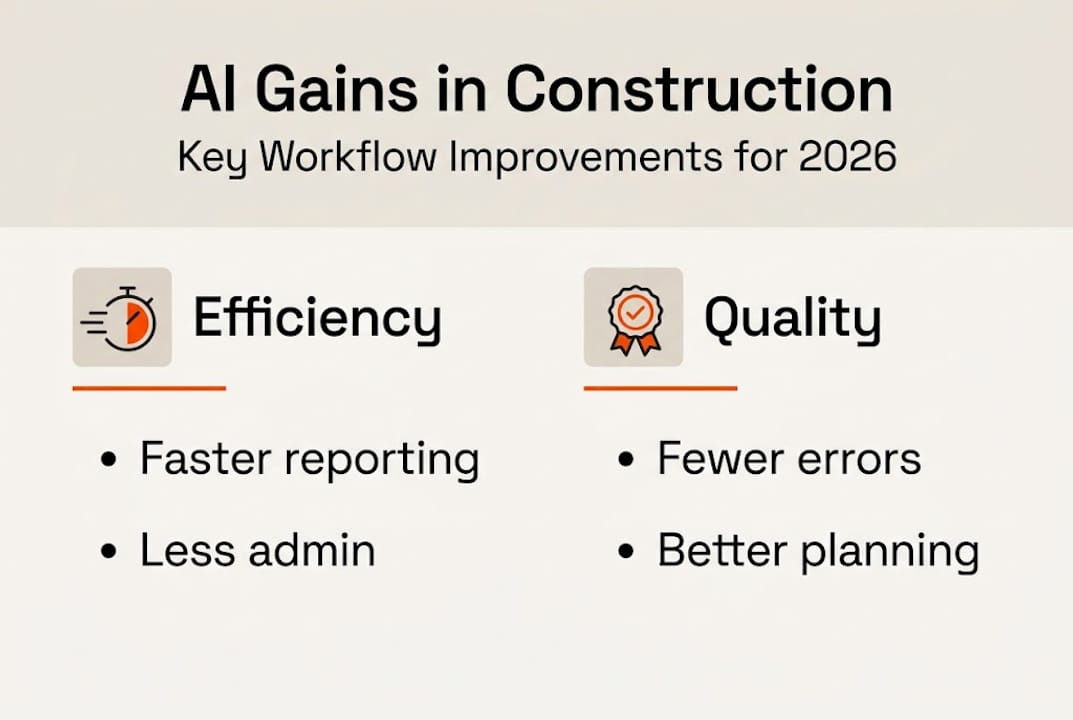
Document management issues compound these problems. When data exists in unstructured formats, or sits in silos across departments, AI tools cannot make sense of it. As data quality issues such as incomplete records and siloed information cause AI failures, the outputs become unreliable, creating liability risks and supply chain fragmentation. You cannot fix a data problem with a smarter algorithm alone.
Common operational bottlenecks include:
- Delayed compliance sign-offs due to missing or inconsistent documentation
- Fragmented communication between site teams, subcontractors, and clients
- High administrative overhead from manual progress reporting
- Slow identification of risks due to infrequent project reviews
- Rework caused by teams acting on outdated or incomplete information
“UK construction productivity sits 21% below the national average. Fragmented data and manual processes are key contributors, and they are exactly the conditions that make AI implementation risky without the right foundations.”
The urgency is real. Projects that continue to rely on periodic, manual reporting will find it increasingly difficult to meet compliance demands and client expectations. The good news is that targeted improvements are achievable.
How AI streamlines construction workflow processes
With these bottlenecks in mind, let us look at where AI steps in to make measurable improvements. The shift is not about replacing your project team with software. It is about removing the low-value, repetitive tasks that eat time and create errors, so your people can focus on judgement and delivery.
AI tools are now being used across UK construction to automate administrative tasks, predictive scheduling, risk management, and real-time data analysis. Crucially, this moves projects from periodic reporting to continuous monitoring, which is increasingly important under Building Safety Act requirements. Rather than reviewing progress once a week, project managers receive live updates and alerts that reflect actual site conditions.
The efficiency gains can be significant. In one UK construction firm AI pilot, legal document review time dropped from 60 minutes to just 15 minutes, a 75% saving. Scaled across a large project’s documentation workload, that is a substantial release of capacity.
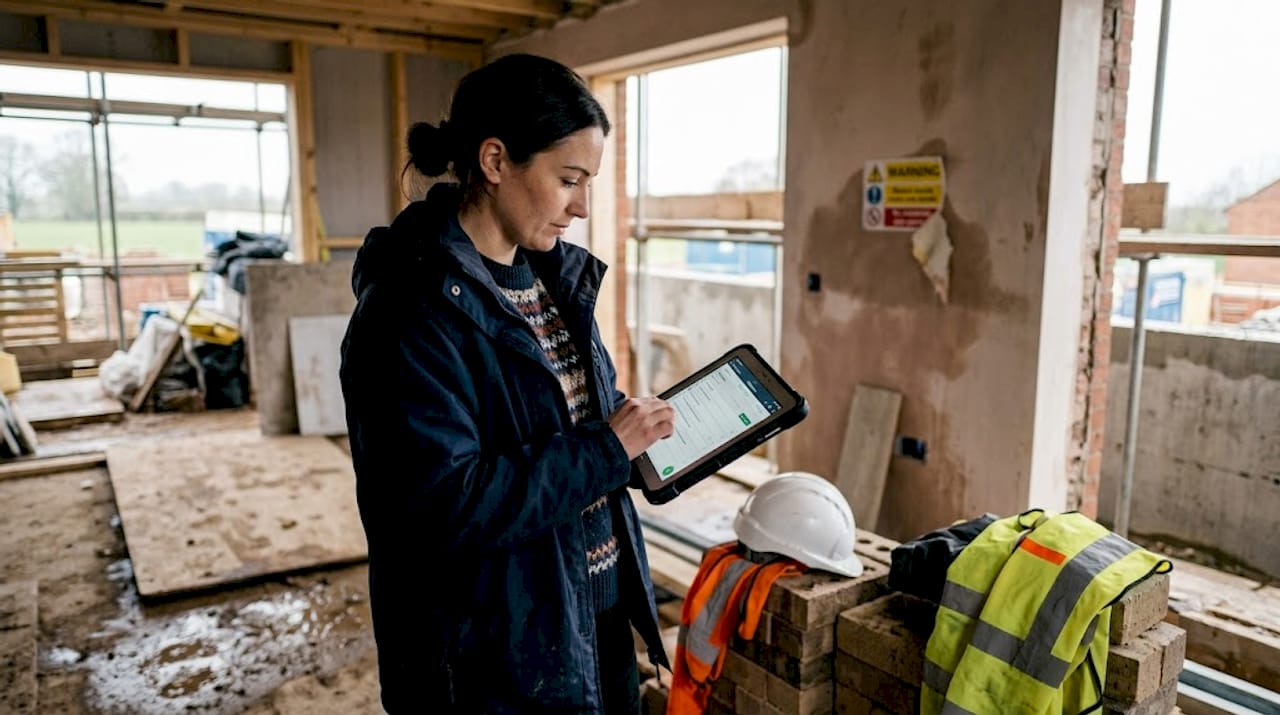
| Workflow process | Before AI | After AI adoption |
|---|---|---|
| Document review | Manual, 60+ min per document | Automated flagging, 15 min average |
| Risk identification | Periodic site walks | Continuous monitoring with alerts |
| Scheduling | Spreadsheet-based, reactive | Predictive, updated in real time |
| Communication | Fragmented across tools | Centralised, searchable, structured |
| Compliance reporting | Manual compilation | Automated audit trail generation |
Here is how AI-powered task allocation typically works in practice:
- Project data is ingested from site reports, drawings, and schedules into the AI platform.
- The system identifies task dependencies and resource availability automatically.
- Optimised task sequences are generated and assigned to the relevant teams.
- Progress updates trigger automatic reschedules if delays are detected.
- Managers receive prioritised alerts, rather than raw data dumps.
Pro Tip: Start with your highest-volume, most repetitive tasks when introducing AI. Document review, compliance checklists, and progress reporting offer the fastest return on investment and the clearest before-and-after comparison.
Platforms that support AI-driven site monitoring are also showing measurable results in material savings with automation, reducing waste through better demand forecasting and procurement timing.
AI foundations: Data, integration, and real-time communications
To get maximum benefit from AI, understanding your project data landscape is critical. AI does not generate insight from nothing. It works by identifying patterns in the information you feed it. If that information is inconsistent, incomplete, or locked in separate systems, the AI’s recommendations will reflect that weakness.
The most effective implementations use BIM and digital twins as a data backbone, combining machine learning, natural language processing, and computer vision for risk sensing, with reinforcement learning for adaptive scheduling. Human oversight remains part of the governance model. This is not a fully automated system. It is a supported decision environment.
Understanding the difference between structured and unstructured data is a good place to start when assessing your readiness:
| Data type | Examples | Impact on AI recommendations |
|---|---|---|
| Structured | Spreadsheets, databases, BIM files | High accuracy, reliable outputs |
| Unstructured | Emails, PDFs, site photos, voice notes | Requires processing before use; prone to gaps |
| Semi-structured | JSON reports, tagged documents | Moderate reliability; benefits from standardisation |
Key foundations to get in place before scaling AI tools:
- Standardise data formats across all project documentation
- Integrate your planning, procurement, and communication tools so data flows between them
- Establish real-time dashboards so site updates reach decision-makers without delay
- Maintain human review at key decision points, particularly for safety and compliance
The digital integration benefits become compounding over time. Once your data infrastructure is solid, AI tools can be layered in progressively, with each addition building on reliable inputs. The role of real-time updates in this process cannot be overstated. Decisions made on live data are simply more reliable than those made on yesterday’s report.
Pro Tip: Before evaluating AI platforms, run a brief audit of your current data. How much is structured and searchable? How much lives in emails or paper files? That ratio will tell you exactly how much preparation work sits between you and reliable AI outputs.
Risks, readiness, and the real role of humans in AI-enhanced construction
With technology in place, what risks and misconceptions should managers watch for? The most persistent misconception is that AI will eventually run projects autonomously, freeing managers from oversight responsibilities. That is not how this works in practice, and believing it leads to poor implementation decisions.
AI augments project manager roles by handling data interpretation and routine monitoring. It does not replace the judgement, stakeholder relationships, or contextual understanding that experienced managers bring. Treating AI as a shortcut to reduced headcount misses the point entirely, and risks undermining the very workflows it is meant to improve.
“AI failures often stem from poor data, not the algorithms. The most sophisticated platform in the world will produce unreliable outputs if it is fed incomplete or inconsistent project records.”
Common project-level pitfalls to avoid:
- Deploying AI tools before standardising data inputs
- Assuming staff will adapt to new systems without structured training
- Failing to secure stakeholder buy-in from site teams and subcontractors
- Overrelying on AI outputs without maintaining human review checkpoints
- Rolling out too broadly too quickly rather than piloting on a single process first
Successful adoption requires genuine change management strategies, not just software procurement. Teams need time to build confidence with new tools. The firms seeing the strongest results are those that invest in upskilling alongside technology, treating both as equally important. Iterative deployment works far better than a single large rollout. Insights on success with change management in construction confirm that incremental approaches reduce resistance and improve adoption rates.
Looking at software for builders that supports team training and onboarding alongside core functionality is a practical starting point for firms at this stage.
Our take: Why AI is powerful, but data discipline is non-negotiable
Stepping back, simply adding AI to your existing processes will not fix a fundamentally disorganised workflow. We have seen this pattern clearly: firms invest in capable platforms, then struggle to extract value because the underlying data is still fragmented and inconsistently maintained.
AI is only as effective as the discipline behind its use. If your team is not yet capturing structured, consistent project data, that is where to start. Not with AI procurement.
Construction leaders who treat data infrastructure as a prerequisite, rather than an afterthought, are the ones building genuine competitive advantage. This means standardising how information is captured, investing in training, and building a culture where data quality is seen as a professional responsibility, not an IT concern.
The long-term advantage goes to adaptable teams that balance technology with human insight. AI handles the volume. Your managers handle the complexity. Platforms that support continuous compliance strategies are a strong foundation for that balance, but they work best when the fundamentals are already in place.
Ready to upgrade your construction workflow?
If you are ready to turn these insights into action, BRCKS offers a practical starting point. Built specifically for UK construction teams, BRCKS consolidates task management, site communication, file sharing, and client updates into a single platform, reducing the tool fragmentation that makes AI adoption harder.

With WhatsApp integration, AI-powered search, and automation that saves teams over two hours daily, BRCKS is designed to deliver real workflow gains without a lengthy implementation process. Whether you manage a small trades team or a large multi-site operation, the platform scales to fit. Explore construction software for builders or see how WhatsApp project management can keep your team connected and your projects moving. Get started with a free 14-day trial.
Frequently asked questions
How does AI actually improve construction project efficiency?
AI automates administrative tasks, speeds up compliance reporting, and delivers real-time scheduling insights, allowing project managers to make faster, better-informed decisions across the full project lifecycle.
What are the main risks of adopting AI in UK construction?
The biggest risks are using poor-quality data, skipping team training, and removing human oversight too early. As data quality issues demonstrate, unreliable inputs lead directly to unreliable outputs, regardless of how capable the AI platform is.
Will AI replace project managers in construction?
No. AI augments PM roles by handling data processing and routine monitoring, freeing managers to focus on leadership, risk judgement, and stakeholder relationships where human expertise is essential.
Where should construction firms start with AI adoption?
Start with data standardisation before selecting any AI tools. Once your project records are structured and consistent, begin automating the most repetitive, high-volume workflows for the clearest early results.
Recommended
- Digital Solutions in UK Construction: 5 Key Gains | BRCKS
- BRCKS | Construction Project Communication Software
- BRCKS | Construction Project Communication Software
- UK Construction Project Coordination Best Practices 2026 | BRCKS
How BRCKS Can Help
As the UK construction industry approaches this digital turning point in 2026, embracing AI-driven workflows will be the defining factor for firms looking to maintain a competitive edge. BRCKS is designed to sit at the heart of this transition, providing the intuitive tools necessary to turn complex data into actionable project insights. By integrating these intelligent processes today, your team can reduce manual oversight and focus on delivering high-quality builds more efficiently. We invite you to discover how BRCKS can modernise your site management and prepare your business for the future of construction. Learn more at BRCKS and explore our full feature set.